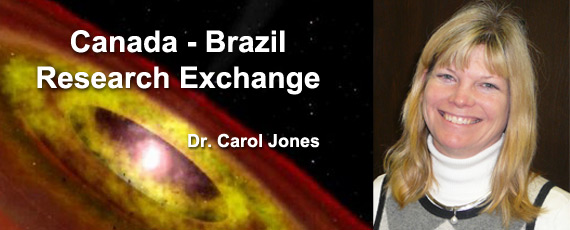
Dr. Carol Jones chosen to participate in Canada – Brazil research exchange.

Prof. Carol Jones is in a very select group of researchers from Western University and The University of Toronto who will take part in a research exchange between Canada and Brazil.

Dr. Jones’ project is titled, “Probing the Physical Characteristics of the Disks Surrounding the Stars”. This research will be done at both Western and The University of São Paolo.

[Western News]

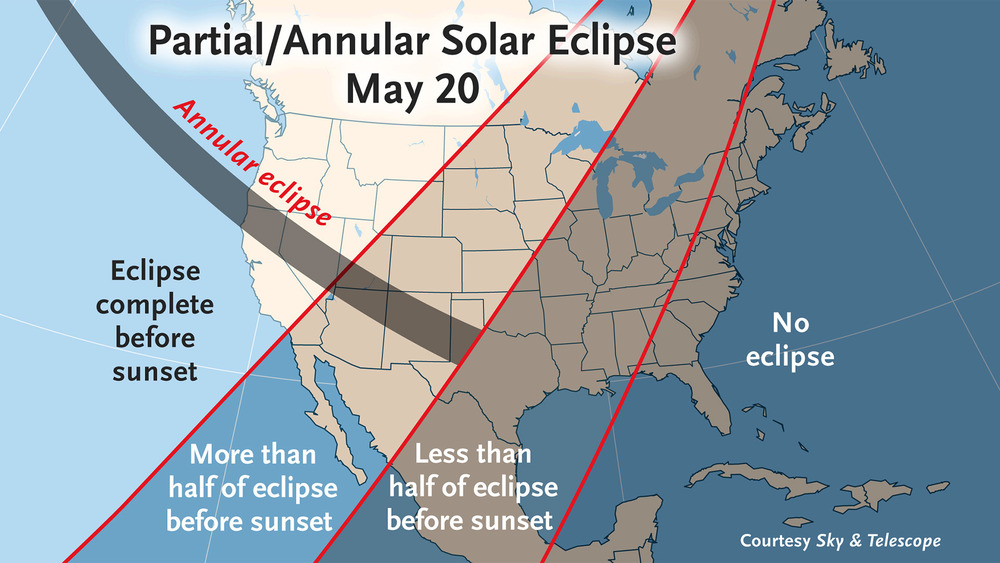
Annular Solar Eclipse on May 20th!

Image Credit: skyandtelescope.com

It’s time for Eclipse again! Luckily, everyone in Southwestern Ontario will be able to witness Partial Solar Eclipse just before sunset. The eclipse in our area will still be in progress at the sunset.

So everyone get out there and witness this beautiful astronomical phenomenon BUT make sure you have special Solar/Eclipse Glasses! DO NOT LOOK AT THE SUN WITH YOUR NAKED EYE! Looking at the Sun directly can harm your retina and can even cause permanent loss of eye sight. Normal sun glasses WON’T DO! Make sure to explain children about the ill effects of looking at the Sun directly. And no you cannot use Floppy Disk (do they even exist?) and Compact Disks (CDs) to view eclipse. Many indirect methods are also used to view the eclipse.

For people (like me), who are crazy about photography, make sure to use proper solar filter! Camera is your second eye, you do not want to lose your second vision 🙂 For more information on Photography of Eclipse, check this link out!

For more information on May 20th Eclipse, check this link! 

Stay safe, enjoy the beauty of nature!


Geocaching as a threat to global security

Some of you know that one of my hobbies is geocaching. For the blissfully ignorant, geocaching works this way: People put some trinkets in a container and hide it somewhere. They post the coordinates (latitude and longitude, accurate to a couple of meters) on a website. Others then use a gps to find the hidden stuff. There are some details, but they are unimportant. There’s also some good physics involved, but we don’t need to go into it now. It’s a fun activity, and a good excuse (if one is needed) for a walk in the woods. I enjoy geocaching when I travel to a new city, as I typically get led to interesting places that I otherwise would never see. There are about a million and a half geocaches hidden around the world, including several hundred around London.  One of the small pleasures of the game is that it’s a little bit subversive – you have to sneak around to find the caches, and you’re not supposed to let the un-initiated know what or where they are. Cachers occasionally get asked what they are up to by various authority figures. It’s all part of the fun.

While we were visiting my in-laws in Victoria this weekend, my sister-in-law pointed out this news article to me: http://www.timescolonist.com/news/Bomb+squad+called+after+suspicious+object+found+tree/6612573/story.html

The gist of it is that someone had found a suspicious object hidden in a tree. The bomb squad had been called out, and after several hours of doing I don’t know what, they determined that the object in question was not in fact a pipe bomb, but a geocache. I thought this was pretty funny. I wondered if this sort of thing had happened before, and in fact it had: in Toronto, just a few days earlier. Here’s the story on that one:

http://www.cbc.ca/news/offbeat/story/2012/05/10/pipe-bomb-scare-geocaching.html

In this case, authorities confined local residents to their houses for three hours while the bomb squad blew up the suspicious container. This cache had been sitting in plain view, attached to a lamp post with cable ties, for more than a month, but apparently it didn’t become a potential bomb until last week. There have been other incidents as well – I found information about one in North Carolina, and another in Colorado Springs.

I suppose such incidents end up costing taxpayers lots of money. I find it hard to get mad at geocachers about this, though. Instead, I take it as a sad commentary on our collective mindset that otherwise rational people would conclude that a piece of plastic pipe hidden in plain view in a public space must be a bomb, rather than something totally innocent. I also find it odd that bomb experts would reach the same conclusion, even after looking carefully at said pipe. Surely there are ways to determine whether that pipe contains trinkets rather than explosives without spending hours at it, without detonating it, and without terrifying all the neighbours. What about using those swabs they always wipe over my laptop at the airport, for example? Or bringing in one of those bomb-sniffing dogs? Or, for that matter, what about going to the geocahcing web site and checking to see if there is a cache listed at the location in question? Perhaps bomb squaddies should put a geocaching app on their mobile phones, so they can easily do this!

Certainly one lesson from this is that geocachers should be careful to hide their caches where people prone to panic are unlikely to find them. Another is that a lot of people need to chill out a bit. Don’t forget, there are another 1.5 million of them still out there!

JOINT Phys&Astro/CPSX Colloquium – MONDAY, 28th May – DR. MARK MATNEY, NASA – Johnson Space Center

Poster: http://www.physics.uwo.ca/colloquia/Colloquia%20Notices/2011_2012/MATNEY%20Joint%20Colloquium.pdf


JOINT SEMINAR—the Department of Physics and Astronomy and theCentre for Planetary Science and Exploration (CPSX)


Date:          MONDAY, 28th May 2012
Time:          1:30 p.m.
Location:    Physics & Astronomy Seminar Room 22


Dr. Mark Matney
Orbital Debris Program Office
NASA Johnson Space Center


“The Challenge of Orbital Debris”


ABSTRACT


Since the dawn of the Space Age more than 50 years ago, humans have been launching objects into the space environment faster than they have been removed by active means or natural decay. This has led to a proliferation of debris—derelict satellites, discarded rocket upper stages, and pieces from satellite breakups—in Earth orbit, especially in well-used orbital regimes. This talk will summarize the current knowledge of the debris environment and describe plans to address the challenges orbital debris raises for the future usability of near-Earth space. The talk will be structured around 4 categories: Measurements, Modeling, Shielding, and Mitigation. This will include discussions of the long-term prognosis of debris growth (i.e., the “Kessler Syndrome”) as well as plans for active debris removal.

Physics & Astronomy Colloquium – THURS. 24th May – DR. MARTIN HOUDE, Western

Poster:  http://www.physics.uwo.ca/colloquia/Colloquia%20Notices/2011_2012/HOUDE%20Colloquium.pdf


Western University
DEPARTMENT OF PHYSICS AND ASTRONOMY


PHYSICS & ASTRONOMY COLLOQUIUM


Date:          Thursday, 24th May 2012
Time:          1:30 p.m.
Location:    Physics & Astronomy Seminar Room 22


Dr. Martin Houde
Department of Physics & Astronomy
Western University


“Non-Zeeman Circular Polarization Measurements of Astronomical Molecular Lines”


ABSTRACT


I will discuss unexpected results recently obtained with the Four-Stokes-Parameter Spectral Line Polarimeter (FSPPol), developed here at Western, on the polarization properties of rotational molecular lines. I will explain why, although small amounts of linear polarization are expected to be present in their spectral profiles, it is usually ascertained that no circular polarization signals could be detected in rotational transitions of Zeeman insensitive molecules like carbon monoxide (CO). Our recent circular polarization observations of the (J = 2 à 1) rotational transition of CO with FSPPol clearly show that this belief was unfounded. I will present a physical model that seeks to explain these observations, and discuss its implications for the characterization of magnetic fields in molecular clouds.

Private Space “Exploration”! #westernu

Recently there has been media attention surrounding private companies expressing an interest in space “exploration”. Later this month, the company SpaceX hopes to dock their spacecraft with the International Space Station (ISS).


Article: http://www.newscientist.com/article/mg21428643.000-silicon-valley-reaches-for-the-sky.html

Also, SpaceX Taxi!

Article: http://www.newscientist.com/blogs/shortsharpscience/2012/05/peek-inside-a-next-generation.html