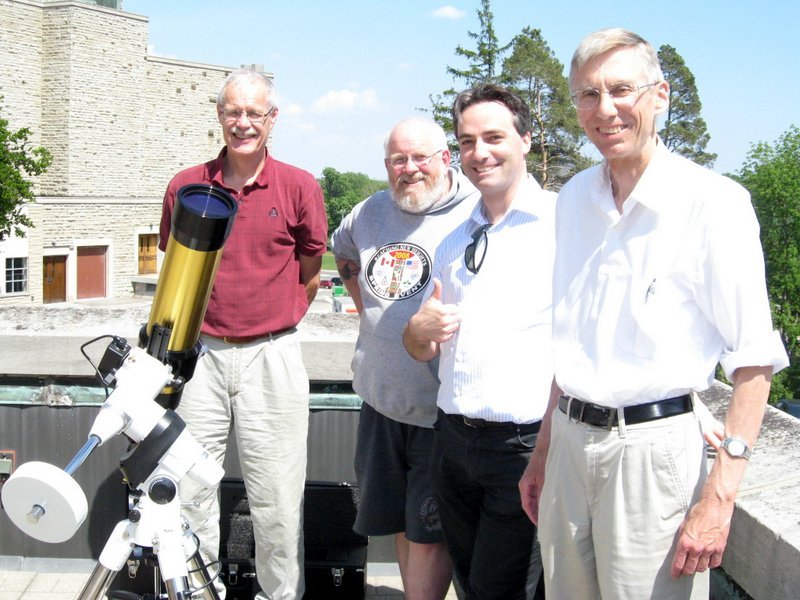
The new Coronado 90 solar telescope that will be used for public viewing of the transit of Venus, saw first light on Wednesday, May 23, 2012. Present were Jan Cami, Bob Duff, Rick Saunders, Mike Debruyne, and Henry Leparskas.

The new Coronado 90 solar telescope that will be used for public viewing of the transit of Venus, saw first light on Wednesday, May 23, 2012. Present were Jan Cami, Bob Duff, Rick Saunders, Mike Debruyne, and Henry Leparskas.
UPCOMING EVENT, Thurs. May 24, 2012 – Annual SCIENCE OLYMPICS
Join us from 8:45am until 2:00pm at the North Campus building and several adjoining buildings, as 735 students from 21 schools take on this year’s Science Olympics challenges.
Poster: http://www.physics.uwo.ca/colloquia/Colloquia%20Notices/2011_2012/HUTTER%20Colloquium.pdf
Western University
DEPARTMENT OF PHYSICS AND ASTRONOMY
PHYSICS & ASTRONOMY COLLOQUIUM
Date: Thursday, 31st May 2012
Time: 1:30 p.m.
Location: Physics & Astronomy Seminar Room 22
Dr. Jeff Hutter
Department of Physics & Astronomy
Western University
“Examining the role of crystallization inhibitors using atomic-force microscopy”
ABSTRACT
Kinetic inhibitors are additives that affect crystallization kinetics without altering thermodynamic properties, such as the melting point. Based on their effectiveness at exceedingly small concentrations, models for the mechanism by which such additives operate have assumed adsorption to crystal growth faces. A well-known model proposed in 1958 by Cabrera and Vermilyea (the C-V model) suggests that impurities adsorb to growth faces and pin growth steps, forcing them to curve, and thus decreasing the effective supersaturation via the Gibbs-Thomson effect. Despite considerable effort, direct evidence for this mechanism has only been offered for a few systems, while significant objections have been raised: How can the irreversible adsorption required to pin growth steps be reconciled with the observed dependence on inhibitor concentration? How can growth proceed at all in the presence of strongly adsorbed inhibitor molecules?
The main example of kinetic inhibition that will be discussed here involves the crystallization of calcium oxalate monohydrate (COM), which is the main mineral component of kidney stones. Certain proteins, such as osteopontin (OPN), are known to inhibit stone formation, but the details of the process are not well understood. In order to determine the role of such inhibitors, we have examined the growth of COM at the molecular level and in real time using the atomic force microscope (AFM). We find that the presence of OPN, as well as synthesized peptides corresponding to portions of the OPN molecule, results in clear changes in the morphology and propagation speed of growth steps. By observing the subsequent recovery of COM growth when the inhibitor is flushed from solution, we can test the validity of the assumptions of the C-V model. An improved understanding of this inhibitor mechanism may result in the design of therapeutic agents for the prevention of kidney stones, as well as an improved ability to tailor additives for a variety of commercial processes.
It’s been busy times for skywatchers. Two weeks ago, on May 5, we had the “Supermoon”: the coincidence of a full moon with the closest approach the Moon makes to the Earth on its elliptical orbit, and which makes the Moon appear larger and brighter in the night sky. Tomorrow, May 20, there will be a solar eclipse, as was posted here before. It is not a coincidence that the Moon happens to be quite far away from the Earth now, and thus the Moon’s apparent size is not big enough to cover the Sun completely, and an annular eclipse is the result in a path that runs over China, Taiwan, southern Japan and parts of the USA. Technically, we should be able to witness a very small partial eclipse in London, but only for less than half an hour before sunset, and only if you have a clear view of the northwestern horizon.
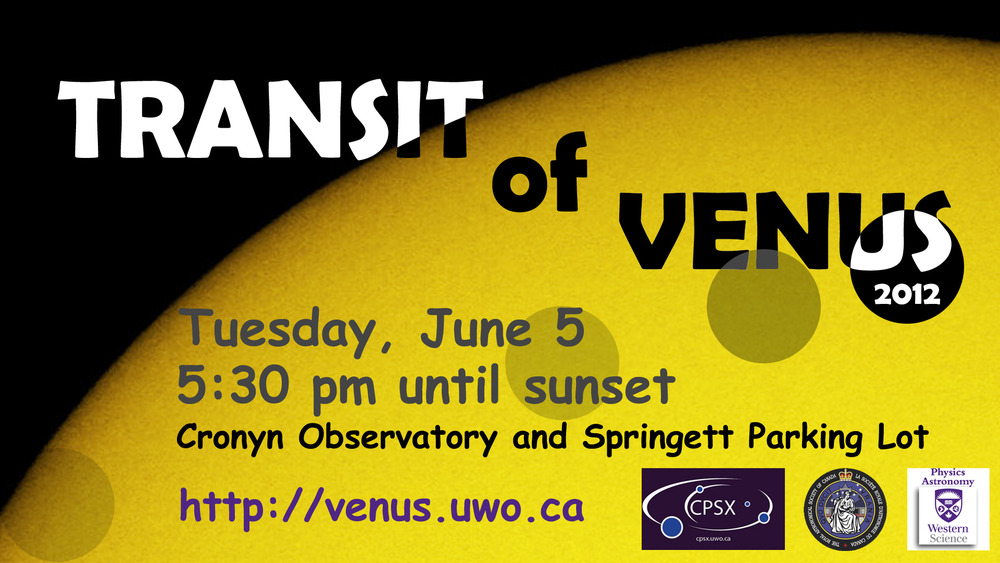
To top it off, the skies offer a very rare Venus transit on Tuesday June 5th, starting a bit after 6pm here in London: the planet will move in front of the Sun and appear as a little black dot that moves across the face of the Sun in just a few hours. Venus’ orbit is inclined with respect to the Earth’s orbit, and as a result, transits are very rare events (as explained in this two-minute video), and follow an unusual cycle as displayed here:
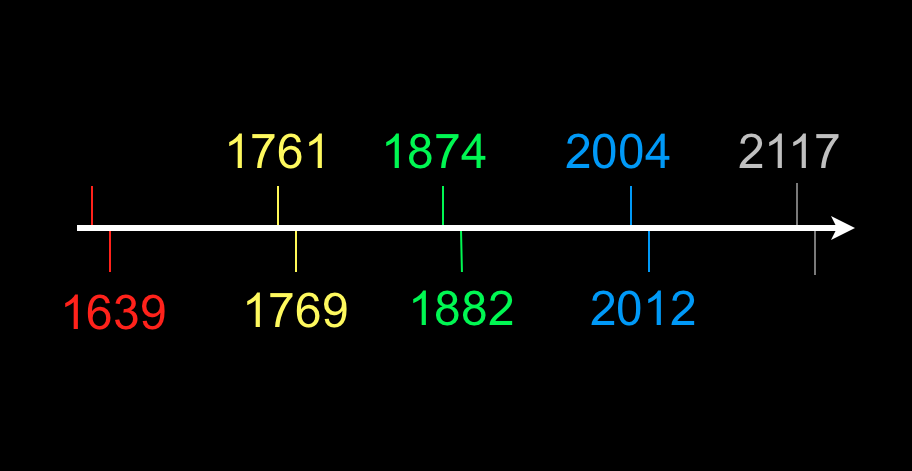
Transits happen in pairs that are separated by 8 years. Between those pairs though, there are big gaps of either 105.5 or 121.5 years without transits. After the June 2012 transit, we will have to wait until December 2117 to see the next one, and so it’s probably safe to say that the upcoming event is the last chance to see a Venus transit in your lifetime! If you want to know more about Venus transits, you can come out to the Cronyn observatory’s open house on June 2nd and listen to a talk about the Venus transit.
You can see this historical event for yourself, but be careful not to look at the Sun directly without adequate eye protection — the lens in your eye will focus the sun’s light onto your retina, and cause damage in seconds (and you wouldn’t notice since it’s painless). There’s various ways to safely observe the event, and we will offer you several options on Western’s campus! The Department of Physics & Astronomy (with support from PASA) is once more collaborating with the Centre for Planetary Science and Exploration and with the Royal Astronomical Society of Canada to make sure you have the best possible observing experience.To begin with, we will be handing out eclipse glasses that allow you to see the event directly with your very own eyes!
But there’s much more than that. We will be opening up the Cronyn observatory from 5:30pm on. One of the safest ways to observe the Sun is by projection, and that’s what we’ll do with the main refractor at the observatory. Unfortunately, buildings are obstructing our view of the western horizon, and se we won’t be able to observe the transit for very long from Cronyn.Therefore, we will also set up a second observation station in the southeast corner of the Springett parking lot. In addition to projection, we will also use direct views using several telescopes with special filters, including a solar telescope using an Hα filter. Between the Cronyn observatory and the Springett lot, a planet path will show you the solar system to scale. In the conference room of the Cronyn observatory, we will set up a small exhibit around Venus, and we will also broadcast a live stream of the event. If you get asked about the event, point your interested friends and family to http://venus.uwo.ca/.
Although a Venus transit is maybe not as spectacular as a total solar eclipse, it’s a unique opportunity to get a sense of the scale of the solar system. Think about it as you watch that little black dot move: that little black dot is nearly as big as our fair planet!
One of my colleagues at the SETI Institute, Franck Marchis, pointed me to this video from NASA Goddard titled “Pursuit of Light”. This video showcases quite a few recent achievements in the top goals from NASA’s Science Mission Directorate — exploration of the solar system as well as detailed observations of the Earth and Solar activity. If you look at some of the images and animations in this video, it’s clear that we’re living in a great era — we have high-resolution and high-quality observations available covering long timescales and often from different perspecives (we continuously observe the sun from all sides for instance with the STEREO satellites), not only revealing phenomena in great detail, but also how they evolve over time. As scientists, we are part of this amazing endeavour (and often on the front row to see new discoveries), which makes us lucky, lucky people! Let’s try to make sure that this effort to understand our home and our place in the Universe is not cut short!
[youtube http://www.youtube.com/watch?v=AkHc_3Zrv8s]
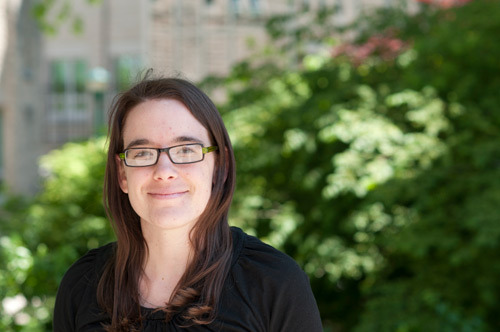
Emily McCullough, PhD Candidate in the Department of Physics & Astronomy, has been selected as the 2012 recipient of the Northern Science Training Program Malcolm Ramsay Memorial Award from Aboriginal Affairs and Northern Development Canada.
A while ago I wrote about writing. In this post I want to say a bit more on the subject. In particular, I’ll discuss one thing that can prepare you to become a better writer – reading.
If you want to write, you have to read. A lot. You have to do more than just scan the words, though, you have to read critically. Certainly if you want to write a scientific paper, you need to understand how scientific papers should be structured and what makes a good or a bad scientific paper. So … read a lot of scientific papers. Naturally, this is something you should be doing anyway to gain the scientific background you need for your research. As you read the papers, though, you should also make note of the way the authors tell their story. Look at how much background material is given in the introductory section. How much detail is provided in the experimental section? Take note of how figures are used, and how the discussion in the text relates to the figures. Follow the trains of thought that the authors take in interpreting their results and developing their conclusions. Not all papers do all of these things the same, of course. Sometimes the differences are a function of the journal the paper is published in. Physical Review Letters restricts papers to only four pages in length, for example, so they have to be very concise, with no extraneous detail. In contrast, papers in Physical Review E have no length restrictions and so can go into more depth. But other differences can be due to the writing style of the authors. As you read, think about whether the point of the paper is easy to understand. Can you follow the authors’ arguments? Do they explain things clearly and logically?
Don’t restrict your reading to scientific journals, however. Read novels. Read newspapers. Read blogs. Read non-fiction. Read everything – and develop a sense of what works and what doesn’t in all of these different types of writing.
Reading other people’s writing can help you to develop an understanding of what constitutes good writing. The next step is to apply that understanding to your own work. I’ll have some ideas on how to do that next time.
Interesting paper on ancient Egyptian records of variable star ‘Algol’!
Check it out here!: http://www.spacedaily.com/reports/Astronomers_discovered_ancient_Egyptian_observations_of_a_variable_star_999.html
The original paper: http://arxiv.org/abs/1204.6206
Ah, Vancouver in the spring. I grew up here, and there are some things about Vancouver that just seem to me to be perfect: the skyline of the mountains on the North Shore, for example, or the dark, damp green of the coastal forests. When these things register on my senses, my brain just pushes a button that says “home.” I moved away for good (so far, at least) after I got my Ph.D. in 1987. I’ve been back several times since then, but since none of my family lives here anymore, I’ve not stayed long. This time we are here for a month, which will give me a chance to get to know the place again. As with any friend you haven’t seen for 25 years, there have been some changes. One is obvious as soon as you arrive – it used to be a real pain to get from the airport to downtown by public transit, but now there is a quick and easy rapid transit link.
We are living on the 29th floor of an apartment building in a trendy part of downtown called Yaletown. We have a nice view of lots of other tall apartment buildings, and if we lean the right way we can see Mt. Seymour. Yaletown didn’t exist when I was a kid, as far as I know. What is now Yaletown used to be a wasteland of light industry and warehouses; it was a part of town one never had any reason to visit. In the mid-80s is became the site of Expo 86, the World’s Fair. After the fair, they sold the area to a developer who tore down everything and built lots and lots of hi-rise apartments. It is now the most densely populated area of the city. I wasn’t sure what to expect, but in fact it is very pleasant. We are a couple of blocks from the waterfront, where there is a great sea-wall walk and bike path. There are dozens of restaurants within a 10 minute walk of our apartment, most of which are quite reasonably priced. Transit is close and convenient. There are parks. It would have been nice if our apartment had been dusted before we arrived, but otherwise we have no complaints.
I’m working at UBC while I’m here. That’s another place where there have been many changes. I haven’t counted, but I am sure that more than half the buildings on campus have been built since I left, and most of the others have had bits added to them. There is ongoing construction at half a dozen sites, and I gather this has been the norm for the last 20 years. I guess I am technically visiting the Math Department. My office is in what used to be the Computer Science Building; it has a new name and new occupants, including the Institute for Applied Mathematics, which is where I am sitting as I type this. Downstairs is the Complex Fluids Laboratory, where I have been spending a fair bit of my time. My hosts are Neil Balmforth, who is Director of the aforesaid Institute, and Ian Frigaard, who divides his time between Math and Mechanical Engineering. Both do research on yield-stress fluids. Neil is interested in geophysical flows, like landslides and lava flows and such, while a lot of Ian’s research has applications in the oil industry. I will be spending part of my time working on an experiment that is supposed to model what happens when water flows beneath a glacier. Not only does the water lubricate the flow of the glacier, in some cases it can also cause the ice sheet to lift up significantly. Neil and his postdoc Ian Hewitt have been working on a mathematical model of this process, including the forces on the water due to the elastic deformation of the ice. The experiments will involve syrup flowing under a rubber sheet; the rubber sheet will exert forces on the fluid that mimic those due to the ice. At present we are at the “looking for stuff” stage of the experiments, but hopefully we’ll get everything set up this week. Meanwhile, I am enjoying the west-coast spring weather!
Not sure what to make of this theory, but its nice to see one can make contributions from outside academia.
http://www.telegraph.co.uk/science/large-hadron-collider/3314456/Surfer-dude-…