Additionally, each of these new planetary systems contains between two and five planets with close enough orbits that the gravitational interaction between the planets accelerate their orbits. This acceleration changes the orbital periods of the planets, which allows astronomers working with Kepler a new way to verify the existence of these planetary systems (check the link for a video explaining this).
Just in time for the holidays, an annotated overview of 98 astronomy applications for smart phones and tablets has been published in the on-line journal “Astronomy Education Review.” Compiled by Andrew Fraknoi (Foothill College), the list features a brief description and a direct URL for each app.
The listing includes a variety of apps for displaying and explaining the sky above you (some using the GPS function in your device); a series of astronomical clocks, calculators, and calendars; sky catalogs and observing planners; planet atlases and globes; citizens science tools and image displays; a directory of astronomy clubs in the U.S.; and even a graphic simulator for making galaxies collide. A number of the apps are free, and others cost just a dollar or two. A brief list of articles featuring astronomy app reviews is also included.
Astronomy Education Review is on-line journal about astronomy education and outreach — published by the American Astronomical Society — which celebrated its 10th anniversary this fall. You can find it at http://aer.aas.org
Gamma-Ray Bursts (GRBs) occur when a massive star explodes (supernova) or when 2 neutron stars merge. If a GRB occurred in a star cluster we can trace its position and speed to deduce whether it coincides with past extinction events [the European Space Agency’s Gaia star-mapper (2013) will determine the position and speed of star clusters].
The author calculated that at least 1 GRB has occurred within striking distance of the Earth in the last billion years.
Q: What is the simplest way to observe the optical Doppler effect?
A: Go out and look at cars. The lights of the ones approaching you are white, while the lights of the ones moving away from you are red.
“If there was no such thing as night the Sun would have run out twice as fast.”
Black holes are where God is dividing by zero.
After eating his first meal on the Moon, the astronaut reported, “The food was good, but the place lacked atmosphere.”
Why did Captain Kirk go into the ladies toilet?
To boldly go where no man has been before!
A pair of nearly-Earth sized planets have been discovered orbiting close to a star which has already passed through the red giant phase. The planets orbit close enough to their parent star that they would have been englufed by the star when it was a red giant and have (somewhat) survived.
You can find the original paper here, if you would like to learn more.
Here is a link to a collection of realy cool vedios made by physicists and astronomers at The University of Nottingham trying to explain the meanings of symbols we use frequently in science.
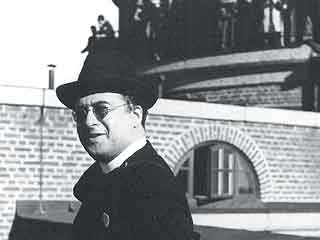
When anyone talks about The Big Bang Cosmology or The Expanding Universe, the first name that comes to one’s mind is Edwin Hubble. He is called the Father of the Big Bang.
But the lesser known fact is that the idea of the expanding universe was first proposed by Georges Lemaitre in 1927.
Asteroid Vesta is one of the handful of asteroids visited by a spacecraft. Asteroids are believed to be debris left over from the formation of our Solar System. Understanding these small bodies will help us understand the formation of the Solar System and the existence of greater terrestrial bodies. A spacecraft hovering near an asteroid yields a lot of information about the body like its mass and density. Some of the most useful information provided by the spacecraft are the spectacular photographs of the body which help us understand its history.
NASA’s Dawn Spacecraft was launched in 2007 to study the two largest bodies of the Asteroid Belt, Vesta and Ceres (the dwarf planet). The mission has provided us with a lot of information about Vesta and will fly by Ceres in 2015.
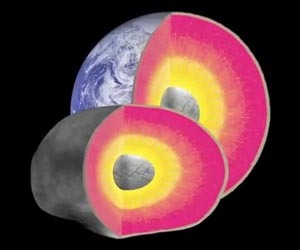
Impressive new information about Vesta was just released by NASA. The principal investigator Chris Russell in a recent interview said that Vesta resembles a terrestrial dwarf planet more than an asteroid. He suggests this is due to the fact that not only is the body differentiated (all terrestrial planets are differentiated), but it also contains an iron core and has surface features like that of the terrestrial planets.
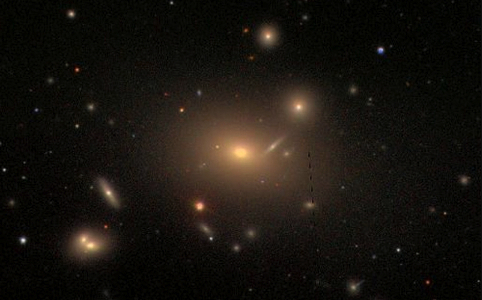
It appears that every massive galaxy hosts a supermassive black hole in its centre. A recent article in the journal Nature described the discovery of black holes as massive as 10 billion Suns. Even by supermassive black hole standards, that’s pretty big. For some perspective, the black hole in the centre of our Galaxy is about 4 million times the mass of the Sun (or about a 2500 times smaller). Is there some upper limit to the mass of black holes? Probably, because they only seem to grow to be a fixed fraction (about 0.3%) of the mass of the galaxies they live in. We’re still working on figuring out how black holes and their host galaxies can grow in tandem.
For those of you that weren’t tracking it asteroid 2005 YU55 passed ~325,000 km from Earth on Nov. 9th at 6:30 p.m (ET). Although this may not seem “close” it is by astronomical standards.This was the closest fly-by of an asteroid since 1976.
Purdue University Professor Jay Melosh said the impact of such an object [YU55 is 400 m wide] would carve a crater ~7 km across and 500 m deep whereas oceanic impact results in a 20 m tsunami [tsunami caused by earthquake that hit Japan earlier this year was estimated at ~10 m high waves].
NASA’s Near-Earth Object (NEO) program tracks ~1000 asteroids that are at least 1 km wide. An impact from one of these NEO’s would cause catastrophic effects. The next fly-by of YU55 is expected in 2028 at a much closer distance…