Getting a Handle on Star Formation with ALMA

ALMA, the Atacama Large Millimeter Array, is the newest and most advanced millimetre and sub-millimetre telescope in the world. Located on the Chajnantor Plateau in Chile, the observatory is still under construction and will not be completed until the end of 2012. It is an international collaboration between countries in Europe, North America, Eastern Asia, and the host country Chile. By observing at these wavelengths, we see the signatures of molecules in space. It’s only in cold, dense environments where molecules can form, and we know these to be the sites of star formation.

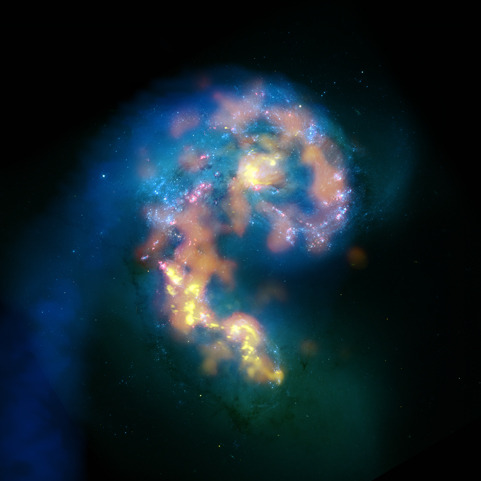
The image shown above was released to the public in October, 2011, and is the first image to be released from ALMA as part of their Early Science observing cycle. It shows a well known collision between two galaxies named The Antennae observed in various parts of the electromagnetic spectrum: optical from the Hubble Space Telescope in white/pink; radio emission from the Very Large Array in blue; and millimetre emission from ALMA in orange/yellow. The ALMA data tell us that large, massive resevoirs of molecular gas (specifically carbon monoxide in this image, a proxy for observing molecular hydrogen) lie along the ridge in the bottom of the image, while more spread out molecular gas exists along the upper rim. This gas will eventually collapse due to the force of gravity and repeatedly fragment into smaller and smaller clouds until stars are eventually born.

Still under half complete, ALMA surpasses the capabilities of any other millimetre/sub-millimetre facility in the world. We eagerly wait to see what new surprises this innovative instrument has in store for us in the near future and after it is fully operational.

Does Dark Matter Really Exist? PROOF!

If you add up all the stuff we see in the Universe (stars, planets, kittens, etc. also called baryonic matter) and compare that to the estimated amount of stuff that actually makes up the Universe, you find that the stuff we can see makes up a paltry 5% of it. Only 5%! Where’s all this other stuff, then??? Part of the answer is “dark matter”.

Dark matter was first hypothesized about in 1933 by a crotchety old astronomer named Fritz Zwicky. He argued that adding up the masses of the individual galaxies in clusters did not come anywhere close to the total mass of the cluster itself. Therefore, some of the mass was missing.

In the 1970s, astronomer Vera Rubin measured the rotational velocities of spiral galaxies and found that they were rotating at a roughly constant velocity all the way to the edges of the galaxy. The problem with this is that galaxies are not solid objects, thus they have differential rotation (they rotate at different speeds depending on how far you are from the centre). Physics says that the rotational velocity should depend on two variables: the distance (radius) from the centre and the mass interior to a circle with the same radius. As we move outward from the centre, we only add a little bit of mass, but we add a lot of radius, so the velocity should decrease. But Vera Rubin’s discovery says different! The rotation stays the same, so we are adding a lot more mass than we think—but still, we can’t see it!

This is the crux of the missing matter problem. Physics is telling us that a large part of our Universe is something we can’t see, but it seems to interact with everything else through gravity. But how do we test if it’s really matter we’re missing and not just a fundamental misunderstanding of physics? The answer comes in the form of the Bullet Cluster.

The Bullet Cluster (pictured below) is the result of a collision between two galaxy clusters. The gas in the each of the clusters, made of normal everyday matter (remember, baryonic matter), slammed into the gas from the other cluster. During the collision, it got heated and glowed in the X-rays (pink in the image). Part of Einstein’s Theory of General Relativity says that one of the effects of mass is the bending of spacetime. This sounds complicated, but never fear! Basically, an object with mass can bend space around it. Proof of this came in 1919 when scientists observing the Sun during a total solar eclipse saw stars that were known to be behind the Sun! Galaxy clusters do something similar, acting as a “gravitational lens”. Through this effect, we can see the stetched out and magnified arcs of distant background galaxies from behind the cluster. By carefully modeling the lensing arcs, scientists discovered that most of the mass was not between the two clusters with the hot gas. Rather, it had passed through the collision unimpeded (shown in blue in the image). Thus, most of the mass of the two clusters was dark and made of something that would not even collide with other stuff.
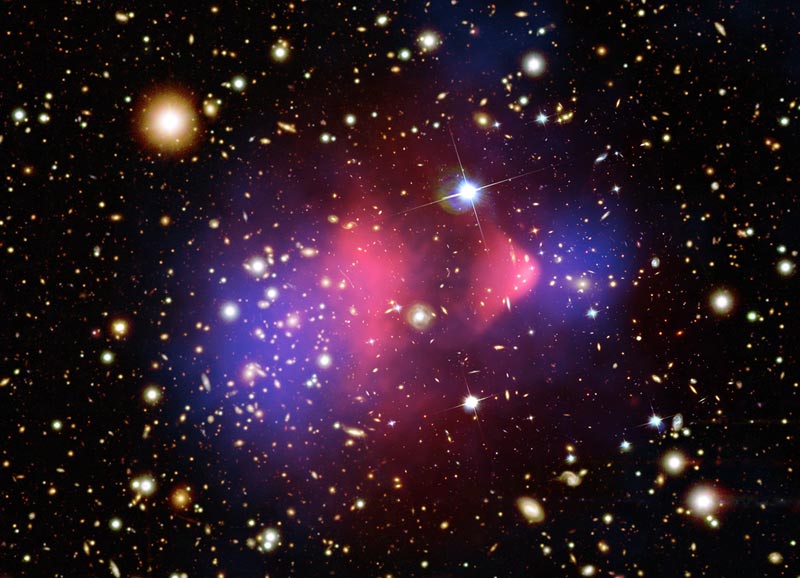
Today, we know that baryonic matter makes up approximately 5% of the Universe, dark matter makes up 23% and some new mysterious substance called dark energy makes up the remaining 72%. We actually live in an era of the Universe dominated by dark energy! What is this dark energy and what is it doing? That’s a story for another time.

Image Credit: NASA/CXC/M.Markevitch et al.; NASA/STScI; Magellan/U.Arizona/D.Clowe et al.; ESO WFI

Congratulations! It’s a baby black hole! …or is it a neutron star?

What happens when a star reaches the end of its life? Well, if it’s a massive enough star (about 8 times as massive as our Sun), it will explode in a brilliant flash called a supernova (there are a few different ways to get a supernova, and this one is called a Type II supernova). What’s left behind is a stellar remnant—either a neutron star or a black hole depending on it’s mass. If the remnant mass is less than about 8 times the mass of the Sun, then it will be a neutron star; more than 8 times the Sun’s mass and it’s a black hole (this is called the Tolman-Oppenheimer-Volkoff limit, analagous to the Chandrasehkar limit for accreting white dwarf stars if you’re familiar). To make a stellar remnant above the T-O-V limit, you need a supernova progenitor to be about 20 times the mass of the Sun. Stars this massive aren’t very common, so black holes formed this way should be relatively rare.

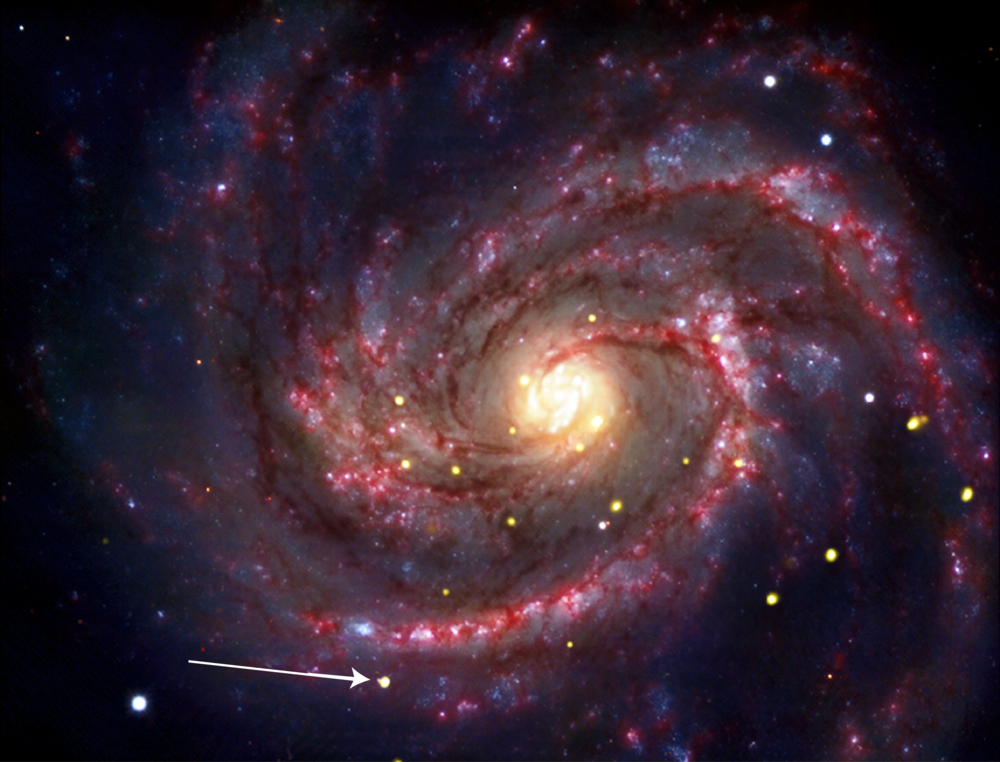
How can we test if the T-O-V limit is true? Last year, NASA’s Chandra X-ray Observatory observed a supernova in the galaxy M 100 named SN 1979C. The interesting thing about this supernova is that we know which star did it! It’s so close that we can look in archival images and see which star was there before the explosion. From this, we know that the star was approximately 20 times the mass of the Sun. New observations from Chandra indicate that there is an accreting compact object where the star was. This means that there is either a neutron star or black hole that is consuming the gas that was thrown out in the explosion. However, the Chandra observations can’t distinguish between it being a black hole or a neutron star! While this seems like a failure on science’s part, it’s not really because it confirms that the T-O-V limit is around 20 times the Sun’s mass. Any more massive, and we should clearly see the effects of a black hole. Any less, and we should see an accreting neutron star.

If it is a black hole, it’s interesting to note that it would be the youngest one we’ve ever discovered. While we observed the explosion of the star, and therefore the formation of the black hole, in 1979, it really occured 55 million years ago and it took all that time for the light to reach us from the distance of M 100.

Photo: X-ray/Optical/Infrared composite image of galaxy M 100. The accreting compact remnant resulting from SN 1979C is the bright X-ray point indicated with an arrow. (Image Credit: X-ray: NASA/CXC/SAO/D.Patnaude et al, Optical: ESO/VLT, Infrared: NASA/JPL/Caltech)

Falling Into a Galaxy Cluster

You may not know it, but we’re on a collision course. This course will make us and our nearby neighbour galaxies in the Local Group members of the Virgo Cluster. But what happens when galaxies fall into galaxy clusters like Virgo? The process is called ram pressure stripping: cold gas in the galaxies is ripped away as the galaxies themselves slam into the hot gas that pervades the cluster (the “intracluster medium”). This cold gas is what gets used to make future generations of stars; without the gas, the galaxies become red and dead.

In studying the process of galaxies entering clusters, astronomer Tom Scott at the Instituto de Astrofísica de Andalucía in Granada, Spain has discovered two long tails of cold gas streaming behind the future cluster members. This isn’t entirely unexpected, except that the galaxies themselves live in tiny groups (RSCG 42 and FGC 1287) on the very outskirts of the cluster Abell 1367. They’re too far away to be interacting with the intracluster medium yet! So how is the cold gas being stripped away? And why is it happening so early before the galaxies even enter the cluster? This could be telling us something more about the importance of the cluster and group environments and how these environments affect the evolution of the individual galaxies.

Astronomers here at The University of Western Ontario are part of a large, international collaboration to study the evolution of galaxies in certain types of groups called “compact groups” (such as RSCG 42 above). Professor Sarah Gallagher and graduate students Konstantin Fedotov and Tyler Desjardins investigate the evolution of the galaxies and the group environment, from star formation to the gas content, of these systems to better understand the relationship between environment and evolution.

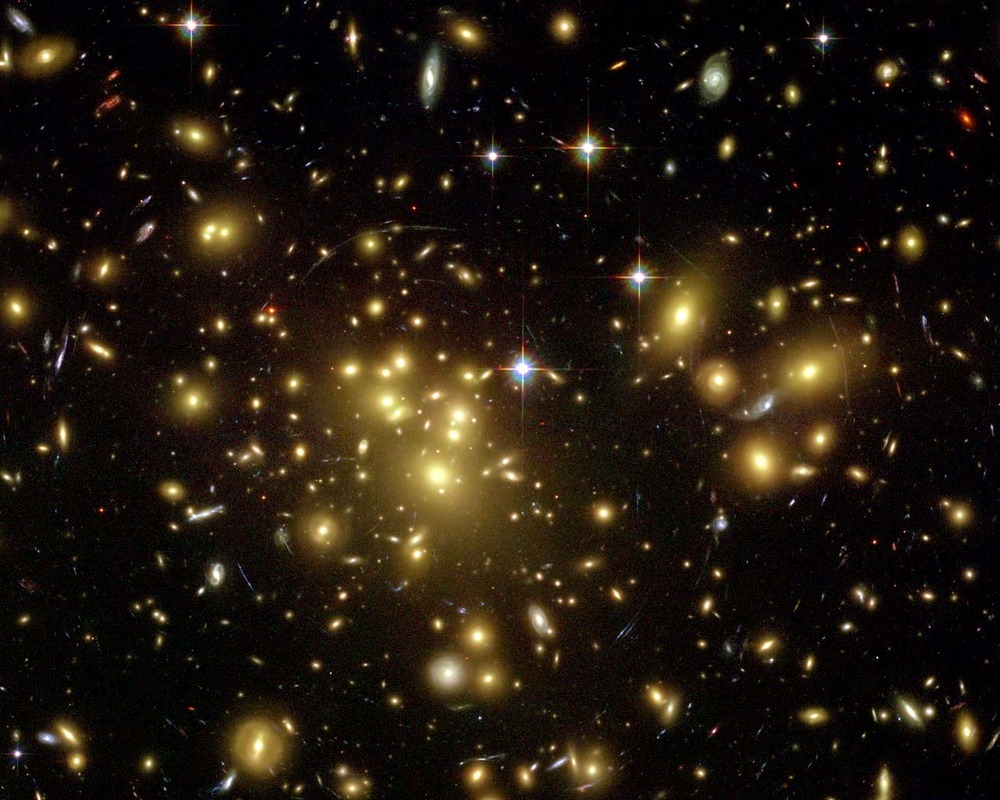
The full article on Tom Scott’s discovery of the long gas tails can be found here. Picture: Hubble Space Telescope image of Abell 1689, one of the most massive galaxy clusters known, which lies 2.2 billion light-years away towards the constellation Virgo. (Image Credit: NASA, N. Benitez (JHU), T. Broadhurst (Racah Institute of Physics/The Hebrew University), H. Ford (JHU), M. Clampin (STScI),G. Hartig (STScI), G. Illingworth (UCO/Lick Observatory), the ACS Science Team and ESA)

An Electrifying Christmas Light Display, Courtesy of Nikola Tesla | Popular Science

By Clay DillowPosted 12.22.2009 at 1:11 pm

13 Comments


Merry ChristmasDr. Peter Terren

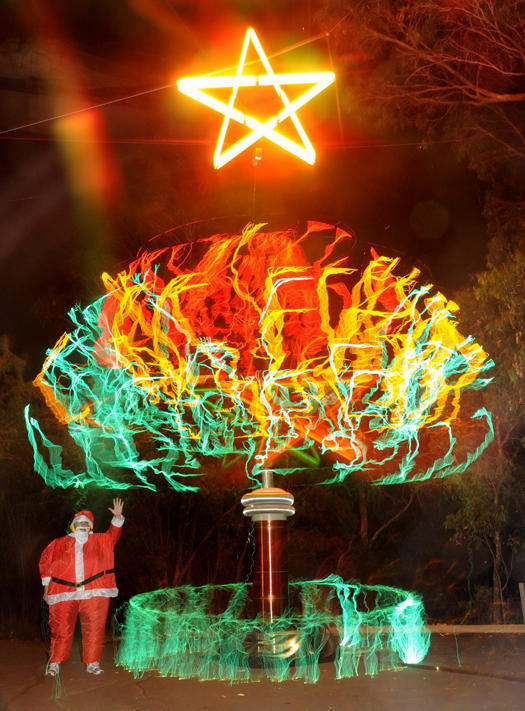
A physics fanatic down under is having a very Tesla Christmas this year, creating a 30-foot electrifying display of yuletide cheer by attaching a rotating rod to the top of a Tesla coil, making for quite the colorful Christmas tree. Using such specialized science tools as a fishing rod and sinker, household power, and a Nikon D300, physician and Tesla buff Peter Terren manipulated 500,000 volts at a time to produce the images seen here.

Using what he calls “electrickery,” Dr. Terren — known for a few other Tesla coil adventures including an electro-colorful remake of Rodin’s “Thinker” — used a really long exposure on his camera, several different lens filters and his knowledge of physics to create the high-voltage scene, manipulating the rod to create different visual effects.

Nothing in the images is Photoshopped, but someone watching Dr. Terren create the images would see something quite different than the image itself. Rather than a fiery display of colorful plumage, a passerby would see two minutes of intense sparking at the coil while Dr. Terren scrambled about switching filters on the camera from green to yellow to red and so on while gradually raising the rod atop the Tesla coil. But when the camera shutter finally snaps shut 120 seconds later, what’s captured is the bright white light, filtered into Christmas wavelengths.

A Discovery Channel segment about Dr. Terren’s tree is in the works, but you can catch more images in our accompanying gallery, and find pics of his creative process here.

[Tesla Down Under, WA Today]

Pondering mammography for breast cancer screening over the Christmas holidays

I attended the first annual Canadian Cancer Research Conference in November which brought a diverse group of cancer researchers together.  In one of the plenary session, Dr. Martin Yaffe, a medical physicist whose expertise is in breast cancer and mammography, gave a talk on the recent recommendation on the guidelines from the Canadian Task Force on Preventive Health Care for women with an average risk of developing breast cancer. The controversy is this:  women who do not have increased risk of breast cancer due to BRAC gene mutations or family history of breast cancer, under age 50, no longer recommended mammography.  Even more controversial is that self-examination does not have any benefits in any age group.


This guideline was first brought to media attention by the Globe and Mail:

http://www.theglobeandmail.com/life/health/new-health/conditions/cancer/breast-cancer/new-breast-cancer-screening-guidelines-inflame-debate-add-to-confusion/article2243503/ 


Subsequenty, Martin Yaffe wrote why he rejected the new screening recommendation: 

http://www.theglobeandmail.com/life/health/new-health/conditions/cancer/breast-cancer/why-i-reject-most-of-the-new-breast-cancer-screening-recommendations/article2252072/


In his talk, he provided additional reasons for the screening program: a)  recommendations were not based on phase 3 randomized clinical trials b) current technologies of digital mammography have even better image signal to noise than those used in randomized trials, and c) the task force did not consult the scientific experts at large prior to understand all the nuances of non-randomized versus randomized trials. 


Being a medical physicist, when I visit friends and families during this time of the year, I do ask if they had done their annual health check. Maybe you should do the same so I won’t be so strange, but one must think through this task force recommendation to make sure that it made sense.

News, Events, and Opinions from our community