
Paul Allen, Elon Musk & Burt Rutan team up for private space travel…. http://news.cnet.com/8301-13772_3-57342415-52/paul-allens-stratolaunch-grand-plan-for-next-gen-space-travel/
Category Archives: Physics and Astronomy at Western What’s Happening
Opinions, news, and events for the Department of Physics and Astronomy at Western University.
Top 24 Deep Space pictures of 2011
Tis the time for “best of” lists for 2011… here’s a pretty cool one:
http://blogs.discovermagazine.com/badastronomy/2011/12/14/top-24-deep-space-p…
An Amazon (Physics) Adventure
One of the highlights of my trip to Brazil was a visit to Manaus, on the Amazon River. My wife and I took a one-day tour on the river and in the rainforest, during which we saw, among other things, sloths, monkeys, an anaconda, caimans, piraracu (the worlds largest freshwater fish) and went fishing for piranha. The physics highlight is shown in the picture. This is the “meeting of the waters,” where the Rio Negro and the Rio Solimoes join to form the Amazon. The water in the Negro is almost black (hence the name), warm (about 26 degrees) and has a current of about 2 km/hr. The Solimoes is brown from the large amount of sediment it carries, cooler (22 degrees) and faster (6 km/hr). When the rivers meet, the boundary between them is very distinct, and when we stuck our hands in the water while the boat drove across the boundary, the temperature difference was very sudden and easy to feel.
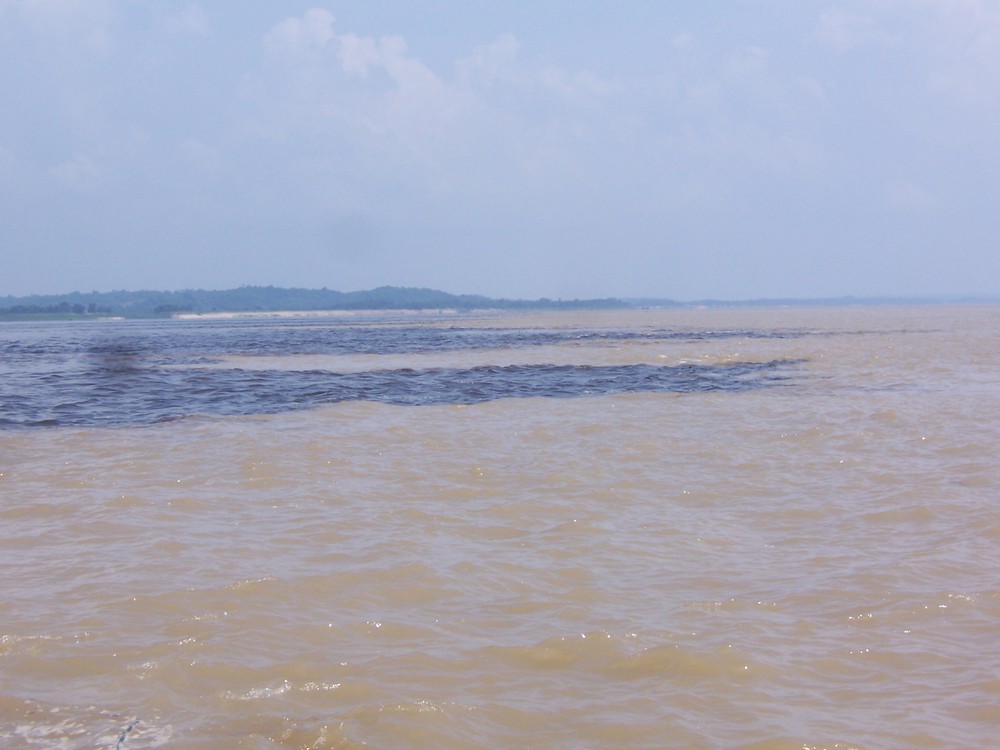
If you look at this location in a satellite photo (e.g., on Google Maps) you’ll see that the boundary between the two colors of water stays distinct for something on the order of 20 kilometers downstream. Why do they mix so slowly? Actually this is the wrong question to ask! If we assume that the two rivers mix by diffusion alone, then the boundary should broaden to a width d of, say, 10 m in a time t = d^2/D, where D = 2e(-9) m^2/s is the diffusion constant of water. This calculation gives a mixing time on the order of 10^11 seconds, which is thousands of years! Diffusion is a very slow process; far too slow to explain what is happening here! The right question to ask is clearly “Why do they mix so quickly?” or, in other words, what process other than diffusion is at play here?
You can see a hint of the answer in my photo, but it’s a lot more clear if you zoom in on the satellite photo on Google Maps. The line separating the black and brown water is not straight – it’s wavy, and it becomes more so as you move downstream. The initially flat interface between the two streams is unstable. Swirls and waves develop and grow at the interface as it flows downstream. This makes mixing much faster for a couple of reasons. First, swirls make the surface area of the interface bigger, so there is more diffusion across it. More importantly, the water gets stirred by the swirls, and this mixes the streams just like stirring your coffee mixes in the cream.
This is a great example of what’s called the Kelvin-Helmholtz instability, and it can be analyzed in detail mathematically. Exactly the same instability gives rise to the parallel rows of clouds you often see in the sky!
Want to know more? Take fluid dynamics next year!
Faster than light?
One of the more interesting physics stories in the news recently concerns an experiment that purports to have measured neutrinos moving faster than the speed of light. A team of researchers sent a beam of neutrinos 700 km through the mountains from CERN in Switzerland, where the neutrinos were created, to a neutrino detector in Italy. The time of flight was 2.4 milliseconds, and the neutrinos arrived at the detector 60 nanoseconds earlier than they would have if they’d traveled at the speed of light. That’s a difference of a few parts in 10^5. People are pretty good at measuring small time intervals. This group used GPS satellites and atomic clocks to do the timing, and the accuracy in their time measurement was 1 nanosecond.
This result raises lots of questions! Like: is it right? I don’t know, but they’ve done it twice – in two slightly differently ways – and got the same result both times. Nonetheless, experiments like this are hard – neutrinos are pesky little things, and anyone who’s taken Physics 1052 knows that measuring time at two different places can be tricky when things are moving close to the speed of light. These folks have probably got the relativity right, but the possibility of some sort of systematic error in their measurements remains. Other experiments will have to be done to confirm – or refute – this result.
There’s one important data point that suggests that neutrinos are in fact well-behaved and do not travel faster than c. The neutrinos emitted by Supernova 1987A (which was discovered by a Canadian astronomy grad student) arrived at earth about three hours before the visible light from the supernova. In this case, the time difference is understood: It’s due to the fact that the refractive index of interstellar space is marginally greater than 1. If the speed of the neutrinos was as high as implied by the new CERN results, then the neutrinos from SN 1987A would have arrived here in 1983, four years before the light was detected in 1987.
If the new experiments are right, though, then perhaps “everything you know is wrong.” Or almost everything, anyway. That would be pretty exciting (lots of jobs for physicists, maybe), but distressing at the same time! Relativity has proven to be a pretty good theory so far, though, and I would be slow to abandon it.
The physics of walking
I like to walk a lot, so naturally (naturally for a physicist, anyway) I have occasionally thought about the physics of walking. Here’s a simple calculation you can do. Imagine that a leg is a pendulum that swings at its natural frequency. First year physics tell you what its period of oscillation is. The length of the stride must be proportional to the length of your leg – if this isn’t obvious, draw a picture. So now it’s easy to figure out how walking speed depends on the length of the leg.
If you do the calculation, you’ll find that walking speed also depends on the acceleration due to gravity.
This is amusing, but do your results make sense? In other words, does this little calculation have anything to do with real walking? What about running? What about walking on the moon?
Post your thoughts as comments here. The best comment wins a very good (albeit slightly used) book of SF short stories (and yes, I’ll mail it to you if you live somewhere else!).
Limer(phys)icks
How I spent my year’s leave, Part 1
I am on administrative leave this year. This is NOT a year-long holiday. It just means I have no classroom teaching duties – all of my time is for research. Nonetheless I am taking advantage of the opportunity to do some work-related traveling. I have just returned from two months in Rio de Janeiro, where I was working in the Department of Mechanical Engineering at the Pontifical Catholic University of Rio (referred to as “Pooky” by those in the know). My host/friend/colleague/collaborator there was Paulo de Souza Mendes. We have a lot of research interests in common. In particular, we both like to do fluid dynamics experiments using a material called Carbopol, which is the main ingredient in hair gel. Much of Paulo’s research is funded by Petrobras, the Brazilian oil company. Petrobras is required by law to use some fraction of their (extremely large) revenues to fund research and other cultural endeavors, and as a result they have a large presence in the research labs of the country. Paulo does experiments that model situations important in the oil extraction business. For example, I was involved in an experiment with Paulo and his graduate student Alexandra Alicke that was concerned with bubbles rising up through Carbopol. Why is this interesting? First of all, Carbopol is a yield-stress fluid, meaning that it behaves like a solid if you don’t push it very hard, but it flows if you push it hard enough. Like hair gel, or margarine, or toothpaste … or freshly poured cement. After an oil well is drilled, a pipe is cemented into the wellbore to isolate the well from the surrounding rock. Bubbles of gas or air can get into the cement before it hardens, rise up a bit due to buoyancy, and then get stuck as the cement hardens. This results in voids in the cement. Sometimes the rising bubble can even leave a long trail behind it as it rises through the not-quite-hard cement. This can weaken the cement and, in the worst case, lead to a catastrophic failure of the well. Paulo and Alexandra use Carbopol to model the properties of the cement. By studying the behavior of the bubbles in their experiment, they can learn more about how bubbles will behave in cement a kilometer under the surface of the ocean, and maybe learn how to prevent expensive and potentially dangerous problems.
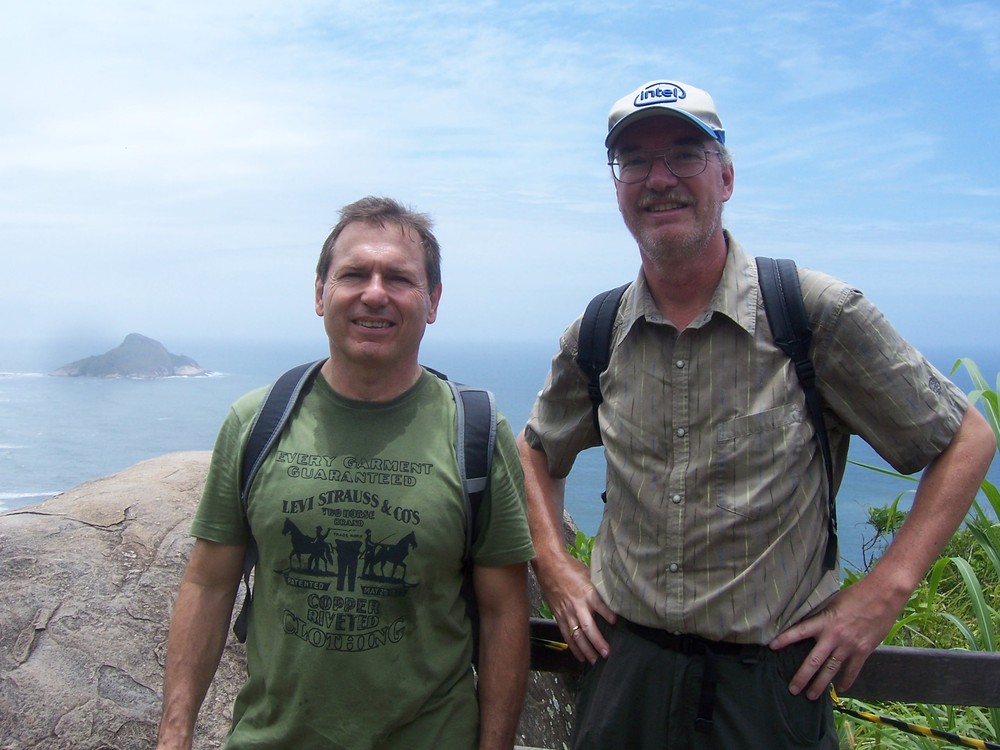
Paulo also likes hiking. Here’s a picture of us in a park a bit south of Rio.
Certificate of Academic Engagement
The Student Development Centre (SDC) at Western offers many useful learning skills services. One service that I found particularly helpful during my undergraduate carreer here was their free series of workshops including writing workshops, learning skills workshops, and psychological services workshops. The content covered in these workshops covers everything from strategies to write exams (particularly multiple choice exams), referencing your paper, writing in the sciences, and writing a thesis statement to managing and regulating your emotions and managing anxiety and stress (something I think all of us need a little help with during exam time).
There are also GradWRITE interactive workshops, where participants are encouraged to bring their own work in progress to get help with writing a literature review, creating an abstract, writing effective proposals, and polishing their writing.
The certificate part? Well, not only do these workshops help you in your studies, but if you attend four of them (between September and April of the same school year), the SDC will issue you a Certificate of Academic Engagement; a regonition to students who “make the effort to be their academic best”.
Find out more information about the Certificate of Academic Engagement, the workshops offered by the SDC, and other services offered by the SDC at: http://www.sdc.uwo.ca/learning/.
(originally posted by Mel Wright)
Study Advice
Ideally, you should go through your class notes every night and spend at least another two hours (per hour of class) solving problems. Realistically, you have a life; it’s not likely that you can devote that kind of time commitment to each course.
Keep good, organized notes
Write your notes out neatly, perhaps in a bound book (available at the book store for roughly $4) or type them up on your computer. Don’t just copy what the professor says; turn it into your own words so that next time you read over them you will understand concepts and steps quicker and better. Neat, good, organized notes are easier to understand than loose papers, especially if you only have half of those papers… Plus, you never know when they are going to come in handy!
Review your notes
Spend about 10 minutes per class hour each night reviewing what you covered in class earlier that day. This enables you to see the material again and become more familiar with it. If you didn’t understand a concept in class, go through it slower on your own and see if you can “decode” what your professor did in class. Don’t have time? Read them on the bus to/from school or while waiting for the bus. You would be amazed at how much time you waste on the bus and waiting for it–that’s how I read all 11 novels for my first year English class!
Ask questions
Don’t understand something? Ask questions!!! Ask your professor questions, your TA, other students in your class. Don’t be worried about “appearing stupid”; everyone has questions (except for perhaps Gauss). You’re in science. The whole point of science is to ask (and try to answer, through observation) questions about stuff we don’t know.
All of the above is great advice, but they are things you need to do throughout the school year, not suddenly at exam time. My advice for those exams that you really have to cram for:
Determine the exam content
You could always try the brute force method of simply asking your professor what is on the exam, but don’t be surprised if it doesn’t work. Think back to lectures and assignments. What did you spend a lot of time on? What did the professor emphasize? Chances are that will be tested.
Determine what kind of examiner your professor is
Think back to midterms and tests. Does your professor prefer to test your knowledge through derivations, problems, or conceptual questions? Will the test be long answer, multiple choice, or a combination?
Determine your weak points
Determine what you don’t know or understand too well. Determine what you need to know in order to understand the tougher/more advanced material. Focus on the more basic stuff first.
Acknowledge your strengths
So you understand a concept really well. Yes, it feels nice to finally be able to get the same answer as the back of the book or practice test solutions or to see how that derivation is “trivial”, but you understand that material; do a couple questions and move on. If later on during your study session you start to get discouraged, do another one of these problems to boost your confidence!
Make a “cheat sheet”
Even if you aren’t allowed to use it on the exam, make a “cheat sheet”. It is a good way to summarize concepts and equations that you need to know.
Reward yourself
Sit yourself down in an area with few to no distractions. Set a time that you are going to work until or a section that you are going to get through. If it is a time, set a timer and don’t look at your watch while studying. If it is a section/chapter, put a post-it note in your book at that spot. Before you begin studying, also set what you will get as your reward, such as two Mario Kart races, a walk around the block, preparing a snack while listening to your favourite song, whatever. I find the best breaks are relatively short (5-10 minutes) and do not involve brain power. When your break is done, acknowledge that it is done; sit yourself back down, set a new study goal, and another reward, then work for it.
Eat healthy–maybe even healthier than normal
Pick up carrots, celery, cucumber, apples, pineapple, watermelon, berries, broccoli, cauliflower, etc. to snack on, rather than junk food. I find I feel a lot better with veggies and fruit in my system. You also won’t run into a sugar crash.
Maintain your work-out schedule
Even though you are swamped with work, yes, you still have time to go to the gym for your daily swim. It is a good study break and healthy for you. If you don’t feel like you have time to head to the gym, then take a walk around your neighbourhood instead.
Avoid coffee and energy drinks
Okay, so the caffeine in coffee and energy drinks helps you stay awake so you can cram more information into your brain, but is it actually helping? Are you retaining that information? A good night’s rest followed by serious studying is more beneficial than spending the night hyped up on caffeine, watching three youtube videos for every two minutes of work, and being completely and utterly drained the next day.
Get a good night’s rest
While you are studying and especially the night before an exam, get a good night’s sleep. You will feel refreshed and your head will likely be clear and willing to accept more information.
Different things work for different people
My advice isn’t the only advice out there–I bet your parents, professors, TAs, and friends all have advice. I know Raffi has a Study Guide on PASA’s website at http://pasa-uwo.com/studytips.php. Try out different methods of studying and see what works best for you.
Good luck!!!
(originally posted by Mel Wright)
Federal R&D Panel reports with six major recommendations
Whether you are a student or a scientist, you are no doubt familiar with the traditional funding agency for the natural sciences in Canada – NSERC. However,if your research leads you into the realm of applied research, you will inevitably begin to be exposed to a wider, more complicated world of industry-partnered R&D. Support for this kind of work can come from companies themselves (often in the form of direct technical service agreements between the company and your lab), dollar-matching programs at the federal and provincial levels (administered by the traditional agencies of NSERC, CIHR, ORF, et cetera), or more foreign (to those of us in the academy) support programs provided directly to corporations themselves (the “SR&ED” or “shread” credits have been a huge part of this for years). This latter support stream is deep, and it is also going to change in a big way. If you haven’t heard of the “Jenkins report”, you should be aware of it (see below). In the next years, we expect the entire National Research Council structure in Canada to change, as well as the detailed nature of R&D support for industry.
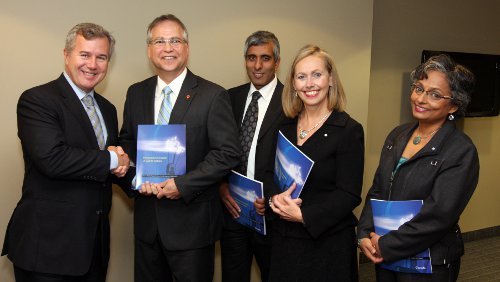
Panel Chair Tom Jenkins, along with Arvind Gupta, Monique F. Leroux and Nobina Robinson, present their reportInnovation Canada: A Call to Action, to the Minister of State (Science and Technology) Gary Goodyear on October 17, 2011. Not shown are panel members David Naylor and Bev Dahlby. (from the Review of Federal Support to Research and Development webpage with link listed below).
http://rd-review.ca/eic/site/033.nsf/eng/home
If this seems all very foreign or irrelevant to university researchers, consider what happened just this past week. The Ontario Research Fund (ORF) provides matching support for Ontario applications to the Canadian Fondation for Innovation (CFI), as well as funds and administers the critical Research Excellence (RE) matching grants competition.
http://www.mri.gov.on.ca/english/programs/ResearchFund.asp
This RE has supported university researchers, with industry partners, with many tens of millions of dollars over the past decade alone. Many, many research staff and students that you see at Western are supported entirely or in part by the ORF RE. This past week (late monday), the current ORF RE application round, as well as the round for next year were cancelled. The money was re-allocated to the South-Western Ontario economic development innitiative announced by Dalton McGuinty on monday (you may have heard about this).
http://www.premier.gov.on.ca/news/event.php?ItemID=19651&Lang=EN).
I’m not going to say whether I think this is good or bad (it is certainly challenging), but these sort of changes (which directly reflect early implementation of the kinds of recommendations made in the federal Jenkins Report) are something we need to react to. There is no immediate benefit to be had by complaining about this, as the changes are already on our doorstep. Criticism may affect change for the coming years, but right now, we need to position ourselves to take advantage of the new climate. This means more industry collaboration, more technical service, and much more strategic planning and effort in monitoring and reacting to the varied opportunities.
The R&D climate has been slowing changing for years now, but I think it’s clear that in the next several years, the changes will be larger and coming faster. It’s an interesting time, so let’s get ready!
(originally posted by Blaine Chronik)