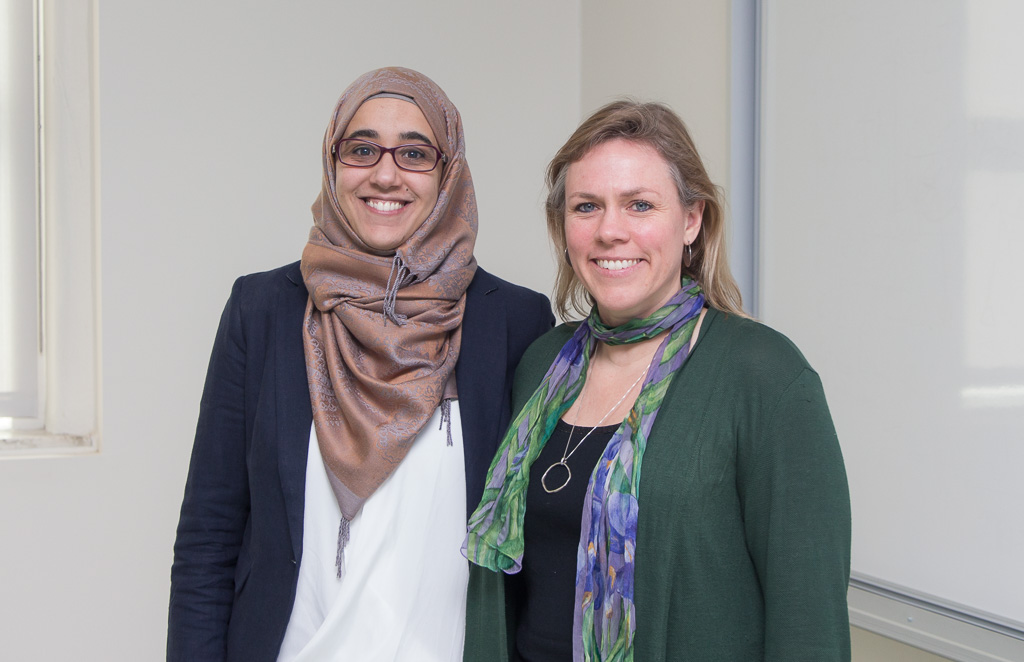
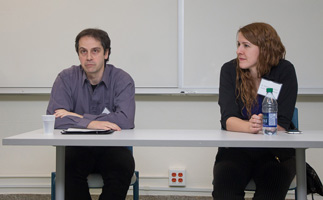
Aycha Tammour (left) with supervisor Sarah Gallagher (right).
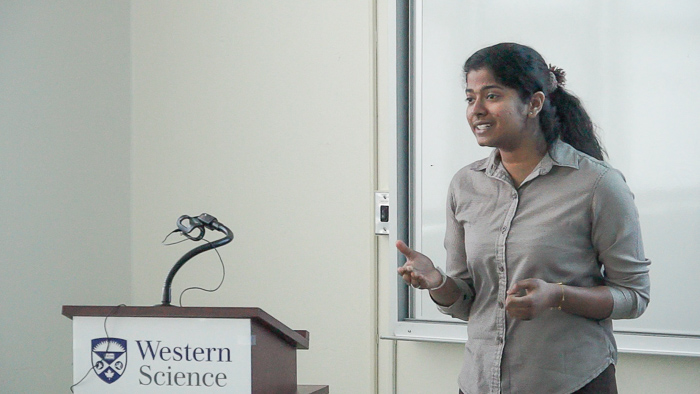
Aycha Tammour successfully defended her PhD thesis on Thursday, April 14, 2016.
Aycha gave a public talk on her thesis, which is titled, “Insights into the physical properties driving emission and absorption in quasar UV/optical spectra“.
Astronomer Dr. Sarah Gallagher is Aycha’s PhD supervisor.
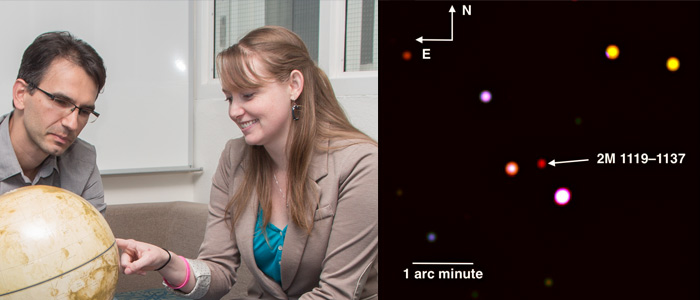
PhD student Kendra Kellogg (centre), supervisor Prof. Stan Metchev (left), with new planet (right).
Astronomers from the Department of Physics and Astronomy and the Centre for Planetary Science and Exploration at Western, led by graduate student Kendra Kellogg, have discovered one of the brightest and youngest free floating ‘extrasolar giant gaseous planet analogues’ (rogue planet) to date. The newly discovered planet, designated 2MASS J1119–1137, is situated in the TW Hydrae association of young stars, residing approximately 160 light years from Earth.
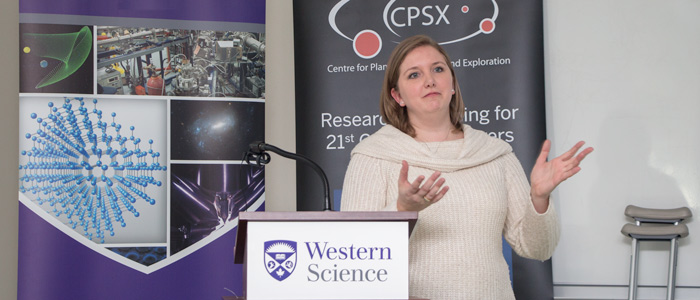
Acting CPSX Director Ken McIsaac warmly welcomed the speakers and the audience to the event, being held in PAB 100.
Acting CPSX Assistant Director Jan Cami introduced keynote speaker Dr. Stefanie Milam of NASAs Goddard Space Flight Centre. Stefanie gave a presentation titled, “Searching for our Molecular Origins in Space through Astrochemistry“, and also added a fascinating update, with great images and video, on the James Webb Space Telescope, which is set to launch in late 2018.
Following the keynote presentation, the audience heard short research presentations from an elite group of researchers.
The research speakers were:
Tanya Harrison – “Thermal Inertia of Gully Fans on Mars as a Marker for Recent Activity”
Matt Shannon – “Auto exhaust along the Milky Way”
Dr. Haley Sapers – “Beyond the Catastrophe: Life after impact”
Jon Kissi – “Geological Formation Reconstruction – a stereo vision perspective”
William Zylberman – “Did a double impact happened 270 Ma ago in Québec?”
Tiffany Ensor – “A Principal Component Analysis of Diffuse Interstellar Bands
Danny Bednar – “Current State of Orbital Debris Politics”
Following the talks, everyone adjourned to the Physics and Astronomy building atrium for a reception and to view student research posters.
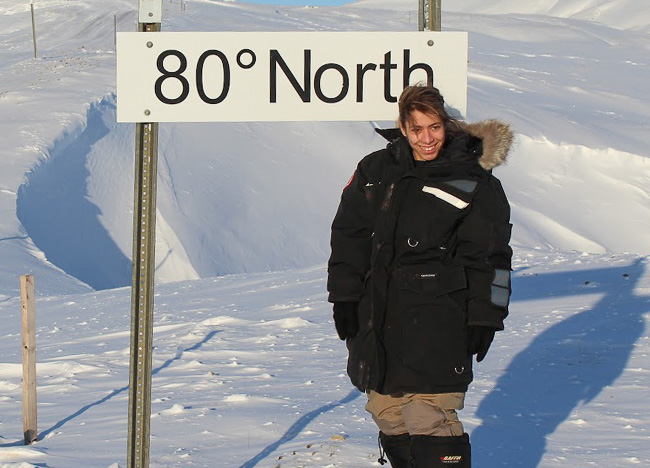
As quick and elusive as its distant southern relative, the African Gazelle, the Arctic Ghazal displays a unique behaviour. She does atmospheric research in Canada’s far north.
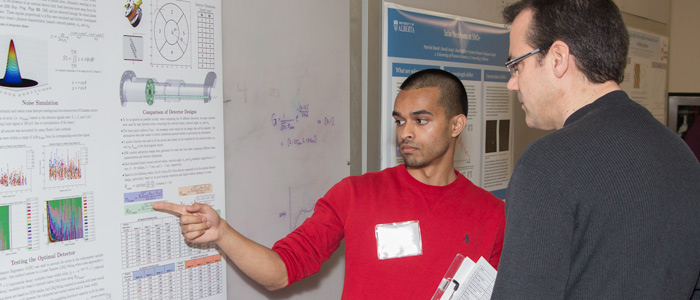
Student presenter Abhilash Matthews (left) describes his research to judge Prof. Colin Denniston (right).
By 10:30 a.m. the poster papers and computer displays were ready for public viewing.
The official program began at 12:30 p.m. with two public oral student presentations, moderated by Professor John de Bruyn.
Nathalie Thibert spoke on “Outflowing Winds in Quasars: A Study of CIV Broad Absorption Lines”.
Next, Ian Mulholland spoke on“Optimizing Kuiper Belt Occultation Searches in the Ecliptic Plane”.
Julie Hlavacek-Larrondo
After a short break, Université de Montréal astronomer Julie Hlavacek-Larrondo gave a talk titled “Black Holes: Sculptors of Galaxies and Clusters“. Host was Chair Bob Sica.
The full house then adjourned for pizza lunch and tour of the poster papers, all in the Physics and Astronomy building atrium. The posters were judged.
Stephanie Simmons
Following the poster session and lunch, the CAP (Canadian Association of Physicists) lecture was given to another packed room by Simon Fraser University physicist Stephanie Simmons. The talk was titled, “The International Race for a Quantum Computer”.
Following Stephanie’s talk, the student awards were announced.
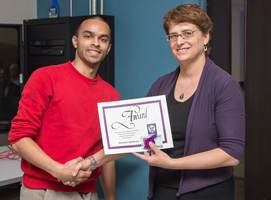
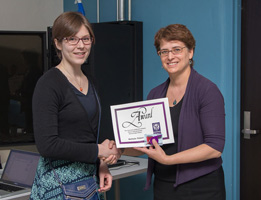
Abhilash Matthews was winner of the award for best poster oral presentation, while Nathalie Thibert received the award for best poster presentation. Professor Tamie Poepping presented the awards.
Expert panelists Michael Cuffaro (left), and Stephanie Simmons (right).
To finish the day, a panel discussion was held on the the topic “How our World Changes with Quantum Computing”. Panelists were Simon Fraser University physicist Stephanie Simmons and Western University philosopher Michael Cuffaro. Moderators were Dylan Del Papa and Jonathon Riddell.
Abhilash Matthews (left) – best poster oral presentation
The organizers, under the direction of Prof. Tamie Poepping, could be proud of hosting a well organized and very well attended event. The student research was impressive, and the invited speakers could not have been better mentors.
Natural Resources Canada Deputy Minister Bob Hamilton (left) and CIO Pierre Ferland (right)
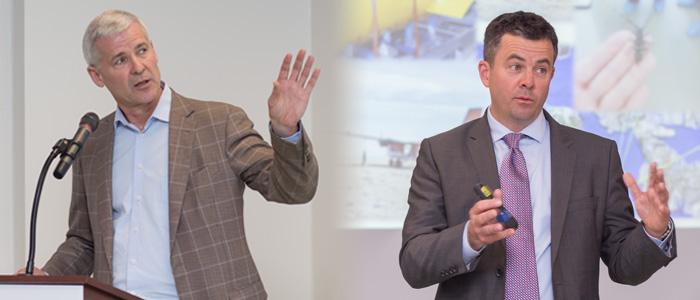
On Monday, March 14, Deputy Minister of Natural Resources Canada (NRCan) Bob Hamilton spoke on the federal government’s perspectives on a changing context in natural resource management in Canada. Physics and Astronomy Rm 100 was filled for the event.
Immediately afterwards, NRCan Chief Information Officer (CIO) Pierre Ferland spoke on IT-related career opportunities (particularly as they relate to the management of Big Data). His talk was titled, “The Future of IT within the Government of Canada: Computing Careers.”
March Break Open House 2016 was held in the Physics and Astronomy building atrium on Saturday, 12 March 2016.
There was a wonderful, positive hum of activity throughout the entire day not only in the atrium, but at the first year laboratories as well.
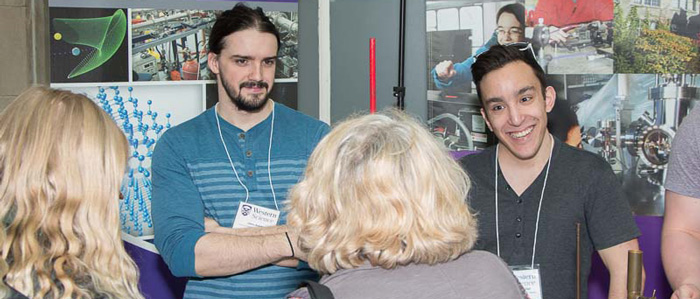
A meet and greet for Physics and Astronomy was attended by about two dozen people. We can’t thank guest mentors Nataliya Moldovan and Laura Lenkic enough for sharing their experiences with our prospective physics and astronomy students. You can view Laura’s and Nataliya’s testimonials online.
Volunteers for 2016 were Patrick Hatch, Nathalie Thibert, Conor Dunne, Nedim Smailovic, Pritpal Matharu, Michael Molliconi, Adrian Mahjour, Jason Aubrey, Jon Levert, Ian Mulholland, Mark Wheatley, Alex Buchel, John de Bruyn, Carol Jones, Wayne Hocking, Jan Cami, Bob Sica, Tammie Poepping, Eugene Wong, Kanthi Kaluarachchi, Shailesh Nene, Peter Frank, Phin Perquin, Jen Tilston, Brian Davis, Dilini Subasinghe, Shayamila Gamage, Edith Yeung, Henry Leparskas.
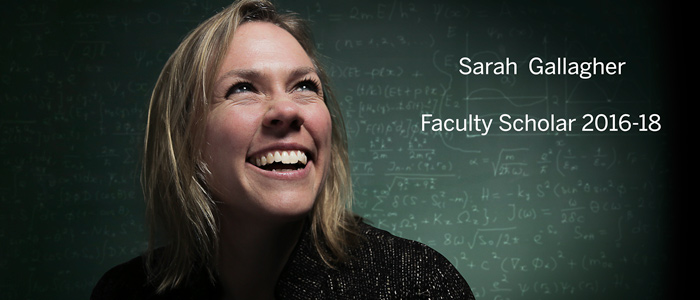
Western astronomer Professor Sarah Gallagher has been named as a Western University Faculty Scholar for 2016-18.
The citation reads, “These awards are limited in number and recognize scholarly achievements of a faculty member at a critical point in his or her career. The awards recognize the complete scholar who has maintained an excellent record in teaching and research, and who has recently achieved prominence in one of these two domains.”