
This nice article discusses the impending death of the Herschel space observatory, but don’t panic it still has a little left in it.
All posts by catschroedinger
The Final Countdown… Month 10
So… Time has moved on at an alarming pace and the end of Febuary fast approaches. Thankfully my hunt for something to do after #westernu has been greatly helped by a few websites:
First and foremost the AAS Job Register and the equally helpful EAS Job Register.
(Now I may have just been exceptionally lucky in terms of what has been posted in the past month, but I have already made one application and I am in the process of a second. So, all I can say is have a look).
Another thing that occurred to me this month is that there are a number of people/groups with whom I would really really like to work or where I know our research interests cross paths. I realised that not all of these will be actively looking for PostDocs. So then, I wondered, can I simply write to these people to display my interest to them?
After discussion with a few of the faculty I have been left with this advice: while it is fine to email regarding interest in working with a group make sure you outline your current research, your research interests, what aspects of their work you are particularly interested in, and most importantly how you will benefit their research. Let us not forget, if we are considering this option, in some cases it will be advantageous to have applied for funding before approaching the people in question. In fact #NSERC have funding opportunities available for exactly that, the Postdoctoral Fellowship.
10 tips to complete your physicist’s advantage
What do people think of physics students? What reaction do you get when you tell people you’re a physicist? Usually the reaction I get ranges from a smiling “that’s really interesting!” to the wide-eyed, exaggeratedly scared face “I can’t do math” response. Actually, it doesn’t range…it’s usually just one or the other. I like the first one.
What about people who don’t do physics, but who know about it? Again, two distinct responses come to mind. The slow-nodding, admiring “you’re learning some valuable skills, I wish I could do math”, or the “does your exorbitant, recession-proof funding solve any problems NOW?”
What do physics students think of themselves? This is left as an exercise for the reader…
The only question like this I can answer with any integrity is what I myself think of physics students. I think we’re a group of people in one of the luckiest niches we could ever nestle ourselves into. My argument for this is simple: our main responsibility is to become mentally agile. We’re not responsible for memorizing flocks of data, playing odds, being diplomatic, enforcing the law, risking our careers over political popularity, developing risky business campaigns, doing manual labour (or we can at least delegate it once we’re old enough). The responsibilities of a physicist may not all be glamorous, but my point is that it FORCES us to develop critical thinking skills that we can apply elsewhere in life. We spend hours racking our brains over the proper way to parametrize a surface, and at the end of that day we can enjoy a wealth of mental versatility that some people have to develop on their days off in order to remain sharp.
Mental versatility is a key to freedom. It makes us self-sufficient and independent, and even if it doesn’t guarantee we make good decisions, it guarantees we make clearerdecisions.
But mental versatility isn’t enough to make our lives easy. In fact, it makes some people’s lives difficult once they become aware of, for example, things they don’t like but can’t change.
I believe one of the greatest long-term investments we can make, as physicists or not, is to develop a versatile set of skills, intellectual and non. Even if we don’t need them to fight for our survival, self-sufficience begets self satisfaction.
Not to say that we should all farm our own crops and build our own houses from scratch, but what we may do is acquire new skills that allow us to solve our own problems, in the same way that learning physics fosters a mindset that can solve problems. Here are a few things you could consider doing to complete the physicist’s advantage:
1) Learn to build a fire. Even if you’re not fighting for survival, I guarantee this will hold the attention of everyone in front of it, even if they’re carrying on a conversation with someone right beside them.
http://www.wikihow.com/Build-a-Fire
2) Make homemade bread. It takes only about 20 mins of labour time, and it’s actually cheaper than Wonderbread! I really recommend this recipe.
http://www.epicurious.com/recipes/food/views/Multi-Grain-Bread-with-Sesame-Flax-and-Poppy-Seeds-523
3) Be nice to people who irritate you, and forgive good people. Although this sounds more like a decision than a skill, some of the people who notice and respect this trait are the people whose admiration is most valuable.
4) Do home repairs. If you’ve lived in student housing, you’ll know handymen aren’t always the messiahs you hope for. This is an excellent guide.
http://homerepair.about.com/od/plumbingrepair/Plumbing_Repair_DIY_Tips_and_StepByStep_Guides.htm
5) Become informed about conversation topics that seem to come up a lot.
6) Understand the economic crisis! The Inside Job is a concise and accessible documentary that gives a thorough rundown.
http://vidbox.net/file.php?fd=c86221b7af9ba6738f45f733d916bd41
7) Consider every action an investment in your values. Find something you do regularly that doesn’t fit. Remove it from your routine.
8) Identify your biases, and go learn about them. If your opinion doesn’t change, feel happy. If your opinion does change, feel happy.
9) Don’t think about any phase of your life as a stage of necessary hard work so that you can enjoy life later. Enjoy your hard work.
10) Arrive 15 minutes early, and carry something with you that can occupy 15 minutes of your time.
*11) Here’s a bonus one: http://litreactor.com/columns/20-common-grammar-mistakes-that-almost-everyone-gets-wrong
Tatooine-ian kind of planets?
A Nature paper describes a new class of planets. The new class of planets are called circumbinary planets; they orbits a pair of stars (it rings a bell right? yup just like the planet Tatooine in Star Wars). Kepler-34b (i think it should be named Tatooine-1) was discovered by Kepler Spacecraft which uses transit method to discover extra-solar planets in constellations of Cygnus and Lyra.
An interesting paper perfect to read with a cup of coffee 🙂
Image courtesy: Nature!
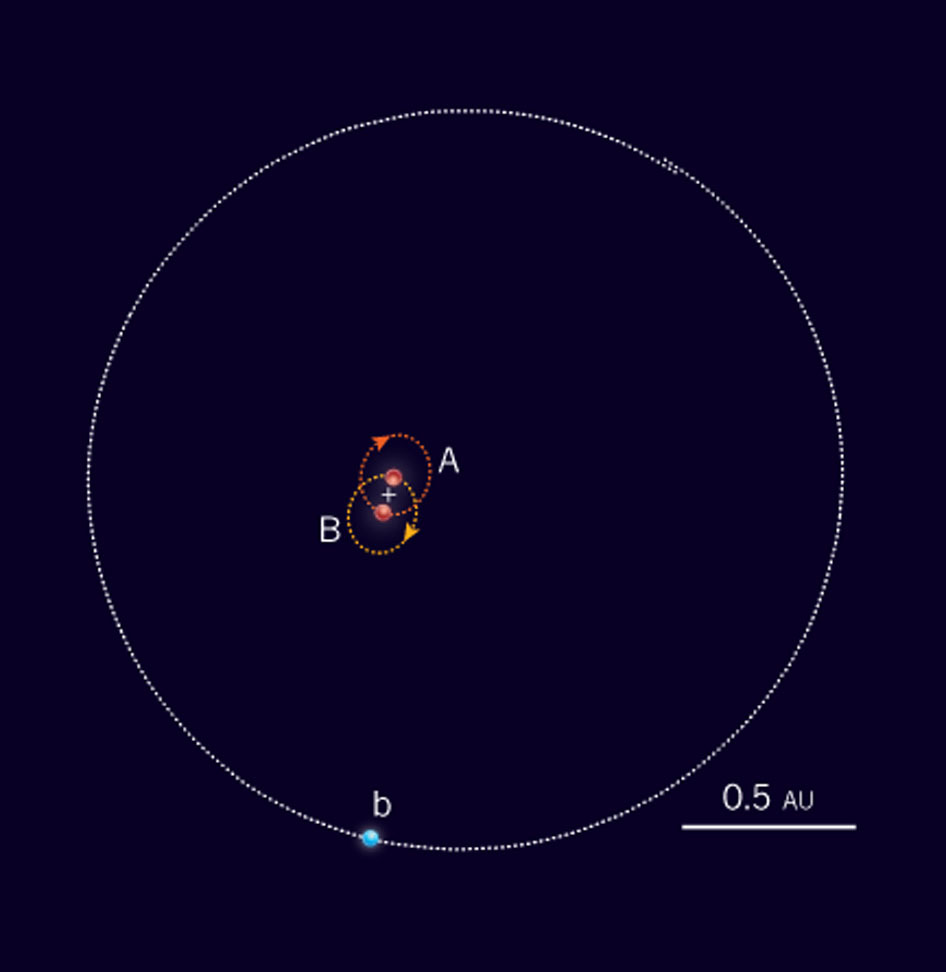
Image Description: Orbital configurations of Kepler-34 system.
Squeeze out the Planetary Water!
Now that we are hunting for Alien Worlds, the first thing that comes to mind for life to survive on such planets is Water.
Here is an interesting study of how Alien Planets might lose their water. Tidal forces!!! Tidal forces are well known to Earthlings; caused by gravitational pull of the Moon and Sun.
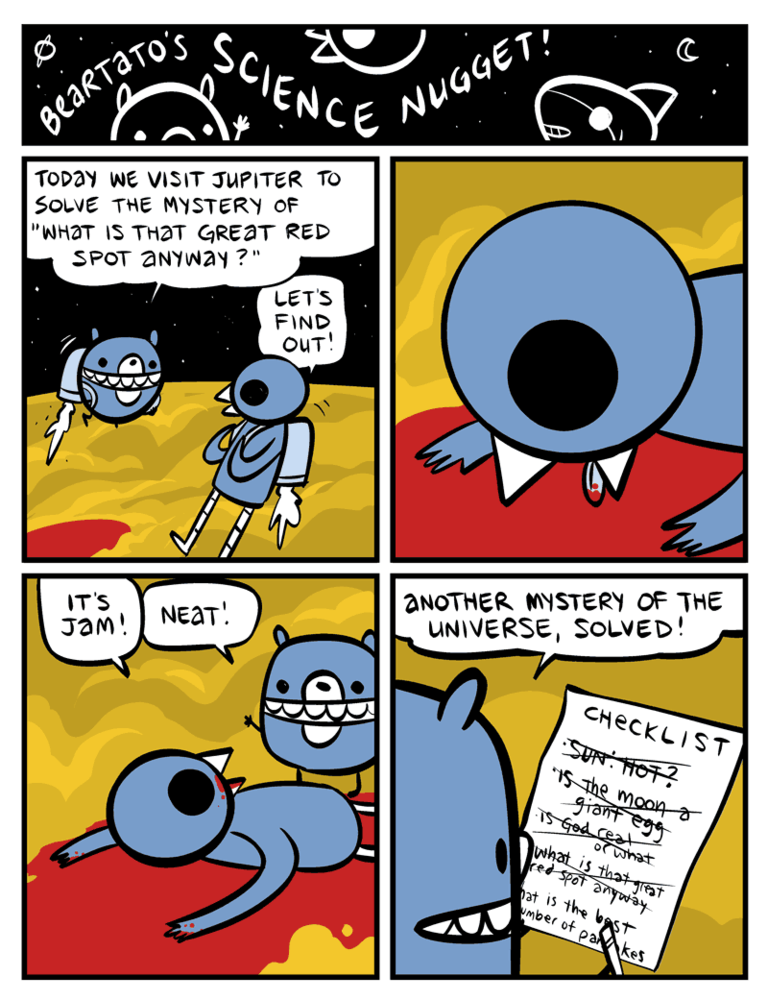
Great Red Spot Mystery Solved (Comic)!
The physics of the ponytail
Physicists in the UK have found an equation to describe the swelling of a swatch of hair as a function of curliness and length. It can be described using the (newly defined) Rapunzel number. Link to Physics Review Letters synopsis.

Image credit: Johnny Gruelle.
Five planets to be visible in a single night this month
Cats and Physics
Question: If you strapped a slice of buttered bread to the back of a cat, which way down would it land?
Answer: I’m glad you asked this question.
When you drop a buttered piece of bread, it drops butter side down and a cat always lands on its feet. What would happen if you took a piece of buttered bread, strapped it on the back on a cat (butter side up) and dropped it off Centerpoint Tower?
Even if you are too lazy to do the experiment yourself you should be able to deduce the obvious result. The laws of butterology demand that the butter must hit the ground, and the equally strict laws of feline aerodynamics demand that the cat can not smash it’s furry back.
If the combined construct were to land, nature would have no way to resolve this paradox. Therefore it simply does not fall.
That’s right you clever mortal (well, as clever as a mortal can get), you have discovered the secret of antigravity! A buttered cat will, when released, quickly move to a height where the forces of cat-twisting and butter repulsion are in equilibrium. This equilibrium point can be modified by scraping off some of the butter, providing lift, or removing some of the cat’s limbs, allowing descent.
Most of the civilized species of the Universe already use this principle to drive their ships while within a planetary system. The loud humming heard by most sighters of UFOs is, in fact, the purring of several hundred tabbies.
The one obvious danger is, of course, if the cats manage to eat the bread off their backs they will instantly plummet. Of course the cats will land on their feet, but this usually doesn’t do them much good, since right after they make their graceful landing several tons of red-hot starship and pissed off aliens crash on top of them.