If I could condense this post into one idea it would be, counter-intuitively perhpas, “Take time off.”
After finishing my undergraduate degree I decided to spend some time some time living abroad in Japan. I’ve always had a fancy for other languages, but Japanese seemed reasonably complicated. With its three “alphabets”, I decided I would need to spend considerable attention studying the language in it’s own environment if I was to learn how to read-write-and-speak it with any degree of adequacy. So, away I went, 10,563 km, from Toronto to Nagoya.
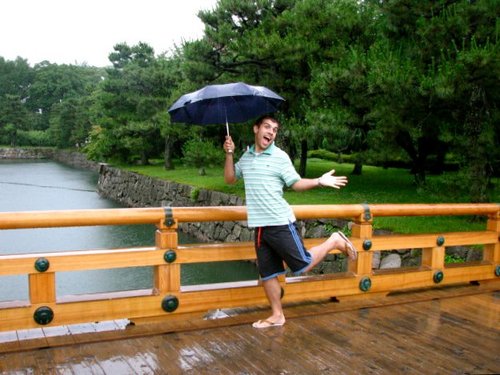
Singing in the rain on a bridge in Kyoto, Japan.
I spent considerable amounts of time huddled over books in libraries and bookstores, writing furiously over cups of coffee in cafes, and striking up conversations with anyone that would pause long enough to listen… to my horrible defacement of the language; though I did get better in time. You get to meet some incredible people when you put down your guard for the simple sake of wanting to have a conversation (a challenging feat when that conversation is in a language you’re struggling to understand): my still-good-friends, graphic designers, Takashi and his wife, Chieko, and I would go cross-country (motor)cycling through the mountains, visiting wonderfully isolated shops and restaurants in the Japanese countryside. I try to visit still, when my schedule, and pocket-book, afford.
With time away from school, you begin to build a life for yourself apart from attending classes and finishing assignments. Yet a part of me could not escape that want for knowledge. On camping trips, I would point out the planets among the stars, and tell stories of the constellations; and my friends would always encourage me, aware of my interest in physics, turning to me for explanations of topics they had heard about on the news, or read in a newspaper, wanting to know more about this-or-that discovery. Perhaps most tellingly for myself, at the end of the day I would return home and almost ritually, with a cup of coffee, browse the arXiv to learn of the latest developments being made by the physics-community.
I have thought of becoming a scientist since I was little boy. But no experience more blatently underscored that desire to me than when I took time away from that trajectory to explore something else. I realized that I didn’t just want to learn about the universe, it was something I needed to do.
Travel is certainly not for everyone, and Japan is a little too far away for many. But the lesson, and perspective, I have found to be essential to encouraging my own focus, now, as an actual graduate student: I don’t just think, but know, I would not want to be doing anything else.
‘Learning to GradSchool’ is a recurring series written by Alexander DeSouza, with posts once-per-month, of his experiences/reflections navigating graduate school/foraging for free food, and learning how to be a better scientist.