All posts by catschroedinger

Supernova 1987A Brightening! #westernu

The most famous supernova ever, 1987A, is celebrating its 25th anniversary this year.

The link below shows the brightening of material (knots) in the ring surrounding the remnant over time.

This occurs as an outward-moving blast wave collides with the ring material and shock-heats it.


See the time-lapse by clicking on the image at http://apod.nasa.gov/apod/ap120227.html


Animation: http://www.youtube.com/watch?v=QfiwDXv6g0Q


Article: http://www.astronomynow.com/news/n1202/23sn/

How to thesis: Time management

Last month, I briefly mentioned I’d talk a bit more about scheduling. So I figured it would be good to follow up on that.

Managing my time well is also something I’ve learned to do in graduate school (although one could maybe argue that I’m still not so great at it). It’s not that nobody ever tried to teach me how to do it before now, it’s more that a lot of the usual ways (e.g. keeping an agenda) don’t really work for me (e.g. I never check the thing). So I’ve tried figuring out what works for me and maybe some of these things will work for some of you too.

To Do Lists

These are things I make not only to keep track of what I’ve done and what I should do, but also because there’s this nice satisfying feeling that comes from crossing an item off the list.

One thing I’ve found really useful lately is actually the Tasks feature that come with gmail. That way every time I check my email I can be reminded of the things I should be doing. With this feature, it’s even possible to create separate lists for different spheres of life. Right now I have a list for research; another for tasks that are still related to work, but not research (e.g. job applications, TA duties); and one for my personal life.

I keep a paper version of my to do list for the week, however and I try to plan out little ones each day. Which brings me to…

Setting Mini-Goals

In research, you’re not going to get everything done in a single day and getting to the point where you’ve completed enough work for a paper (or a thesis) can seem really far away. Further, it isn’t even always clear what you have to do in order to get to this end state or it can be really easy to lose sight of what has to be done.

To avoid losing sight of everything, it’s helpful to break every large task into many smaller tasks. This can be done over the course of months or weeks or even throughout a day.

To keep from spending too much time on one task, I try to set mini-goals as I work throughout the day (e.g. by 3pm, I want a program that does x). I also try to hold myself accountable for how I spent my time. To do this, I use this document:

time_well_spent.pdf
Download this file

It’s basically a pdf that I print out each week that helps me plan out my week and my days.  This version is just 5 days (my weekends are a bit more free-form).  I usually try to write down what I’ve done every hour or so and set small goals to be accomplished throughout the day.  Sometimes it’s difficult to stick to this, but when I do it definitely helps.

I (once again) hope that something I’ve said can be useful to someone else.  If you have suggestions for how to manage time effectively, you’re welcome to leave these suggestions in the comments.

Until next month.


Sarah is in the final year of her PhD. “How to thesis” is a series in which she imparts various (hopefully) useful things she has learned during her graduate career.

Astronomy Picture of the Day: Stephan’s Quintet

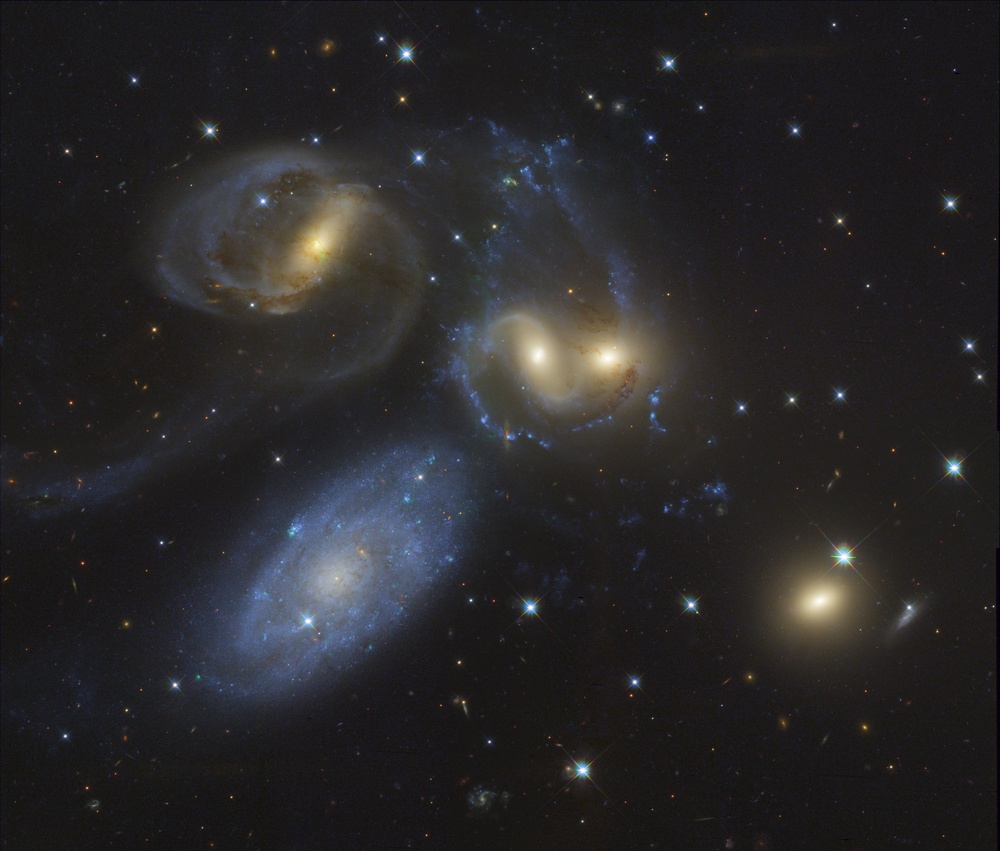
Today’s Astronomy Picture of the Day (sponsored by NASA, see http://apod.nasa.gov/) held a bit of a surprise: the ever photogenic galaxy group Stephan’s Quintet imaged by the Advanced Camera for Surveys (ACS) and Wide Field Camera 3 (WFC3) onboard the Hubble Space Telescope. The Quintet is part of the research of UWO professor Dr. Sarah Gallagher and her graduate students Konstantin Fedotov, who uses Hubble to study the star cluster population in the galaxy group, and Tyler Desjardins (that is to say myself), who uses X-ray observations from NASA’s Chandra X-ray Observatory to examine hot gas in a sample of galaxy groups including the Quintet.


Pictured: Stephan’s Quintet (Hubble Legacy Archive; NASA; ESA; Al Kelly)

Undergrad Life in the Department

Undergraduate students here in the department have banded together into the Physics and Astronomy Student Association (PASA) to help their members with their studies, organize social events for themselves and the department at-large, and promote physics and astronomy outside of the department among other activities. To get to know PASA a little better, see their website at http://www.pasa-uwo.com/index.php which includes interesting features such as montly interviews with department faculty and grad students.

Serving Our Communities

How do astronomers serve their communities? One example is through outreach programs designed to increase the scientific awareness of the general public. Here at The University of Western Ontario, our department runs one such program called Exploring the Stars. We invite any group interested in learning more about astronomy to join us for a lecture on a topic of their choice, and a chance to look through our historic 25.4 cm refractor telescope at the Cronyn Observatory on campus. The program instructors also host open houses at the observatory on the last Saturday of each month (tonight from 7pm-9pm!) during the school year and every Saturday from 8:30pm-11pm during the summer. More information can be found at these links:

http://www.astro.uwo.ca/exploringthestars/

http://physics.uwo.ca/outreach/public_nights.html

End of an Era

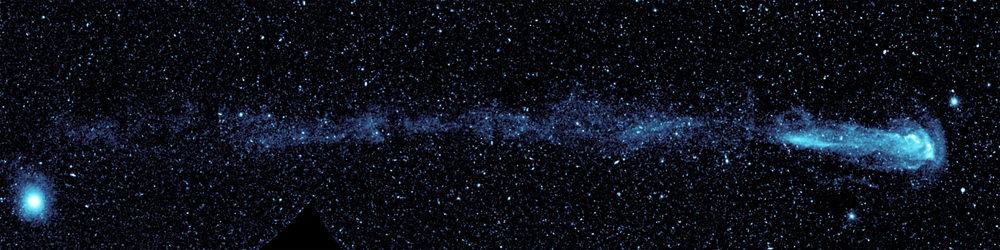
The Galaxy Evolution Explorer (GALEX), an orbital ultaviolet telescope, was recently placed in standby mode as teams prepare to end the 9 year old mission. Its mission was originally to determine distances to galaxies in the nearby and distant Universe and measure how quickly they are forming stars. However, among the mission’s many scientific discoveries are things like the image below, an ultraviolet tail and a bow shock between the stellar wind of the star Mira and the surrounding interstellar medium as it plows through our own home galaxy The Milky Way.

More information about GALEX, its discoveries, and the latest news can be found on their website.

Photo: GALEX view of Mira (NASA/JPL-Caltech/C. Martin (Caltech)/M. Seibert(OCIW))