All posts by catschroedinger

Kepler finds more planets

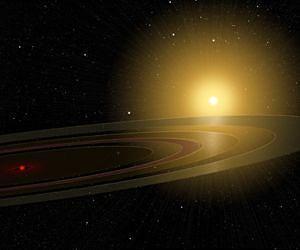
Yesterday, NASA announced that Kepler has found 11 planetary systems with a total of 26 new planets.  This triples the number of stars known to have multiple planets in orbit.

Additionally, each of these new planetary systems contains between two and five planets with close enough orbits that the gravitational interaction between the planets accelerate their orbits.  This acceleration changes the orbital periods of the planets, which allows astronomers working with Kepler a new way to verify the existence of these planetary systems (check the link for a video explaining this).

Galaxy Zoo

All the internet dicussions of the last week got me thinking ‘what discoveries has the internet aided/caused?’.  Then I recalled NASAs Galaxy Zoo project, which asks people of the internet to classify galaxies from HST and SDSS images.  They have had tremendous success with many follow-up observations being made due to the general public simply asking ‘what is that?’.  I highly recommend taking a look at their Blog or getting involved yourself.  I find this typre of science inspiring, simultaneously capturing public interest and imagination by getting them actively involved and furthering scientific knowledge: a big thumbs up.

The Final Countdown… Month 11

I trust we all had a great Christmas and New Year and are back in to the swing of a new winter term.  I have, as promised, been doing some reading into the preparation of an academic CV, and no real surprise it is pretty straight forward and with some common sense not really to difficult.  That being said like all things in research experience is key and thus, looking at websites and reading over example documents is the best way to prepare the initial one; which can then be improved upon.  For this purpose I include two links:

  1. Western’s Career Centre – a sample CV may be found at the bottom of this page.
  2. Vitae – a British resource which has a number of samples depending on level of application and field of study/research.  May be found here.

As a graduate student near the end of my student career I am both nervous and excited about what the next few years have in store and plan to do my utmost to prepare myself for the reality of the current academic and nonacademic job markets.  For me, this means information is key, thus I cannot recommend strongly enough events like the Graduate Career Day for arming ones self with the information to make the decision that is right for you.

I also, highly recommend that we spend a long time deciding which path to take.  Make the academis versus industry decision for yourself.  It wasn’t something I really thought about seriously until my PhD. was well underway, and I spent a lot of time weighing up the pros and cons for me and my family.  For me personally the final decision came when I was looking over the projects that I have had to lay a side, the bits that I am not going to have time to finish in my PhD. research.  As I was sorting the folders with all the titbits of background information and personal data I began to wonder about the possibilities housed in these notes.  It was that juvenile excitement that made me realise that it is not only the science of Stellar Astronomy that is important to me but also the freedom of personal research.  That being said, if I had to choose between research and hands on observing, the telescope would win hands down (but that is for another dicussion, later when I start looking at my options).

Anyway, since I seem to have rambled a little there, I will conclude.  Make the decision for you, not for your supervisor or simply because it is easier to not think about it.

Limer(phys)ics #2 – Re-Schroded

Thanks to everyone who read my attempt to unify the greatest branch of science with the lowest branch of poetry last month.  Professor Barmby issued a stern challenge (thanks also to Henry Leparskas for his stellar response!) to find something that rhymes with ‘Schrodinger’.  First, let me pay tribute to the equation that made Mr Schrodinger famous…

Its physics is explicit in a manner so exquisite,
when you quiz it
seems illicit,
so re-visit, don’t dismiss it!


Now here are some more limericks!


Erwin Schrodinger,
The quantum woe bringer,
Was at a logical dysjunction,
Curiosity that,
Did away with his cat?
Or was it that pesky wave function?


Alone with a cat-box Bohr sat,
To test Schrody’s cool idea that,
“I’ve poked air holes” Neils said,
“He’ll be living OR dead…
…well…
…unless I poked holes in the cat…”


(This next one is my uncle Eric’s, I get no credit!)
A horseshoe Neils Bohr had just bought,
His brain, his friends claimed, came to naught,
He said “Don’t be jerks,
I’ve heard that it works
If indeed, you believe it or not!”


(This one’s not mine either)
A dying mosquito exclaimed,
“A chemist has poisoned my brain!”
The cause of his sorrow
Was para-dichloro
Diphenyl-tri
chloroethane.


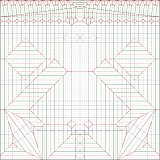
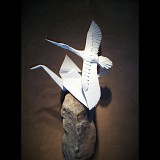
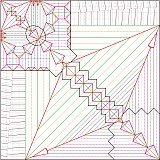
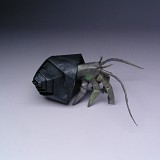
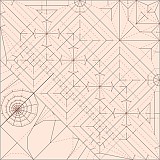
Limericks aside though, I wanted to write a few sentences about a compelling Ted Talk that got me interested in origami. Robert Lang is a retired astrophysicist who gave up his job to pursue a career in origami folding. He set his math background to work with a concept called Circle Packing to tackle the problem of generating two dimensional blueprints, or ‘folding patterns’, corresponding to any conceivable three dimensional object, such that, if the folds were performed in the correct order, you could make any object out of a single sheet of paper without cutting, gluing, etc. The idea of circle packing describes the representation of a 3D figure as a unique pattern of circles on a 2D plane. Then you connect the circles with lines, and if you fold along these lines, you get the object! Obviously easier said than done 🙂 but Robert Lang wrote a computer program that generates these blueprints based on stick figures input into the program. Here’s the link to his Ted Talk if you’re interested: http://blog.ted.com/2008/07/31/idea_square_ori/   and I’ve attached pictures of a few of his creations, with their corresponding folding patterns. Thanks again to everyone who has a chance to read my posts, and I really appreciate the comments!


Gabe

Newly Discovered ‘Criegee Biradicals’ Shown to Naturally Cool The Planet!!

Scientists detected a chemical produced from reaction between ozone and alkenes that could help in ending Global Warming. Criegee Biradicals are chemical compounds that are mostly released by plants. Biradicals could oxidize sulfur dioxide, which eventually turns into sulphuric acid. Sulphuric acid acts as a cooling effect in the atmosphere.Since plants help in making Biradicals, the ecosystem can act as negative effect on global warming. For more information on this newly detected particle, check out!

Researchers now able to stop, restart light

By William J. Cromie 
Gazette Staff
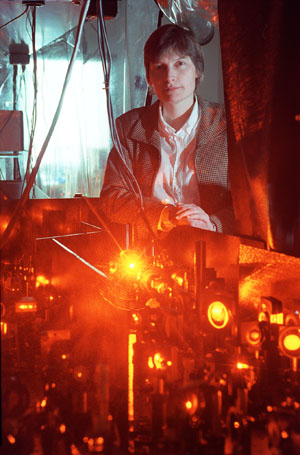

Lene Hau and her colleagues created a new form of matter to bring a light beam to a complete stop, then restart it again. (Staff photo by Kris Snibbe)

“Two years ago we slowed it down to 38 miles an hour; now we’ve been able to park it then bring it back up to full speed.” Lene Hau isn’t talking about a used motorbike, but about light – that ethereal, life-sustaining stuff that normally travels 93 million miles from the sun in about eight minutes.

Less than five years ago, the speed of light was considered one of the universe’s great constants. Albert Einstein theorized that light cannot travel faster than 186,282 miles per second. No one has proved him wrong, but he never said that it couldn’t go slower.

Hau, 41, a professor of physics at Harvard, admits that the famous genius would “probably be stunned” at the results of her experiments. Working at the Rowland Institute for Science, overlooking the Charles River and the gold dome of the state Capitol in Boston, she and her colleagues slowed light 20 million-fold in 1999, to an incredible 38 miles an hour. They did it by passing a beam of light through a small cloud of atoms cooled to temperatures a billion times colder than those in the spaces between stars. The atom cloud was suspended magnetically in a chamber pumped down to a vacuum 100 trillion times lower than the pressure of air in the room where you are reading this.


“It’s nifty to look into the chamber and see a clump of ultracold atoms floating there,” Hau says. “In this odd state, light takes on a more human dimension; you can almost touch it.”

She and her team continued to tweak their system until they finally brought light to a complete stop. The light dims as it slows down, so you think that it’s being turned out. Then Hau shoots a yellow-orange laser beam into the cloud of atoms, and the light emerges at full speed and intensity.

Inspired by Hau’s success at slowing light, researchers working on a wooded hill a few miles away at the Harvard-Smithsonian Center for Astrophysics (CfA) used a similar technique to stop, then restart, a light beam. That team was headed by Ronald Walsworth and Mikhail Lukin, both associates of Harvard College. Their success was independent of Hau’s effort.

“We didn’t have much contact,” she notes, “just a few e-mails.”

Stopping cold

Besides stirring a research rush to explore exotic forms of matter, such experiments open the door to some practical applications. These include vastly more powerful computers as well as the possibility of communications that are much more secure from hackers and people trying to steal your credit and bank card numbers.

“We hope for wonderful things,” says David Phillips, who worked on the CfA “stop light” project. “Our imagination hasn’t figured out what the possibilities are yet.”

Hau, a tall, slender scientist educated as a theoretical physicist in Denmark, had a hunch several years ago that intensely cold atoms would become a hot area in physics. In the mid-1990s, she and her colleagues became excited about experiments aimed at crowding atoms so close together that unusual things happen. The key is to cool them to within a billionth of a degree of minus 459.7 degrees F. Called “absolute zero,” this is the temperature at which atoms have the least possible energy, and they all but cease to move around.

Hau was one of several researchers who succeeded in creating this novel state of matter. She corresponded with a colleague, Stepen Harris at Stanford University, and they came up with the idea that it might be possible to use a small ball of cold atoms to slow down light.

Hau and her group then figured out a way to make it work. Using sodium atoms and two laser beams, they made a new kind of medium that entangles light and slows it down. The laser beams glow yellow-orange like sodium streetlights, and the cigar-shaped cloud of atoms is about eight-thousandths of an inch long and about a third as wide.

Working with Chien Liu, a postdoctoral fellow at Rowland, and Harvard graduate students Zachary Dutton and Cyrus Behroozi, Hau kept tweaking the atoms until they completely stopped laser light. This happens when a second laser beam directed at right angles to the cloud of atoms is cut off. When that laser is switched on again, it abruptly frees the light from the trap and it goes on its way.

Hau explains that light entering the atomic entanglement transfers its energy to the atoms. Light energy raises the atoms to higher energy levels in ways that depend on the frequency and intensity of the light. The laser illuminating the cloud at right angles to the incoming beam acts like a parking brake, stopping the beam inside the cloud when it is shut off. When it is turned on again, the brake is released, the atoms transfer their energy back to the light, and it leaves the end of the cloud at full speed and intensity.

Hau’s team stopped light for one-thousandth of a second. Atomically speaking, “this is an amazingly long time,” Hau notes. “But we think it can be stopped for much longer.”

The CfA researchers used an easier method. They shot laser beams through a dense cloud of rubidium and helium gas. (Rubidium, in its solid or natural form, is a soft, silver-white metal.) The light bounced from atom to atom, gradually slowing down until it stopped. No supervacuum or ultra-cold was needed. In fact, the chamber where the light stopped was at a temperature of 176 degrees F.

This convenience comes at a cost, however. Only half of the incoming light was stored, then recovered, and the storage time was much shorter.

Think of both contraptions as sophisticated light switches that control not just light but information. Incoming light can carry information expressed by changes or modulations of its frequency, amplitude, and phase. When the light stops, that information is stored just like information is stored in the electronic memory of a computer. To access the information, you turn on a control laser, and out it comes.

Shrinking computers

Computers operating by these so-called quantum effects are much more efficient that those available today, or even on the drawing board. (“Quantum” refers to changes in the energy levels of the atoms.) Today’s machines represent information in bits, electronic combinations of zeros and ones. Bits represented by quantum states of atoms could carry much, much more information. Cubic inch for cubic inch, quantum computers could tackle problems that would stymie the most super of conventional computers. For example, they could perform many calculations simultaneously.

Another thing they could do would be to encrypt information in complex codes impossible to crack without extremely expensive and time-consuming methods. Financial and other information would be prodigiously safer with a quantum computer.

As marvelous as they are, however, both the Rowland and CfA systems take up more space and power than would be practical. Hau’s experiment requires a small room, CfA’s needs a large tabletop.

CfA researchers need to solve this problem and to make sure all the light is stored – not just half. That will take many years.

Hau has already started ordering and installing equipment with which she plans to construct a quantum light stopper no bigger than a fingernail. She envisions ultracold and supervacuums being achieved with devices less than one-thousandth of an inch in size. These would be built on chips no bigger than the Pentium IV that runs many of today’s small laptop and palm-sized computers.

“Wouldn’t that be nifty!” Hau says. She and her colleagues describe their experiment in detail in today’s issue of the journal Nature.

Team build world’s smallest hard drive


Team build world’s smallest hard drive

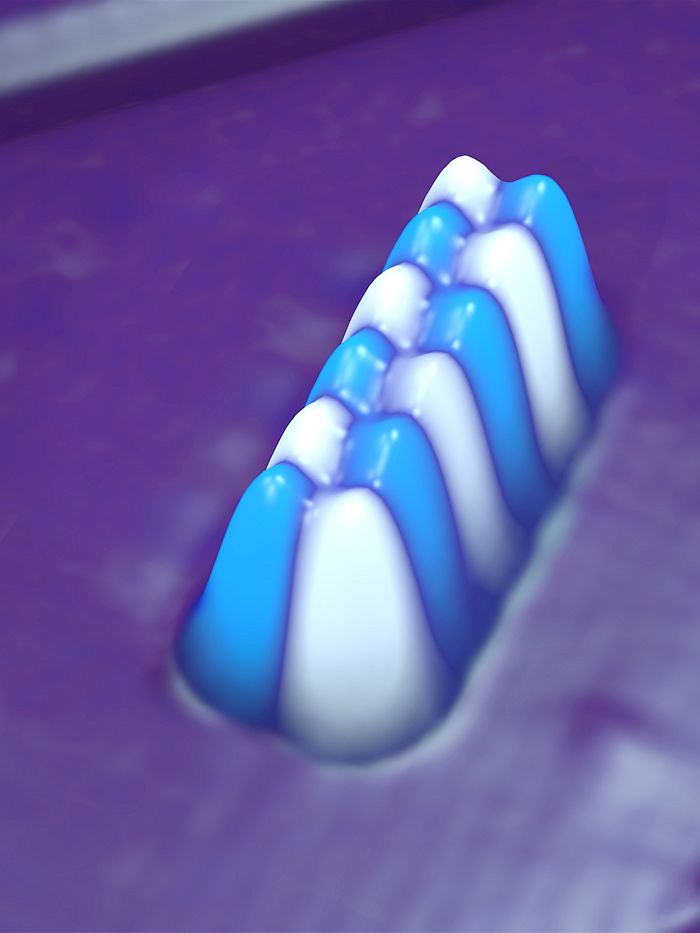
Twelve iron atoms make up the world’s smallest magnetic data storage unit to date (CFEL: Sebastian Loth)

Related Stories

Hard drives could one day be the size of rice grains, powering music players so small they would fit inside your ear.

Scientists at IBM and the German Center for Free-Electron Laser Science have built the world’s smallest unit of magnetic storage, using just 96 atoms to create one byte of data. Conventional drives require a half a billion atoms for each byte.

The advance could lead to tiny hard drives able to store 200 to 300 times more information than they can today. Just imagine an iPod Touch that held 12.8 terabytes of music.

“An effect that is common in nature can produce this information storage idea,” says Sebastian Loth of CFEL, lead author of the research, which is being published today in the journal Science.

The natural phenomenon Loth is referring to has to do with the way electrons spin inside an atom. Modern hard drives rely on magnetic materials such as iron, where electrons all spin in the same direction perfectly aligned with each other. The drives work by reading the magnetic states of small regions on a disk and using an external field to write to them.

But these so-called ferromagnetic materials can only be shrunk down so far. If the magnetic regions get too close to each other, their magnetic fields interfere with each other and make it difficult to accurately store data.

“This is a big problem if you want to pack in the magnetic density,” says Loth.

But with materials that are not magnetic, known as antiferromagnetic materials, the electrons spin in opposite directions from one another and are magnetically neutral.

“Antiferromagnetic regions don’t have a magnetic field so you can pack them closer,” Loth says.

In fact, the scientists were able to squeeze bits into a space just one nanometre apart.

Built atom by atom

The team assembled the tiny hard drive from the atom up, using a special tool known as scanning tunnelling microscope, or STM. They carefully placed atoms into rows of six atoms each. Two rows were enough to store one bit of information. Eight pairs of rows amounted to one byte of data.

Each pair of rows has two possible magnetic states, representing the classical 0 and 1 of binary computer data. An electric pulse from the STM tip flips the magnetic configuration from one to the other. A weaker pulse was used to read it.

“What this shows is you have all the ingredients for storing information on an antiferromagnetic grain,” says Dr Matthias Bode, an experimental physics professor at the University of Würzburg, who was not involved in the research.

It will be some time before this technology is used in a hard drive for a computer, as there are a few problems that still have to be overcome. First, this hard drive was built atom-by-atom, using an STM – an impractical and slow method for manufacturing.

Secondly, the storage of the information, the magnetic state, is only stable at very cold temperatures, about 5 degrees above absolute zero. Warmer than that and the spins of the atoms get jostled.

Bode says that finding a material that works at room temperature isn’t impossible. What material will work, however, remains to be seen.

Loth notes there are lots of other materials to experiment with that are known to hold antiferromagnetic states at room temperature. “This isn’t like superconductors, where we are looking for ways to boost the critical temperature,” says Loth. “We know that antiferromagnetic materials are stable.”

This work is also important because it demonstrated for the scientists how few atoms they could use before the effects of quantum mechanics took over. It turns out that twelve atoms are the minimum number required. Fewer than that and quantum effects begin to mess around with the stored information.


Thunderstorms proven to create antimatter


Thunderstorms have been shown to create positrons and send them to space. As the late, great, Johnny Carson of the Tonight Show used to say, “That is some weird, wild, stuff“.

NASA’s Fermi Catches Thunderstorms Hurling Antimatter into Space

TGFs produce high-energy electrons and positrons. Moving near the speed of light, these particles travel into space along Earth’s magnetic field. High Energy Electrons in yellow, positrons in green- click to enlarge