CANCELLED – Physics & Astronomy Colloquium – THURS. 25th Oct. – DR. CARLOS SILVA, U de Montréal

—CANCELLED— Please note that our speaker forTOMORROW’scolloquium has had to CANCELhis visit.

No colloquium tomorrow. Our apologies.

Western University
DEPARTMENT OF PHYSICS AND ASTRONOMY

PHYSICS & ASTRONOMY COLLOQUIUM

Date:           Thursday, 25th October 2012
Time:          1:30 p.m.
Location:    Physics & Astronomy Seminar Room 100

Dr. Carlos Silva
Département de Physique & Regroupement québécois sur les matériaux de pointe
Université de Montréal

“The dependence of charge recombination dynamics on the solid-state microstructure in neat, semicrystalline polymeric semiconductors”

ABSTRACT

We investigate the dynamics of geminate-polaron-pair recombination in the neat polymeric semiconductor regioregular poly(3-hexylthiophene) (P3HT) by means of time-resolved photoluminescence (PL) spectroscopy as a function of the solid-state microstructure, imposed by the molecular weight of the polymer and the thin-film processing route. At 10K, we observe delayed PL that originates from recombination of long-lived geminate-polaron pairs. The delayed PL decays over microsecond timescales, which is orders of magnitude longer than the exciton lifetime. We find that >36% of the total PL in solution-processed films of high-molecular-weight (331 kg/mol) material, which features a two-phase semicrystalline microstructure of alternating chain-entangled amorphous phases and crystalline lamella. In this microstructure, both the yield and the decay dynamics depend upon molecular weight. However, in films with dominant one-phase chain-extended microstructures, delayed PL is strongly suppressed. We thus find that a two-phase morphology leads to a higher yield of delayed PL with a higher distribution of decay rates than one-phase, chain-extended morphologies. By invoking a kinetic model including interconversion of excitons and geminate polarons, we conclude that geminate electron-hole pairs are on average further apart in two-phase morphologies, and that these microstructures result in a higher yield of geminate pairs that do not recombine within the timeframe of our experiment.


Refreshments will be available.
Physics of YouTube

OK, not the physics of how the website works (although that would be interesting too) but “what kind of interesting physics videos can I find on YouTube?” I was thinking about this as I was trying to find videso about motion in a non-point-mass potential and kept finding things about how to paint your fingernails with a galaxy design. Really.

But there are gems out there, and surely what I could turn up in half an hour only scratches the surface. Of course there are course videos from universities and the like. Check out the first-year course taught by Walter Lewin from MIT, and Leonard Susskind’s Modern Physics course at Stanford. There are lots of videos of galaxy collisions and some scary ones about MRI safety.

There are several YouTube channels which have good stuff: there’s Minute Physics, the University of Nottingham has Sixty Symbols, “videos about the symbols of physics and astronomy”, and the American Physical Society has a Physics Central channel.

And then a few random ones that I found amusing:

Space telescope physics (not for cat lovers)

Ruben’s Tube (most of us should not try this at home)

Lego man in space

Spitzer Space Telescope — the Musical

Add your own!

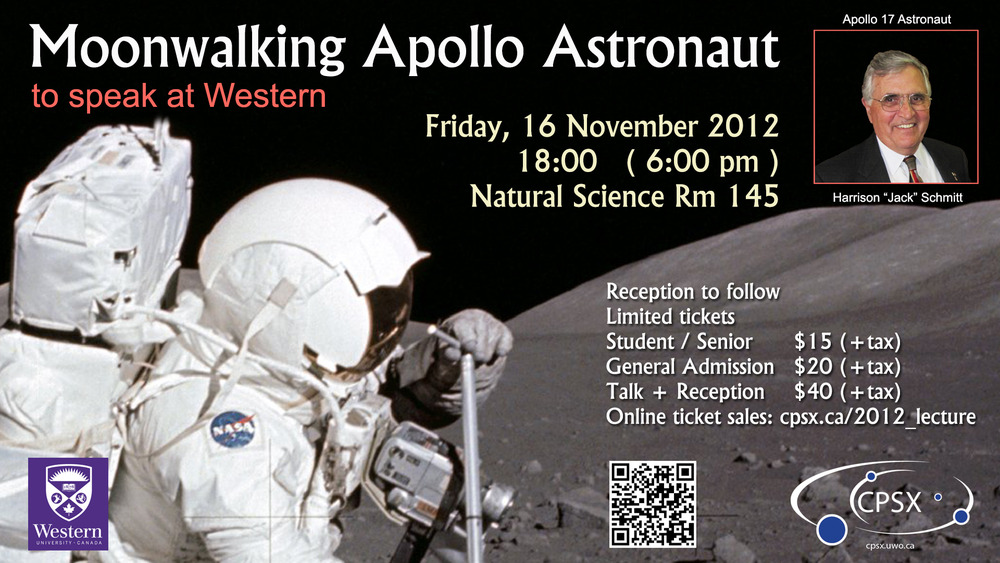
Apollo 17 astronaut Harrison ‘Jack’ Schmitt to present 9th annual Planetary Science Distinguished Public Lecture.


The Centre for Planetary Science & Exploration at Western will be holding our 9th Annual Planetary Science Distinguished Public Lecture on November 16th. This year, we are pleased to announce that Harrison “Jack” Schmitt – the last man to descend to the Moon – will be giving the lecture!


Tickets will be $15 for students/seniors, $20 for regular, and $40 for the talk + reception afterwards. More information can be found at: cpsx.ca/2012_lecture.


MSc Public Lecture – next Wednesday @ 11 – Tahani ALDAHRI

Department of Physics and Astronomy


MSc Public Lecture


Tahani Aldahri

Supervisor: Dr. John de Bruyn


“The behaviour of a falling particle in a funnel”


DATE:                  WEDNESDAY, 31st October 2012

TIME:                   11:00 a.m.

PLACE:               Physics & Astronomy Room 100


All are welcome to attend.

Patrick Whippey spoke to North London Rotary Club

Whippey_rotary_17oct

Professor Emeritus Patrick Whippey spoke to the North London Rotary Club on October 17, 2012.

Patrick spoke of the London and District Science Fair, with which he has been associated for many years.

The Science Fair is an international program that students from grades 4-5 through
to grade 12 can participate in. Science projects on various topics can be submitted by those students who choose to participate.

Winners can work their way through the ranks of city, regional, national and international competitions. Over the years there have been a number of London students who have done extremely well and have continued in the field of science and done very well not only for themselves
but for mankind. The local committee is quite sure that there is something in our water that helps
to produce these great scientific gene pools. This is a totally volunteer program and helpers are needed in many areas. Financing is also done on a fund raising / donation basis.

After his talk, Patrick was presented with a ‘Polio Plus’ award for his contribution.

Physics & Astronomy Colloquium – THURS. 1st November – DR. SAJEEV JOHN, U of T Physics

Poster: http://www.physics.uwo.ca/colloquia/Colloquia%20Notices/2012_2013/JOHN%20Colloquium.pdf


Western University
DEPARTMENT OF PHYSICS AND ASTRONOMY


PHYSICS & ASTRONOMY COLLOQUIUM


Date:               Thursday, 1st November 2012
Time:              1:30 p.m.
Location:        Physics & Astronomy Seminar Room 100

Dr. Sajeev John
Department of Physics
University of Toronto


“Light Trapping and Solar Energy Harvesting in Thin Film Photonic Crystals”


ABSTRACT


Photonic crystals are widely known for their light-trapping capabilities. This is often associated with the occurrence of a photonic band gap or other suppression in the electromagnetic density of states. This enables guiding of light on an optical micro-chip and unprecedented forms of strong-coupling between light and matter. In the past, practical applications of these effects have focused on information technology. More recently, an important opportunity has emerged in the area of energy technology. This arises from light-trapping in the higher bands of a photonic crystal, where the electromagnetic density of states is enhanced rather than suppressed. This enables unprecedented strong absorption of sunlight in a material with weak intrinsic absorption.

We describe designs of 3D photonic crystal silicon-based solar cells that enhance the overall absorption of sunlight using architectures consisting of just 1 micron (equivalent bulk thickness) of silicon. These crystals trap light through a parallel-to-interface negative refraction (PIR) effect and other optical resonances that occur over a broad angular and frequency range. These 3D photonic crystals exhibit an enhanced electromagnetic density of states, consisting of slow group velocity modes, in which the flow of energy is transverse to the depth of a thin film of material. In the case of a modulated nanowire photonic crystal solar cell, it is possible to absorb roughly 75% of all available sunlight in the wavelength range of 400–1100 nm, using one micron of silicon. In the case of conical nano-pore silicon photonic crystal, roughly 85% of all available sunlight is absorbed. The power conversion efficiencies of these one-micron photonic crystals rival those of present-day solar cells using up to 300 microns of silicon. These photonic crystals offer additional opportunities for solar spectral reshaping to rival and possibly surpass the famous Shockley-Queisser power conversion efficiency limit of 33%.

Coffee & snacks will be available.

Planet around one of our nearest stellar neighbours.

Astronomers have discovered a planet with a mass very comparable to the Earth, circling alpha Centauri B, one of our closest stellar neighbours merely 4 light years away! It’s a hot planet close to its parent star, but there’s probably more planets hiding in that system — and who knows, maybe one we’ll find one in the Goldilocks zone!

This finding is yet another indication that small rocky planets must be very common around stars — what would otherwise be the odds of finding one circling our nearest neighbour?


http://www.bbc.co.uk/news/science-environment-19959531

Visit by scientists from The University of Nigeria

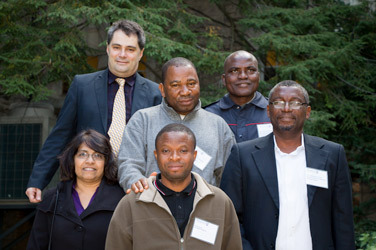
During the week of October 8-12, a group of 4 scientists from the University of Nigeria in Nsukka, Nigeria, paid a visit to Western.

The visitors were Professor Chukwuemeka Okoye (Dean of Science, Department of Physics and Astronomy), Professor Pius Ukoha (Associate Dean of Science, Dept. of Pure and Industrial Chemistry), Dr. Chukwudi Anyanwu (Senior Lecturer, Dept. of Microbiology), and Philip Ayogu (Technologist, Dept. of Chemistry.

They are here to learn about our first year labs in Physics, Chemistry and Biology. They are planning build new first year labs and would like to learn about our lab experiments, new technology we use in teaching laboratories and the building structure. Physics and Astronomy Dept is hosting them. Professor Kanthi Kaluarachchi organized the visit with assistance from Professor Giovanni Fanchini, Shailesh Nene, and Peter Frank also helped. In Chemistry, Jan Mathers, first year Chemistry lab supervisor helped organized tours in the Chemistry department. In Biology, Winona Gadapati, first year Biology lab supervisor helped organized tours in the Biology department.

International collaboration with the University of Nigeria is presently being discussed.

[more photos]