REMINDER: Physics & Astronomy Colloquium – TODAY (21 June) – DR. DUNCAN FORGAN, Royal Observatory

TODAY @ 1:30


Western University
DEPARTMENT OF PHYSICS AND ASTRONOMY

PHYSICS & ASTRONOMY COLLOQUIUM

Date:           Thursday, 21st June 2012
Time:          1:30 p.m.
Location:    Physics & Astronomy Seminar Room 22

Dr. Duncan Forgan
Institute for Astronomy
Royal Observatory, Edinburgh

“Numerical Astrobiology and the Search for ExtraTerrestrial Life”

ABSTRACT

Traditionally, theoretical studies of extraterrestrial intelligence have been founded on simple calculations such as Drake’s Equation. While a useful first step, these approaches do not fully incorporate the statistical richness of the Galaxy’s stellar and planetary populations. I will review my attempts to improve SETI calculations using Monte Carlo Realisation techniques. This allows us to compare hypotheses for the origin of life and intelligence, using mock galaxies as a playing field.

Physics & Astronomy Colloquium – NEXT Wed. (27 June) @ 3pm – Dr. SAMAYA NISSANKE, Caltech

Poster: http://www.physics.uwo.ca/colloquia/Colloquia%20Notices/2011_2012/NISSANKE%20Colloquium.pdf


Western University
PHYSICS & ASTRONOMY COLLOQUIUM


Date:           Wednesday, 27th June 2012
Time:          3:00 p.m.
Location:    Physics & Astronomy Seminar Room 22


Dr. Samaya Nissanke
Astronomy Department
California Institute of Technology (Caltech)


“Seeing and hearing the Violent Universe”


ABSTRACT


The strongest gravitational waves in the universe are expected to arise from violent events such as the mergers of neutron star or black hole binaries. Decades of theoretical and experimental efforts could result in the first direct detection of gravitational waves. Subsequent measurements should offer us an unprecedented view of strong-field gravity in action. A subset of neutron star binary mergers could be associated with a transient electromagnetic (EM) counterpart, and EM follow-up using radio, optical and high-energy facilities of these events are critical for improving our understanding of the physics underlying strong-field gravity astrophysics, and compact objects. I will outline the challenges that lie ahead in pinpointing the sky location of neutron star binary mergers using worldwide networks of gravitational-wave interferometers and electromagnetic synoptic wide-field surveys.

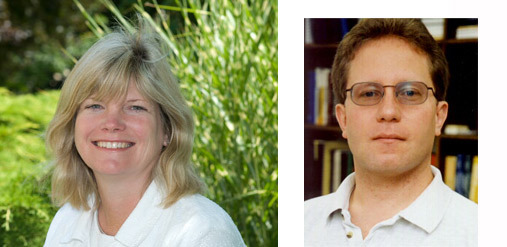
Carol Jones and Jeff Hutter appointed as Associate Deans, Faculty of Science.

Dr. Carol Jones (left) is new Associate Dean of Graduate and Postdoctoral Studies in the Faculty of Science.

Dr. Jeff Hutter (at right) is new Associate Dean Academic, in the Faculty of Science.

Dean of Science Charmaine Dean describes the two as follows;

“Carol Jones  is an Associate Professor in the Department of Physics and Astronomy and has held the inaugural position of Assistant Dean, Diversity and Outreach for the Faculty of Science since 2009. During this time Dr. Jones has developed initiatives designed to enhance the working environment here and to strengthen the image of Western through outreach activities and efforts related to diversity on campus.

Her area of expertise is in theoretical Astrophysics, specifically on disks surrounding massive stars. Massive stars affect their surroundings by providing energy via their radiation fields, stellar winds, and by supernova explosions. They also supply heavy elements, the building blocks of planetary systems. Her research focuses on constructing computer models of disk-like material surrounding massive stars, and comparing the results to observations from world-class observatories. She has developed an extensive list of international collaborators and has built a very active and productive research group in the Department of Physics and Astronomy. Dr. Jones has established a reputation as an excellent, award-winning teacher. She is extremely effective in the classroom and has served as an inspiration and mentor to many students.
Dr. Jones looks forward to bringing her administrative experience, her skills as a consensus-builder, and her expertise and passion for training to the role of Associate Dean, Graduate and Post-Doctoral Studies for the Faculty of Science.

Jeff Hutter is an experimental condensed-matter physicist with an interest in processes and properties at the nanoscale. He received his BSc and MSc in physics from the University of British Columbia, followed by a PhD from Simon Fraser University in 1997. Jeff joined the Department of Physics and Astronomy at Western in 1999 after completing a postdoctoral term at the Exxon Research and Engineering Company. He has been an Associate Professor since 2006 and Associate Chair for Undergraduate Studies since 2008.

Prof. Hutter’s current research projects include: in situ studies of the crystallization of calcium oxalate (the main mineral component of kidney stones), and the inhibition of such crystallization by specific proteins and peptides, using the atomic-force microscope (AFM); measurements of the strength of nanofibres such as spider-mite silk using the AFM; and studies of the viscoelastic properties of hydrogels using light scattering and small-angle neutron scattering.
In his term as Associate Dean, Academic, Prof. Hutter looks forward to working with the member departments of the Faculty of Science to facilitate new programs and initiatives that will increase our profile as a destination of choice for students in the basic sciences.”

REMINDER: Physics & Astronomy Colloquium – TODAY (20th June) – DR. B.G. SIDHARTH, B.M. Birla Science Centre

TODAY @ 2:30


Western University
DEPARTMENT OF PHYSICS AND ASTRONOMY

PHYSICS & ASTRONOMY COLLOQUIUM

Date:           Wednesday, 20th June 2012
Time:          2:30 p.m.
Location:       Physics & Astronomy Seminar Room 22

Dr. B. G. Sidharth
B. M. Birla Science Centre
Director, International Institute for Applicable Mathematics & Information Sciences
Hyderabad, INDIA

“A model for the cosmological constant (dark energy)”

ABSTRACT

A dark energy driven expanding universe with a small acceleration was theoretically predicted in 1997 and observed in 1998 and then reconfirmed. This went against the then prevailing view of a decelerating dark energy dominated universe. But the exact characterization of dark energy has remained elusive. Several models have been constructed for it. We discuss one such model based on the neutrino background which gives the correct order of the cosmological constant.

Physics & Astronomy Colloquium – Next Friday, 29 June – DR. GAUTIER MATHYS, ALMA-ESO Observatory

Poster: http://www.physics.uwo.ca/colloquia/Colloquia%20Notices/2011_2012/MATHYS%20Colloquium.pdf


Western University
DEPARTMENT OF PHYSICS AND ASTRONOMY


PHYSICS & ASTRONOMY COLLOQUIUM


Date:           Friday, 29th June 2012
Time:          1:30 p.m.
Location:    Physics & Astronomy Seminar Room 22


Dr. Gautier Mathys
Joint ALMA Observatory
& European Southern Observatory, CHILE


“Rotation, Magnetism, Binarity, and Chemical Peculiarities in A-type Stars”


ABSTRACT


In recent years, growing evidence has been collected for the existence of a number of dependences between rotation rate, magnetic field strength and structure, and binary orbital properties, of magnetic chemically peculiar stars of spectral type A (Ap stars). One of the most recent and intriguing results suggests the existence of a connection between rotation and orbital periods in Ap binaries. I shall discuss the nature of this connection and its potential implications for the origin of the magnetic fields of Ap stars.

Physics & Astronomy Colloquium – THIS THURS., 21 June – DR. DUNCAN FORGAN, Royal Observatory, Edinburgh

Poster: http://www.physics.uwo.ca/colloquia/Colloquia%20Notices/2011_2012/FORGAN%20Colloquium.pdf


Western University
DEPARTMENT OF PHYSICS AND ASTRONOMY


PHYSICS & ASTRONOMY COLLOQUIUM


Date:           Thursday, 21st June 2012
Time:          1:30 p.m.
Location:    Physics & Astronomy Seminar Room 22


Dr. Duncan Forgan
Institute for Astronomy
Royal Observatory, Edinburgh


“Numerical Astrobiology and the Search for ExtraTerrestrial Life”


ABSTRACT


Traditionally, theoretical studies of extraterrestrial intelligence have been founded on simple calculations such as Drake’s Equation. While a useful first step, these approaches do not fully incorporate the statistical richness of the Galaxy’s stellar and planetary populations. I will review my attempts to improve SETI calculations using Monte Carlo Realisation techniques. This allows us to compare hypotheses for the origin of life and intelligence, using mock galaxies as a playing field.

fold proteins on your computer; make someone else famous

You have probably heard about “citizen science” distributed computing projects, in which you can run a program on your computer that produces data that is used for real scientific investigations. Folding@home is another such project. You can download a program that computes configurations of protein molecules. The information your computer generates will help the investigators (who are from Stanford Unibersity) understand the process of protein folding. Here’s their web site: http://folding.stanford.edu/English/HomePage

Report from the CAP congress in Calgary

The annual congress of the Canadian Association of Physicists was held last week in Calgary. This is Canada’s biggest and most important national physics conference. The Canadian physics community is small and quite diverse, so it’s not the most important conference of the year from a scientific perspective, but I find it extremely useful politically and socially, and I always learn something there. In fact, because of the diversity of talks at the meeting, it’s an opportunity to attend some good talks on subjects outside of my own field.

This year’s meeting was attended by 619 people. That’s not as much as in Toronto two years ago, but it’s pretty good overall. Our department was represented by faculty members Giovanni Fanchini and me, grad students Tahani Aldahri, Arash Akbari-Sharbaf, Eric Barbagiovanni, and Sergey Dedyulin, and undergrad but soon-to-be grad student Masha Goiko. (If I missed you, I apologize! Please let me know and I’ll edit this post to include you!) There were, I think, a lot of students there. I attended the final session of the conference where the prizes for the student talks were decided, and heard 8 excellent presentations on subjects ranging from the tracking of ionized blobs in the ionosphere to the characterization of the plexiglass used in a planned dark-matter detector.

There were excellent plenary talks on the Alpha experiment to trap anti-hydrogen atoms at CERN and on using nanotechnology for biophysical experiments – in both cases, both the physics and the technical skill involved in doing the experiments were amazing. The winners of the various CAP medals all gave talks. Included among these were two of the best talks about quantum field theory and string theory that I have ever heard. It appears that superstring theory is now making predictions of new, measureable phenomena. If these predictions are borne out, I might start to believe that superstrings are more than just fancy math and actually have something to do with explaining reality.  There was a public talk in the Red and White room at McMahon Stadium (where the Calgary Stampeders  play) about quantum computing. In my opinion (and my wife’s), this talk was less accessible to the public than it should have been, and I remain unconvinced about the prospects of quantum computers to change the world. I also attended sessions on physics education, magnetism, soft matter and surfaces, graphene, Monte Carlo techniques, and others that have already faded from my memory.  The poster session on Tuesday evening was extremely well attended and I had good conversations with many people about my poster (co-authored with Alyssa Gilbert) about Canadian publications (or rather, the relative absence of Canadian publications) in the field of physics education. My voice was hoarse and my feet were sore by the end of the evening.

On the science policy front, we had extensive and constructive discussions with Samir Boughaba, the NSERC staffer in charge of physics and astronomy. One topic discussed in detail was the RTI program.  I learned that the decision to cancel RTI and MRS was more complex than I had thought, with part of the cause being a federal decision to disallow the re-targeting of unspent year-end money. Since RTI has always been funded by exactly these funds, NSERC was more or less stuck. I can tell you, however, that NSERC has heard loud and clear that the community views RTI as extremely important, and they are trying to find a way to keep some form of the RTI program operating for the next few years, albeit with a smaller budget, until they can find a way to fund it properly. That is very positive news. CAP decided to commission a bibliometric study of Canadian physics (see my post a few months ago about bibliometrics) in preparation for the upcoming NSERC reallocation process.  Ted Hsu, MP for Kingston and the Islands, who has a PhD in physics and is the Liberal science critic, spoke to us by Skype after the conference banquet Thursday evening about his life as a politician.  CAP remains active in lobbying Parliament Hill on matters relating to science and research, and I think that their message is getting through – the facts that NSERC’s budget was cut by only 1.7% while other government departments were cut by an average of 7%, and that “basic research” was mentioned explicitly in the budget speech have to be taken as strong indicators that there is some recognition by the government of the importance of research to the country.

I am now on the CAP executive as Director for Full Members, as well as being the CAP Councilor for Southwestern Ontario. If you have any gripes, or want more information about anything to do with CAP, feel free to let me know. Meanwhile:

–          If you are a CAP member and have not yet filled out their survey about NSERC funding, please do so as soon as possible. The survey will remain open until the end of June.

If you are not a member of CAP, please join. Given the CAP’s role in promoting our discipline to government decision makers, I can’t see that you have any excuse not to be a member. Undergrads can join for free, and grad students get a year’s membership at no cost. And for my astronomy colleagues, bear in mind that you can get a joint membership in CAP and CASCA at a special discounted rate.