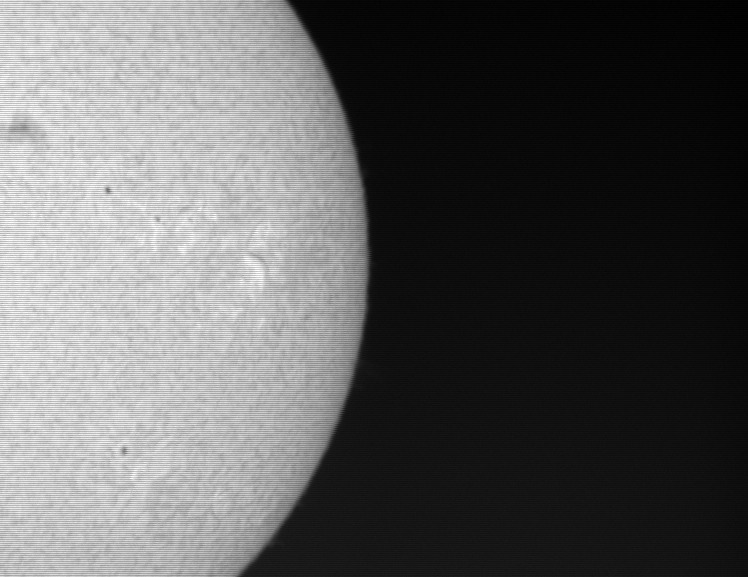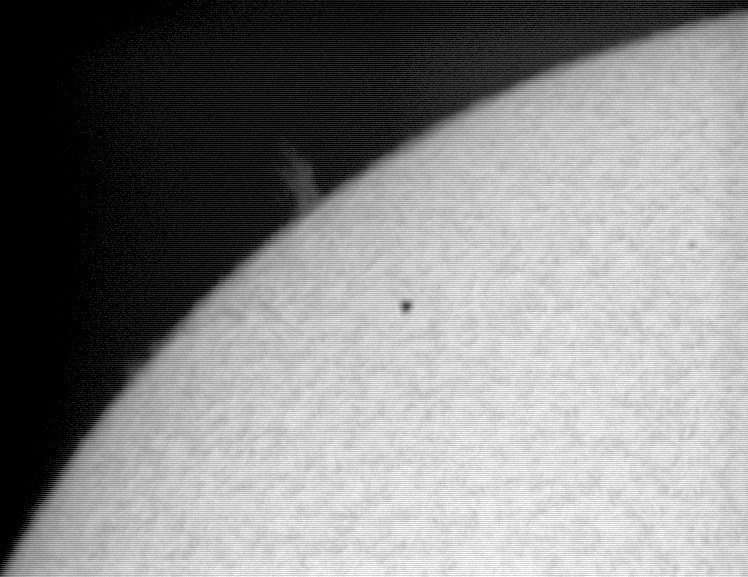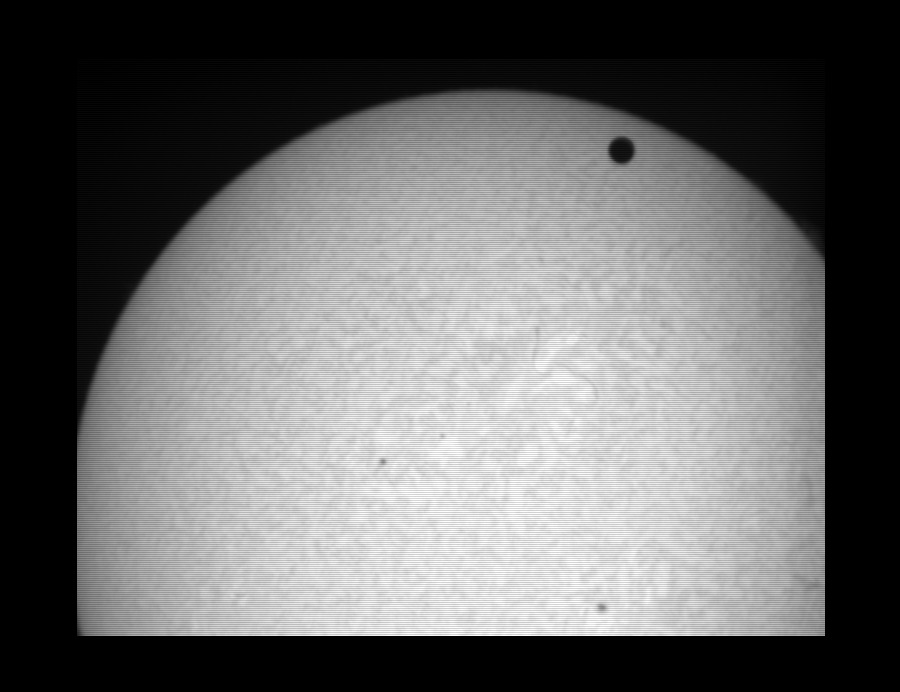
Think about it: the big whitish ball is about 3 times further away than the little black dot. Gosh, that Sun must be a massive ball of gas, and our fair planet must be small and almost insignificant.
And then, two things happened that in my mind occurred instantaneously and simultaneously. Suddenly, all the clouds were gone, and suddenly, there was a crowd. And let me tell you: I’d rather have a crowd than a cloud in these circumstances.
The clouds stayed away for the rest of the day (contrary to the forecast), and through the different telescopes or with the eclipse glasses (courtesy of the Dunlap Institute), the views were spectacular. Venus looked great through the Solar telescope with a prominence near the solar limb; and one of the most impressive sights for me was through our 8 inch Schmidt-Cassegrain telescope manned by Bob Duff (I didn’t manage to look through all telescopes). When I looked, that setup offered the best illusion of depth that I’ve seen all day, maybe aided by the level of detail seen in the sunspots! If you take the time (in your mind) to put the Sun more than three times further away than the little dot Venus, you realize how much smaller planets are than the Sun… humbling!
And yes, there certainly was a crowd. We had 1,000 eclipse glasses to distribute, but they were all gone *before* second contact, by about 6:15pm. There were many more people showing up after that, so we must have had somewhere between 2,000 and 3,000 visitors. That’s *WAY* more than I had hoped for, and I cannot thank our friends from the RASC enough to show up in such numbers. We certainly could not have handled such a crowd alone — it’s a great example of collaboration!
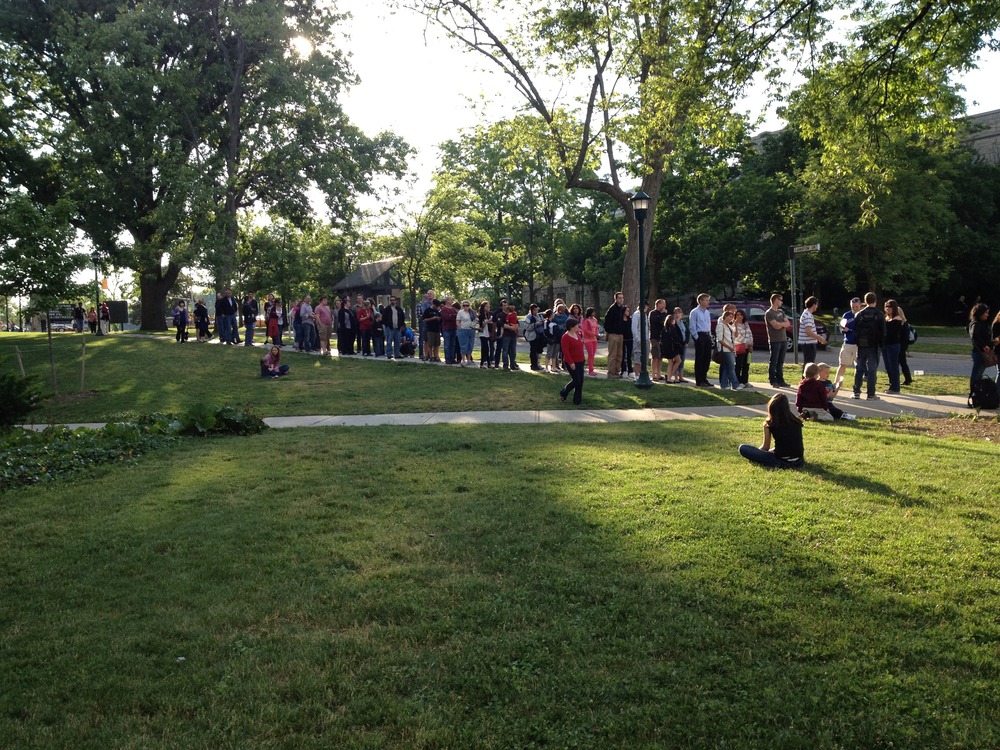
Similar scenarios of crowd overload were unfolding at the Cronyn observatory. I thought I had seen people in a long, neverending line when our Astronomy 1021 projects were going into their last week. I was wrong. Judge for yourself; I have never seen something like this at Cronyn (picture taken facing away from the observatory, looking in the direction of Western road; if you’re not familiar with Western you should know that what you’re seeing here is only a very small part of the actual line. The people in the picture here would probably have to wait in line for about 2 hours to get to the telescope….).
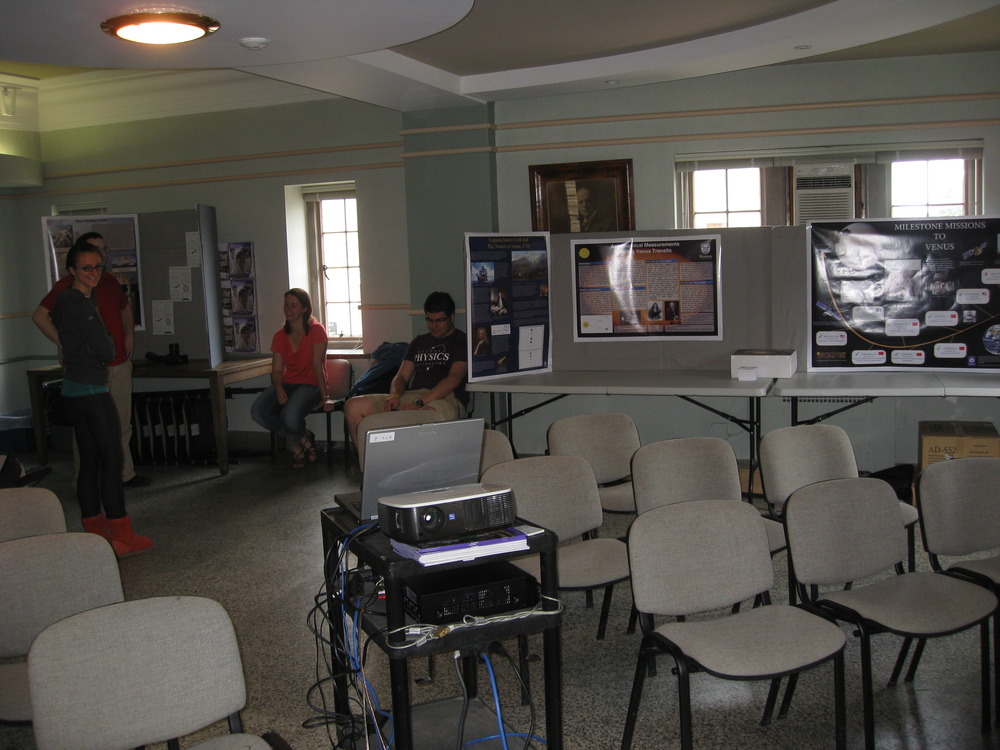
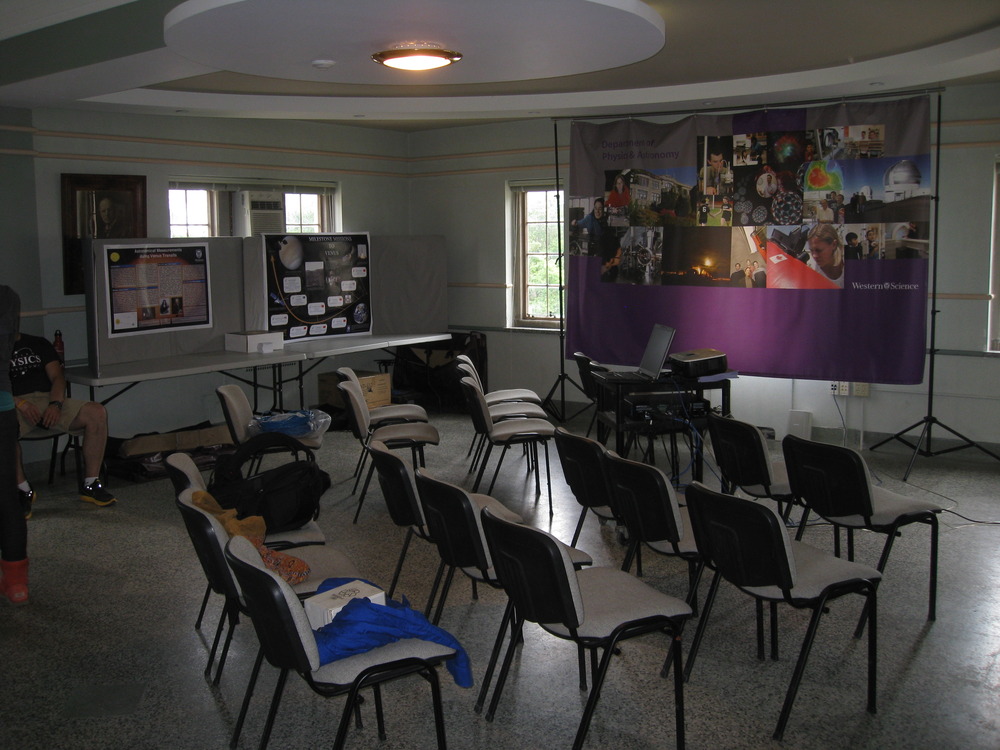
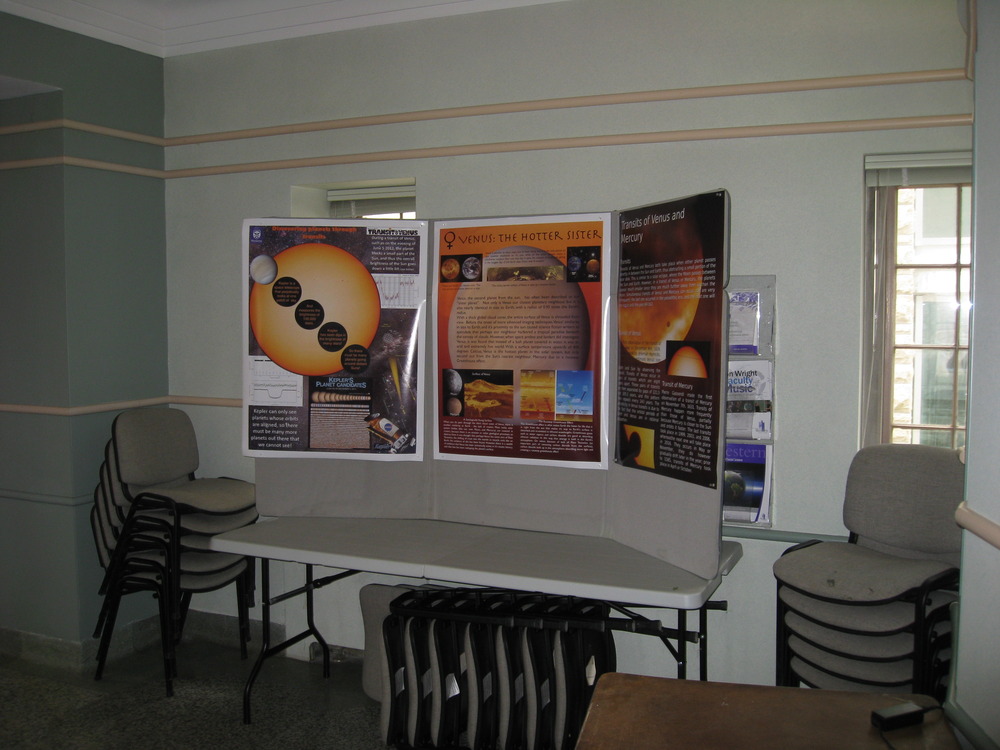
At Cronyn, we had a live feed of the event from Hawaii in the conference room as well as in the dome upstairs, and we also had a small exhibit with 8 custom-made posters about Venus, transits or related topics made especially for the event, many made by students. A nice addition was a poster from my colleague Kelly Olson from the classics department about Venus and Aphrodite in the classic culture, with some augmented reality (several Venus statues).
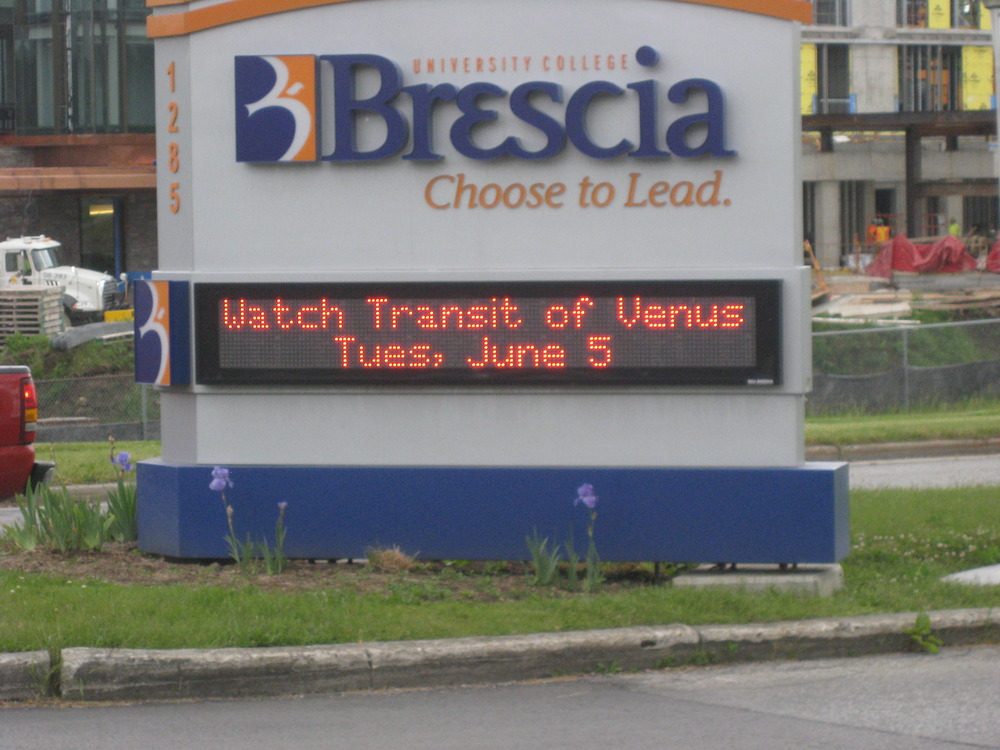
If we had a crowd, it may have been partly due to some advertising. In addition to newspaper, radio, TV and the interweb, we catered to our 4-wheeled friends on the road. Whoever had to stop for a red light, couldn’t avoid it:
So I think this was a great success, beyond any expectation. As humbled as I am by the cosmic alignment and sense of scale, it was the crowds and the fact that our team could accomodate them that just blew my mind.
Let it be clear that many people made this event the success it was, and I want to thank each and every one of them for representing the Department of Physics and Astronomy in such a brilliant way, and for creating an unforgettable memory. I would like to especially express my sincere gratitude, appreciation and admiration though to Henry Leparskas. For this event, he was my right hand, left hand, both feet and my brain at the same time. I guess that only my belly was still fully my own (although Phin is responsible for part of that as well). Henry had a hand in pretty much everything — web site, all posters, buttons, cards, signage, ads, telescopes, …. — and his experience was invaluable. He was on site at 7am, and left Cronyn near 11pm. So thanks Henry — you made this work from the beginning to the end!
As I said, this was a team effort, and all of the players were necessary for success. So a big big thanks also to: Phin Perquin, Peter Frank, Brian Dalrymple, Nelia Andrade Lo Russo, Clara Buma and Jodi Gutrhie; Kelly Olson, Sarah Gallagher, Els Peeters, Pauline Barmby, Allison Hill, Dilini Subasinghe, Farhang Jalilian, Annemarie Pickersgill, Patrick Cookson, Gabe Keenleyside, Sarah Dawson, Laura Lenkic, Robin Wing, Alexander DeSouza, Alyssa Gilbert, Raymond Francis, Tyler August, Michael Bramble and others from the Centre for Planetary Science and Exploration (CPSX); Bob Duff, Peter Jedicke, Rick Saunders and others from the Royal Astronomical Society of Canada (RASC). And my apologies to anybody I would have forgotten here — I am not less grateful to you, but fatigue may be demanding its toll. And of course, thanks to all those that showed up and made it a success!
Finally, if you want to see the best of the best when it comes to movies of this transit, here they are: from the Solar Dynamics Observatory. This is just…. i don’t know, awesome suddenly seems like such a common word….(play all movies!!! really!!)
http://venustransit.gsfc.nasa.gov/
I was thinking about how to properly end a day of this magnitude, and wasn’t sure whether there was a proper end. Fortunately, in my basement, I found Maredsous Tripel. Another reason to be grateful!