
Monthly Archives: January 2012
Physics & Astronomy Building Atrium Project
The Science Students’ Council has a ‘Legacy Fund’which they want to use to fund a project “that will have a lasting benefit to students on campus.”They are already working on a project that will enhance the new atrium in B&G, and have asked us if we are interested in something similar for the PAB atrium. The money involved could be several tens of thousands of dollars, so not insubstantial.
Ideas that have been floated already include some kind of small Planetarium, or Science on a Sphere (see http://sos.noaa.gov/). But we need more ideas, from you (rumour has it that the B&G plan involves a dinosaur – so we have to figure out how to top that!)
Please send your ideas to me, and I’ll work with the Outreach Committee to sort through them and follow-up. If we could get your ideas within the next 3 weeks or so (before Friday, 10th February), that would be great.
Thanks!
Pauline Barmby
Department of Physics & Astronomy
University of Western Ontario
1151 Richmond St.
London, ON N6A 3K7, CANADA
Voice: (519) 661-2111 x81557 Fax: (519) 661-2033
Jobs for physicists
A while back Shantanu posted a link to an article on the question of whether our universities are producing too many PhDs. I don’t have a yes or no answer to that question, but I have some rambling thoughts on the subject. Bear with me, the punch line is way down at the end.
I was a undergrad in the late 70s and a grad student for most of the 80s. (I’m not that one guy who skews all the statistics on graduate degree completion times, but I took a while. That’s another story, though.) I wanted to be a university professor, and for most of that time, university jobs for physicists were very tight. Most universities expanded a lot in the early 70s, then didn’t hire anyone for a long time. Industry jobs got harder to find, too. When I was an undergrad, my profs told me, “Don’t worry, when you finish your PhD in five years the job market will really open up.” When I was an MSc student, they said, “Don’t worry, in five years the job market will really open up.” When I was a PhD student, they said “Don’t worry, in five years the job market will really open up.” What I learned from this is that Physics profs don’t know very much about job markets, or about economics in general. Nonetheless I was fortunate to get a faculty position in 1989, after a short postdoc in the States. There were six faculty positions in physics advertised in Canada that year. If I remember correctly, two of them were 3-year positions and the other four were tenure-track. I know three of the other people who got hired that year, and I have to say that I am in good company.
In the early 90s, students figured out that jobs for physicists were hard to find. Enrollment in university physics programs all across the continent started to drop, and kept dropping for all of the 90s. I don’t have the figures for Canada, but in 1999 the number of BSc and PhD degrees in physics hit a minimum. I think around this time UWO’s honors physics class had all of two students. In the meanwhile, though, something really did change in the job market. In the early 90s things started to pick up. Not just in the universities – industry started to hire more physicists, too. Opto-electronics, semiconductors, and “high-tech” in general exploded. Investment banks discovered that the problem solving, math, and computer skills that physicists knew were useful in the world of finance, and hired a significant number of physicists at salaries on the order of $300,000 per year. As the world’s economy became more and more computer-based, information based, knowledge-based, whatever you want to call it, people like physicists who were good at dealing with computers, and information, and knowledge became more in demand.
So, eventually students figured out that there actually were jobs for physicists out there. Through the 00s, physics enrollments steadily went back up. In 2010, the number of BSc and PhD degrees awarded in the States was the highest it’s ever been! Again the numbers for Canada are harder to find, but the trends here have been the same, and Western’s honors class has been in the high teens to low 20s for the last few years.
The point is this: If there are physics jobs available, students will take physics. If there are not, they won’t. There tends to be a bit of a time lag between employment conditions and enrollments, so the system is not perfect (actually this kind of feedback system can be mathematically unstable, but again that’s another story) but it is more-or-less self-regulating.
In recent years, both the federal and provincial governments have decided that Canada needs more “highly qualified personnel” to support the “new knowledge-based economy” … blah blah blah. To help meet this need, the governments have dangled money in front of the universities, rewarding them for increasing their graduate enrollments. Of course the universities love this, because they get more money, and more students, and more research papers, and more degrees, and more alumni who when they are rich will give more money to the universities…. But do programs like this really help the economy? What is the effect of these programs on the more-or-less self-regulation of enrollments that I mentioned above? Most importantly, will all of the “extra” grad students were are training find jobs when they graduate?
I said that physics profs aren’t very good at economics, and that applies to me, too. I can’t answer my own questions. I assume that somebody, somewhere, thought about these questions before the governments decided that we needed more scientifically-trained people, but I’ve never heard the answers.
I will end on an optimistic note. According to the American Institute of Physics, the unemployment rate among newly-minted PhD physicists has never been more than about 6% for as long as they have been keeping statistics. It’s typically around 2%. Their graph is quite interesting; you can see it here: http://www.aip.org/statistics/trends/highlite/emp3/figure1a.htm
You can track the strength of the economy by following the curves for “Potentially Permanent Position” and “Postdoc.” Their graph shows a small hump in unemployment in the 90s that peaks at 6% in 1993, but since then unemployment has been lower. Here the message is simply that essentially all PhD physicists have been able to get jobs when they graduate, even when there were supposedly no jobs for physicists out there! I don’t understand economics, but I do understand this: the bottom line is that the skills that physicists have are useful, so people hire them. I am hopeful that this will continue even as the supply of physicists increases.
Supernova in a jar
My brother-in-law (and collaborator) Stephen Morris is a prof in the Physics Department at U of T. He and his student Mike Rogers studied a particular auto-catalytic chemical reaction that produces buoyant plumes. The interplay between the chemistry and the fluid flow leads to interesting dynamics, which you can read about here:
http://focus.aps.org/story/v26/st23
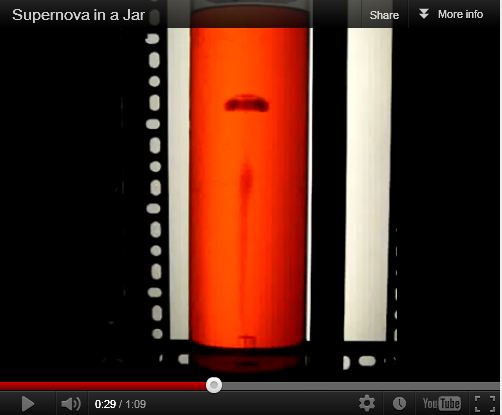
But there is an interesting side story. When Stephen was writing this paper a year ago, he discovered that one of his earlier papers on the subject had been cited in a paper about supernovae. It turns out that you get buoyant plumes at the beginning of Type IA supernovae, too, except that the reactions involved are nuclear, not chemical, and the whole thing is over in microseconds rather than hours. So, Stephen put a line in his paper to the effect that their chemical plumes might serve as a laboratory analog for the plumes involved in the detonation of Type IA supernovae. Apparently science writers troll through the arXive preprint site looking for cool stuff to write about. Some of them came across Stephen’s paper and went wild. He is now famous for having created a “supernova in a jar.” Here’s a video:
[youtube http://www.youtube.com/watch?v=7tedVybfxSI?wmode=transparent]
U.S. legislation on the internet
Lots in the news today about proposed US legislation that would seriously affect the way the internet works. Me, I’m all for freedom and openness. If you want to know more about this, have a look at this link (thanks, Bob!)
http://blog.reddit.com/2012/01/technical-examination-of-sopa-and.html
Limer(phys)ics #2 – Re-Schroded
Thanks to everyone who read my attempt to unify the greatest branch of science with the lowest branch of poetry last month. Professor Barmby issued a stern challenge (thanks also to Henry Leparskas for his stellar response!) to find something that rhymes with ‘Schrodinger’. First, let me pay tribute to the equation that made Mr Schrodinger famous…
Its physics is explicit in a manner so exquisite,
when you quiz it
seems illicit,
so re-visit, don’t dismiss it!
Now here are some more limericks!
Erwin Schrodinger,
The quantum woe bringer,
Was at a logical dysjunction,
Curiosity that,
Did away with his cat?
Or was it that pesky wave function?
Alone with a cat-box Bohr sat,
To test Schrody’s cool idea that,
“I’ve poked air holes” Neils said,
“He’ll be living OR dead…
…well…
…unless I poked holes in the cat…”
(This next one is my uncle Eric’s, I get no credit!)
A horseshoe Neils Bohr had just bought,
His brain, his friends claimed, came to naught,
He said “Don’t be jerks,
I’ve heard that it works
If indeed, you believe it or not!”
(This one’s not mine either)
A dying mosquito exclaimed,
“A chemist has poisoned my brain!”
The cause of his sorrow
Was para-dichloro
Diphenyl-trichloroethane.
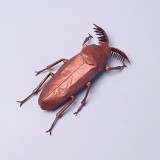
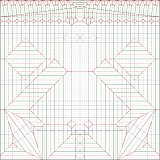
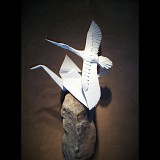
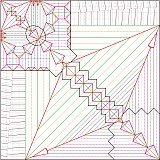
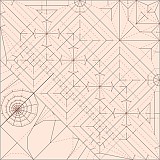
Limericks aside though, I wanted to write a few sentences about a compelling Ted Talk that got me interested in origami. Robert Lang is a retired astrophysicist who gave up his job to pursue a career in origami folding. He set his math background to work with a concept called Circle Packing to tackle the problem of generating two dimensional blueprints, or ‘folding patterns’, corresponding to any conceivable three dimensional object, such that, if the folds were performed in the correct order, you could make any object out of a single sheet of paper without cutting, gluing, etc. The idea of circle packing describes the representation of a 3D figure as a unique pattern of circles on a 2D plane. Then you connect the circles with lines, and if you fold along these lines, you get the object! Obviously easier said than done 🙂 but Robert Lang wrote a computer program that generates these blueprints based on stick figures input into the program. Here’s the link to his Ted Talk if you’re interested: http://blog.ted.com/2008/07/31/idea_square_ori/ and I’ve attached pictures of a few of his creations, with their corresponding folding patterns. Thanks again to everyone who has a chance to read my posts, and I really appreciate the comments!
Gabe

What’s lies ahead for Physics in 2012?
Anticipating 2012 will be a very good year for news that we can share with our non-physics friends and colleagues.
Mapping the dark matter distribution in galaxies
Just back from annual AAS winter meeting, held in Austin, Texas this year. A great place to connect with friends and colleagues, if you can find them amongst ~ 3000 people! Here is an article on one of the interesting press releases at the meeting.
http://earthsky.org/space/mapping-dark-matter-from-ripples-of-passing-satellites
Scientists Discover a Saturn-like Ring System Eclipsing a Sun-like Star!!
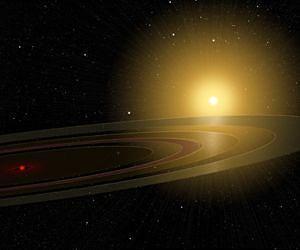
In near future, Saturn won’t be the only planet with rings that we will admire. Scientists discover ring system in a near by Centaurus constellation
Here is an interesting article about the discovery of this system!
How I spent my year’s leave, part 2
While I was in Brazil this fall, I visited Raimundo Costa Filho at the University of Ceara in Fortaleza. Raimundo was a prof at Western for a couple of years. Fortaleza is only three degrees south of the equator, and the weather there is the same all year round: sunny, temperature in the low to mid 30s, with a nice breeze blowing off the ocean to keep things from getting too hot. Lovely! And the beaches around Fortaleza are absolutely spectacular.

While he was at Western, Raimundo and I talked about some work I was doing with my PhD student Simon de Vet on the formation of impact craters in granular materials. Since then, Raimundo and one of his former students have been working on numerical simulations of the impact process. I’m looking forward to seeing their paper.
I gave a talk about our crater work in Fortaleza. The experiments Simon did are quite simple – he dropped a ball into a bucket of tiny glass beads, and looked at the crater that results. Our granular craters look just like craters on the moon: Small ones are smooth bowls with a raised rim, and bigger ones have a peak in the middle. Simon and I were interested in the extent to which the process we were studying really mimicked the formation of craters by a meteor impact. The energy scale in our case was some 20 orders of magnitude smaller, and many of the details were dramatically different, but nonetheless the end product was very similar. There were also some theoretical reasons to think that our experiments really did have something to say about “real” impact craters. Simon’s work focused on the granular flows that took place after the impact. We think that the fluid dynamics is essentially the same as it is in a meteor impact, and that’s why the shape and morphology of the craters is the same. On the other hand, Simon found that the (appropriately scaled) energetics of the crater-formation process were quite different in the two cases. In big lunar craters, essentially all of the kinetic energy of the projectile is used to excavate the crater, while in our granular impacts it’s about 0.1%. Where does all the energy go in the granular case? Friction, and inelastic collisions between the grains. I spent part of my time in Brazil writing a paper about some of Simon’s work.
I won’t write about Brazil any more, becasue next month we are going to Hong Kong.