Mars, Ice, Water, Life . . . Ethical Dilemma?

In the past few years, discoveries of ice on Mars, and evidence appearing to show proof of liquid water on the planet, have raised the serious possibility of Martian (microbial) life, either now or sometime in the past. Then a little less than two weeks ago, NASA’s Curiosity rover successfully launched. Its primary goal is to dig up more evidence that suggests life, or the holy grail – evidence of life itself.

All of this raises a whole host of other issues, including, and importantly, ethical ones. If life is found on the red planet, what should we do about it? Are we obligated to abandon exploration or give up on an idea of expanding to Mars, to let it follow its own path? After all, humanity’s track record when it comes to colonizing new worlds is not impressive, so do we get the right to more? And what sort of interference with the evolutionary process (if any) might be acceptable? On Earth we experiment on single-celled life all the time. We encourage our children to do so. Would it make a difference – should it make a difference – if the life we’re looking at came from somewhere else? And if the answer’s yes, doesn’t that imply something about how we define life in the first place?

Just a few questions without answers. At the moment they’re fairly trivial, but if Curiosity finds something, or when, eventually, something somewhere is found, they’re going to be very important. Looking forward to that day.
World’s Lightest Material

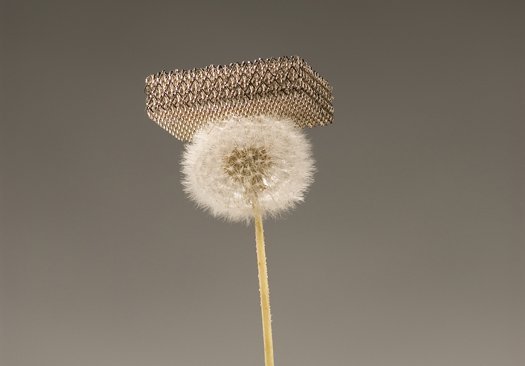
Last month, a team of scientists from HRL Laboratories, University of California Irvine, and The California Institute of Technology announced the development of microlattice, apparently the lightest material ever. 99.99% of the material’s volume is open, giving the lattice of hollow tubes a density about one hundred times less than Styrofoam’s. It’s also extraordinarily resistant to compression and can absorb much greater energy than most metals. Each tube wall in the lattice is roughly 100 nanometers thick, or about 1000 times thinner than the width of a human hair.

Check it out:

http://www.gizmag.com/ultralight-micro-lattice-material/20537/

Or read the abstract from November’s Science:

http://www.sciencemag.org/content/334/6058/962


(Image credit: Dan Little, HRL Laboratories)

Voyager 1 hits the doldrums!

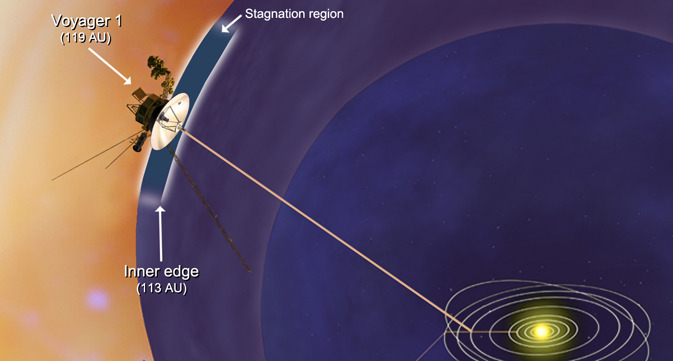
NASA’s Voyager 1 probe has entered a new region of space. What’s being called the ‘stagnation zone’ is a region in the outermost layer of the solar system, just on the edge of interstellar space. Launched in 1977 and expected to run out of fuel by 2020, the longest-running deep space probe (with its twin Voyager 2) is expected to make it out of our solar system ‘bubble’ in a few months to years.

Here’s an artist’s interpretation of Voyager’s position and the relevant NASA news release.

http://www.jpl.nasa.gov/news/news.cfm?release=2011-372

MRI talk on Dec 7, 5:30 pm

The following talk tomorrow Dec 7 should be an interesting talk for anyone — newbies and pros alike — interested in magnetic resonance imaging:


BIRC SEMINAR SERIES:
Dr. Alex MacKay, Magnetic Resonance Relaxation in Brain
Wed, Dec 7th 2011; 5:30-7:00pm; Auditorium A, LHSC


A detailed site map of the London Health Sciences Centre — University Hospital can be found here: http://www.lhsc.on.ca/About_Us/LHSC/Maps_Directions/UH_Map.htm
Auditorium A is on the third floor in Zone B.


Seminar Poster_MacKay.pdf
Download this file

Curling anyone?

I’m sitting here watching the Canada-One Canada Cup of curling (in case you’ve never heard of this, it’s a major curling competition (we call them bonspiels generally), and the winner automatically gets into the 2014 olympic curling trials for Canada). Makes me wonder: hey, how many people in physics and astronomy curl? Have many/any of us curled regularly? Do we actually have “curlers” in our midst?

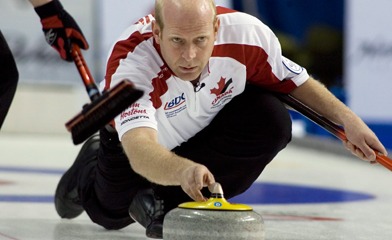
Picured above: Kevin Martin, universal god of curling.

Actually, I know at least part of the answer to this: yes, we do have curlers in our midst. I curl regularly in a local men’s league. Tim Scholl curls on my team. One of Western’s Vanier Scholarship winners (Matt Quinn, recent graduate from our undergraduate program and current MD-PhD student at Western over in imaging at Robarts) curls (he spares for my team whenever I need him!). I know Mike Cottam curls every week, as does Pauline Barmby. Brian Dalrymple also curls.

Who else? If you have ever curled, comment to this post. If you would call yourself a “curler”, let us know! And by the way, in case you’ve never curled before, you need to know that Kevin Martin (pictured above) is the best curler that has ever lived. Take it to the bank!

I’ll restrain from putting in a link here to an academic article on the physics of curling (I assure you, there exist)…