
http://www.nasa.gov/home/hqnews/2011/dec/HQ_11-403_Mars_Rover_Gypsum.html
Category Archives: Physics and Astronomy at Western What’s Happening
Opinions, news, and events for the Department of Physics and Astronomy at Western University.
Graphene for the Real World
Last year’s Nobel Prize in Physics went to a pair of researchers working on graphene. The remarkable two-dimensional material was noted for its impressive conductivity and strength. At the time, however, no one knew how to make it practical. Now a team in China have managed to turn nanometre-sized flakes of graphene oxide into long fibres, which can be used in a variety of applications.
Mars, Ice, Water, Life . . . Ethical Dilemma?
In the past few years, discoveries of ice on Mars, and evidence appearing to show proof of liquid water on the planet, have raised the serious possibility of Martian (microbial) life, either now or sometime in the past. Then a little less than two weeks ago, NASA’s Curiosity rover successfully launched. Its primary goal is to dig up more evidence that suggests life, or the holy grail – evidence of life itself.
All of this raises a whole host of other issues, including, and importantly, ethical ones. If life is found on the red planet, what should we do about it? Are we obligated to abandon exploration or give up on an idea of expanding to Mars, to let it follow its own path? After all, humanity’s track record when it comes to colonizing new worlds is not impressive, so do we get the right to more? And what sort of interference with the evolutionary process (if any) might be acceptable? On Earth we experiment on single-celled life all the time. We encourage our children to do so. Would it make a difference – should it make a difference – if the life we’re looking at came from somewhere else? And if the answer’s yes, doesn’t that imply something about how we define life in the first place?
Just a few questions without answers. At the moment they’re fairly trivial, but if Curiosity finds something, or when, eventually, something somewhere is found, they’re going to be very important. Looking forward to that day.
World’s Lightest Material
Last month, a team of scientists from HRL Laboratories, University of California Irvine, and The California Institute of Technology announced the development of microlattice, apparently the lightest material ever. 99.99% of the material’s volume is open, giving the lattice of hollow tubes a density about one hundred times less than Styrofoam’s. It’s also extraordinarily resistant to compression and can absorb much greater energy than most metals. Each tube wall in the lattice is roughly 100 nanometers thick, or about 1000 times thinner than the width of a human hair.
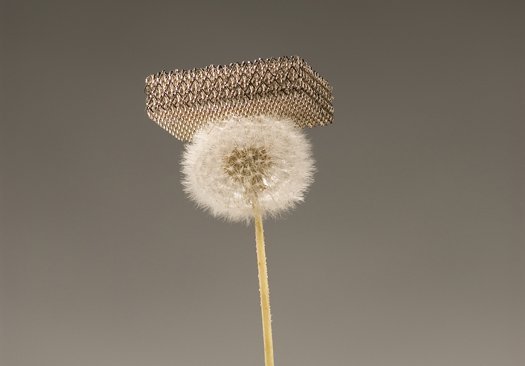
Check it out:
http://www.gizmag.com/ultralight-micro-lattice-material/20537/
Or read the abstract from November’s Science:
http://www.sciencemag.org/content/334/6058/962
(Image credit: Dan Little, HRL Laboratories)
Voyager 1 hits the doldrums!
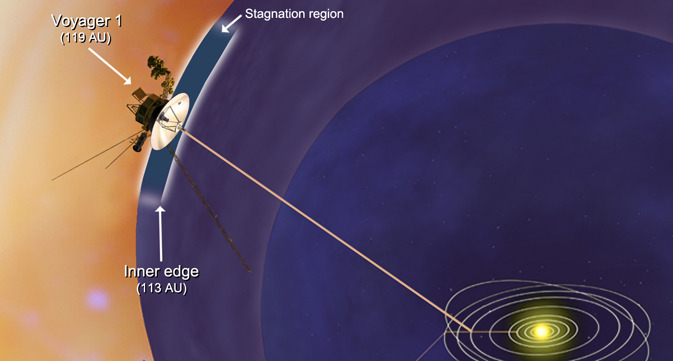
NASA’s Voyager 1 probe has entered a new region of space. What’s being called the ‘stagnation zone’ is a region in the outermost layer of the solar system, just on the edge of interstellar space. Launched in 1977 and expected to run out of fuel by 2020, the longest-running deep space probe (with its twin Voyager 2) is expected to make it out of our solar system ‘bubble’ in a few months to years.
Here’s an artist’s interpretation of Voyager’s position and the relevant NASA news release.
MRI talk on Dec 7, 5:30 pm
The following talk tomorrow Dec 7 should be an interesting talk for anyone — newbies and pros alike — interested in magnetic resonance imaging:
BIRC SEMINAR SERIES:
Dr. Alex MacKay, Magnetic Resonance Relaxation in Brain
Wed, Dec 7th 2011; 5:30-7:00pm; Auditorium A, LHSC
A detailed site map of the London Health Sciences Centre — University Hospital can be found here: http://www.lhsc.on.ca/About_Us/LHSC/Maps_Directions/UH_Map.htm
Auditorium A is on the third floor in Zone B.

Kepler detects first extrasolar planet in habitable zone!
Fastest Rotating Star Found in Neighbouring Galaxy
Check out this Hubble News Release posted today about a star which is almost rotating at the speeds required for centrifugal forces to rip it apart. For full story:
http://hubblesite.org/newscenter/archive/releases/2011/39/full/
In continuing with the Stephan’s Quintet theme…
Western’s own Konstantin Fedotov’s submission to the Astronomical Journal made the cover (for issue 142)! Check out the full article at http://iopscience.iop.org/1538-3881/142/2/42/fulltext/
Astronomy in “It’s a Wonderful Life”
How do you connect Astronomy to the holiday season? Check out the intro to the classic christmas movie “It’s a Wonderful Life” (see vid). If you click ahead to 2:00 min in the video you will see that God is actually Stephan’s Quintet (HCG 92).