Physicists have taken over the east side of the building. Astronomers have yet to react.

Grade 7 students living near Chicago drew pictures of how they imagined scientists looked. There were a lot of lab coats! Crazy hair! And glasses! And not too many women, either. Then they visited the US Department of Energy’s Fermilab and met some actual scientists. The before and after drawings are definitely worth checking out, as well as the explanations of what a scientist does.
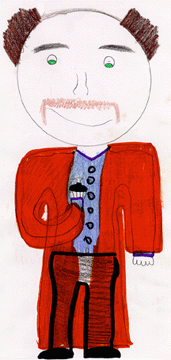
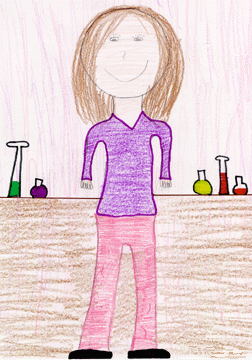
Left: before visiting Fermilab; Right: after visiting Fermilab. Image credit: Rachel
Here are some more photos of scientists from around the world.
Q: What did the male magnet say to the female magnet?
A: From your backside, I thought you were repulsive. However, after seeing you from the front, I find you rather attractive.
There is just one thing I can promise you about the outer-space program: your tax dollar will go farther.
What kind of star wears sunglasses? A movie star.
How did the astronaut serve drinks? In sun-glasses.
Astronomer 1: So, anyway, the cop pulled me over for running the red light. I explained to him that I did not see the light as red, since I was traveling towards it and it was blue-shifted.
Astronomer 2: And he let you go?
Astronomer 1: No, he gave me a speeding ticket instead.
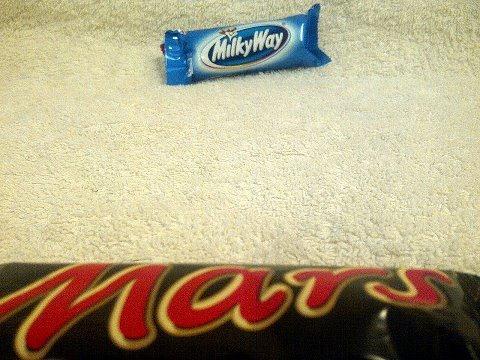
Former astronomy staff member Mira Rasche sends us this delicious image showing the Milky Way from the surface of Mars.
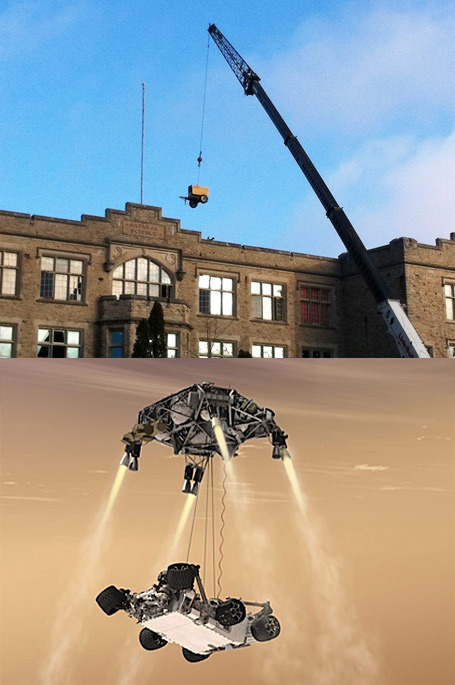
NORLON – New Outrageous Rover Lander ONtario ?
[photo credit: Robert Sica]
Not as funny as I thought it would be
Posted on Astrobetter:
http://www.astrobetter.com/things-astronomers-say-video/?utm_source=feedburne…
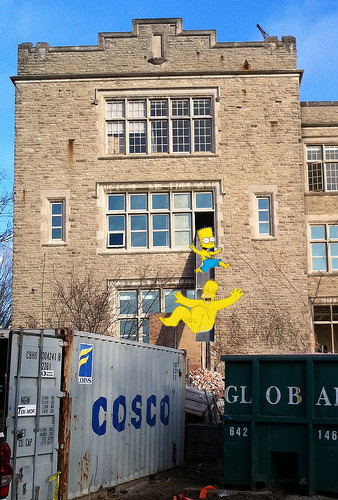
I thought that the posting I read this morning regarding the quick decision to proceed directly to Phase V of building renovations to be a joke.
That was until I saw the mass evictions taking place with my own eyes.
Shame on them!
There were almost no big surprises in the new federal budget. For science, (as discussed on this blog by Prof. Chronik) most of the changes were given earlier in the Jenkins report and concerned changes in research/industrial partnerships between NRC and the private sector. But no one reading the tea leaves was prepared for what was apparently a last minute addition by scientific policy advisors to Chapter 3, Supporting Jobs and Growth.
The Government requires all scientists, engineers and astrologers receiving federal funding to immediately use the following constants.

Imagine from the University of Bergen’s Department of Mathematics website.
It started with some ideas for a few hands-on exhibits, grew to a small Foucault pendulum and then the Chair of the Department of Physics, Astronomy and Enology at Occidental Université (formally the Easterly University of Northerly Ontario), Prof. S. Basu said enough is enough. “If we keep thinking small we will stay small” he told a group of reporters anxious for the 411 on this latest coup for Occidental.
Prof. Basu called CERN director general Rolf-Dieter Heuer and laid it on the line: give us the Large Hadron Collider. “I told him we have a world-class building with the latest renovations and due to the topology of the landscape we are built on neutrinos should be moving at least at 2c as they whiz through our building. He said deal and we’re in the process of making a few tweaks in the atrium design to accommodate the main storage ring.”
The Large Hadron Collider (LHC) currently sits in a circular tunnel 27 km in circumference. The tunnel is buried around 50 to 175 m underground and straddles the border between Switzerland and France. How will the atrium accommodate it, Basu was asked. “The Euros goofed when they designed LHC and they knew it. Special relativity tells that though we see the ring having a circumference of 27 km the particles in the ring, moving near the speed of light, see the tunnel as having a circumference about the diameter of our atrium. So there is no need for such a huge tunnel, it was a political move so the French would pony up big bucks.”
Basu went on to discuss how the Department would produce twin particles, of which one particle would stay in the centre of the ring and the other could be accelerated by a student around the ring a few times and come back 100 years older than its twin and with a long grey beard. The installation is expected to come online when the building renovations are finished in 2525 (“if Man is still alive”).
Below: Director General of Cern Rolf-Dieter Heuer with Prof. Basu at the announcement.
Easterly University of Northerly Ontario (formally Westward University of Southward Ontario) Professor of Lidarology R. J. Sica was called in by the Provost who had a most unusual problem. “We don’t understand it, but this winter students have been dropping like flies on campus during the day, particularly during the 10 min periods between class changes. Since your Department has all the brains in this place we thought you could solve the mystery.”
Prof. Sica replied he would get to the bottom of it, because frankly he really had nothing else to do in his cushy position except for occasionally diving out of the wall of falling valances. Here is part of the Executive Summary of his final report, which you can view in its entirety here.
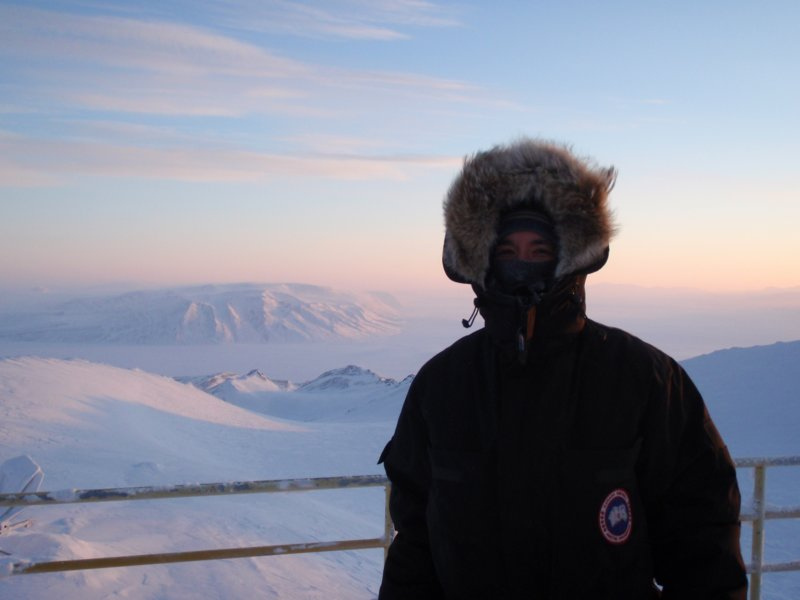
Students were observed moving between classes. I notice a large fraction of one of the genders had Canada Goose South Pole Expedition parkas on. Having lived in interior Alaska for several long, cold, dark winters, I knew that these coats were typically uncomfortably warm in Fairbanks during January, when the average temperature was –25C. This winter the temperature seldom got down to +5C. However, as I watched the weak collapse in the herd of students leaving Nat Sci 145 I observed that not all the students in the parkas dropped. I had to be missing something. Then it came to me. The parkas were generating an additional 1000 W of body heat, but when worn with heels the excess heat could dump to the ground through the feet. The students who dropped were all wearing Uggs with the coats. The combination of the Canada Goose Expedition Parkas, Uggs and balmy temperatures were the perfect negative storm, producing temperatures equivalent to solar chromosphere near the body of the wearer.
These results were verified by Crow Emily, shown here standing barefoot in the Eureka, NWT as part of a 30 min experiment to determine if she would get cold or not. Funny, I haven’t heard anything back from her yet?