
It’s exam time so we need a little bit of levity. Here are the professor view and the student view of the “5 stages of grading”.
All posts by Pauline Barmby
Earthrise revisited
http://cdn-akm.vmixcore.com/player/2.0/player.swf?player_id=ba55fb58969b45546ee8de839b4394c7
via nasa.gov
The circumstances of the “Earthrise” picture from Apollo 8 have been recreated, so we can all pretend we were there. Pretty nifty.
Gemini Science Meeting 2012
Don’t miss the excitement of the 2012 Gemini Science meeting. The abstract deadline is Friday, April 27.
Twitter alert!
If you want to know about space-related happenings in real time, you can follow:
@AuroraMAX — when are the northern lights visible over Canada? There are other aurora alert services for other locations.
@twisst — tells you when the Interntaional Space Station passes over you
@astronomerstel — the Astronomer’s Telegram: gamma-ray bursts and other snazzy thing
@lowflyingrocks — “.. every near earth object that passes within 0.2AU of Earth”
@spaceweather — “keep tabs on the space environment around the Earth as it is disturbed by the variable output of particles & radiation from the Sun”
What are your favorites?
Those lazy profs, part 3
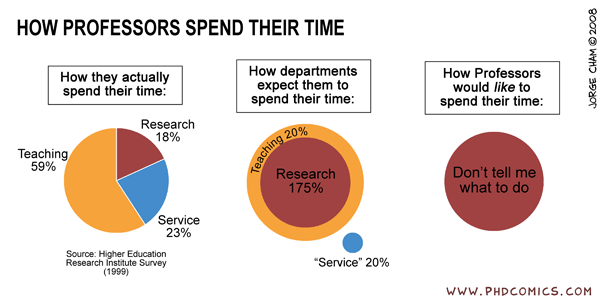
via phdcomics.com
As usual, PhD Comics has it about right. In my January and February posts, I tried to describe a little about what the teaching and research parts of the job entail. But service is even more nebulous — what does it mean? [Generally no tennis or badminton is involved.]
Part of service is doing things for the benefit of the Department or University. So this might mean being a member of committee that selects scholarship recipients, in which case one reads a lot of application forms, tries to rank the applicants, and then goes to a meeting in which the committee comes to a consensus. Or it might mean being on a committee which is deciding on changes to the curriculum — again, doing some background reading and then going to a meeting where things get discussed. Service also includes things like being a member of the University Senate (I suspect meetings are also involved here) or a department chair or Dean (again, meetings, probably also paperwork).
Another kind of service would be service to one’s scientific community. This would include things like peer review of papers, grant applications, or (for astronomers) telescope time applications. There are two kinds of review here: in one type, the reviewer sees only one paper/application and does a detailed check for sensibility and worthiness. In the other kind, more like the scholarship application, the reviewer sees a whole bunch of applications and has to rank them relative to each other. These are somewhat different and it can take time to switch one’s mindset from one to the other. Other things that qualify as service to one’s profession might include organizing conferences, helping to run a professional society like the Canadian Astronomical Society, or being an outside reviewer of another university’s department or program.
Finally, there is service to the wider community: being a judge at a science fair, giving a public talk, visiting a school to talk about your field, answering questions from the public on a website. Different fields vary in how important this is considered to be: in astronomy, because we use taxpayers’ money to do something which (some would say) doesn’t have immediate economic value, most of us consider outreach to be extremely important. Plus we think we get to do fantastic stuff and we love to tell people about it! Admittedly it helps that many people are interested in our field, moreso than in others, like (say) actuarial science.
So that’s academic service from my point of view. As I have to keep explaining to my Mom, we don’t get paid extra for this; it’s part of the job. How big a part? I refer you to the eloquent statement by Jorge Cham — it’s supposed to be 20% of one’s time, and if you can accomplish it by not actually spending any time on it (see middle chart), so much the better.
Supernova in nearby galaxy M95
I just learned that there’s a possible (but nearly certain) supernova on the rise in the relatively nearby spiral galaxy M95. This is exciting, because it should get bright enough to spot in small telescopes! By coincidence, Mars happens to be sitting in the sky very close to the location of M95; that makes it easier to find in that you have an obvious landmark in the sky, but tougher because Mars is so close and so bright it swamps the region with light!
Right now, the supernova is still at roughly 12th magnitude, making it too faint to see without bigger ‘scopes, or smaller ones with digital cameras. However, it was only discovered on March 16, so it’s most likely going to get brighter. The galaxy itself is about magnitude 9 or 10, so the supernova may get that bright.
There are quite a few pictures of the galaxy+supernova on Flickr, but most
are copyrightedaren’t free license so I can’t post them here. However, searching the site for “M95 supernova” yielded a few of them. You can also find a list of links here. I think this one in particular is cool; it has bright lines going across that’s scattered light from nearby Mars!However, by a funny coincidence (?), the European Southern Observatory chose a Very Large Telescope image of M95 as its Picture of the Week just this morning:
[Click to galactinate.]
I say it’s a coincidence because there’s no mention of the supernova in the caption. Anyway, M95 is a gorgeous barred ring spiral: the bar is the rectangular feature in the middle, and the ring around it of gas and stars is not uncommon in galaxies (like here and here). M95 is about 35-40 million light years away, and is part of a small group of a couple of dozen galaxies called the Leo I group. M96, another spiral in the group, is even prettier!
Back to the supernova, DeepSkyVideos put together a very quick-and-dirty video about it which manages to be very informative and good despite being put up so quickly:
If you have a good telescope and detector, the coordinates of the supernova are online. Astrobob has a good finder chart for it. I’ll note that observations right now are critical; the physics of the explosion are best characterized by how rapidly it brightens. At this point, we don’t even know if it’s a Type I or Type II! So observe it if you can. And if you take good pictures or see any online that are
not copyrightedfreely licensed, please let me know!And as a final note for now: we’re in no danger from this. I normally wouldn’t bother writing that, but a lot of people seem jittery due to 1) the 2012 nonsense, b) the recent (coincidental) solar flares, and γ) the asteroids (DA14 and AG5) I wrote about last week. So to proclude any fear-mongering, I’ll just say this supernova is something like 400 million trillion kilometers away, and probably won’t even get bright enough to see in binoculars. I hope that helps assuage any fears.
Image credit: ESO
March 19th, 2012 6:31 PM Tags: M95, supernova
by Phil Plait in Astronomy, Pretty pictures | 27 comments | RSS feed | Trackback >


Lots of good info and links on the Bad Astronomer’s blog
Neutrino-based communication
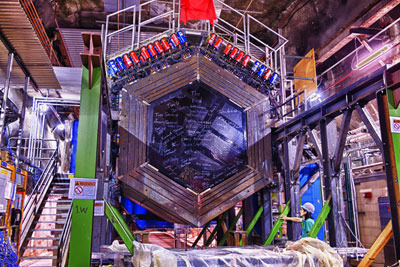
via physicsworld.com
It’s not faster than light, but still pretty cool. And don’t you think that the receiver looks rather like the stargate in Stargate SG-1?
Cronyn Observatory open tonight
Free public observatory night, tonight at 7:00pm. More info: http://www.physics.uwo.ca/outreach/public_nights.html
Those lazy profs, part 2
Last month I tried to explain how I spend my teaching time both inside and outside the classroom. So what about the other 60% of my time: 40% for research and 20% for service. What do those mean? Let’s tackle the research part this month.
I’m an observational astrophysicist, which means that my research consists of using observational data to figure out how the universe works. But this doesn’t mean that I spend my nights at a telescope glued to the eyepiece. I use data from telescopes on the ground (CFHT, Gemini, JCMT, and others) and in space (Hubble, Spitzer, Chandra) to try and answer specific questions about how stars in nearby galaxies are born, live and die. So, broadly, my research might go something like this.
- Think of an interesting question and find out if it’s already answered. This usualy involves a lot of reading, mostly through the Astrophysics Data Service.
- If not answered, figure out what data might be needed to answer it. If already answered, go back to step 1.
- Figure out whether the data already exist. This can involve a lot of web-searching at online archives of telescope data. Someday there will be one-stop-shopping for such (the “Virtual Observatory”) but not yet.
- If the data already exist, great: download them and get to work. If not: figure out what telescope could generate the necessary data, write a compelling proposal for telescope time, and design (& perhaps perform) the observations. [The previous sentence summarizes what can be months of work and will perhaps be the subject of a future post.] Sometimes it turns out that it’s not feasible to get the necessary data, in which case go back to step 1.
- Once data are in hand, “reduce” them. The idea is to go from numbers in some kind of digital image to physical measurements, for example luminosity of an object in Watts. This step is what grad students spend a lot of their time on.
- Finally, figure out the meaning of the physical measurements. Often this is done by comparing to simulations or other theoretical models — do the models and data agree? If not, is there a plausible reason why?
- Share the results of the research: write a journal paper, give a conference talk or seminar, present a poster. More often than not, I do all three for a given piece of research (sometimes at different stages in the work).
- Hopefully the research has suggested new questions to explore: return to step 1.
Many of these steps are done in collaboration with other people (see recent post by John de Bruyn) — one person doesn’t usually have the required technical expertise to do everything. (And see also this paper on the decline of the single-author paper in astronomy.) Almost all of these steps are done while sitting in front of a computer, but that computer can be nearly anywhere in the world. I know people who reduce the data from observing runs on their airplane flights home. Or write their papers in telescope control rooms. I’m usually too tired to do either.
You’ll also notice that there’s a lot of “back to step 1” in the list above. That’s the nature of research: 2 steps forward, 3 steps back, a couple of sideways steps. Eventually we get somewhere, but it’s not always where we expected. But that’s why it’s fun.
Now, if you will excuse me, I have an observing proposal to write.
Physics & astronomy podcasts
Last month I listed some of my favorite, mostly general science, podcasts. Here are some more which focus specifically on physics and/or astronomy. This list doesn’t include “course lecture recording”-type podcasts, of which there are many: next month I’ll try to recommend some of these.
Physics Central Podcasts and Vodcasts
Learning About Teaching Physics Podcast
Naked Astronomy (my son says this name is “just plain creepy”)