All posts by Jan Cami

An overdose of planets in the night sky

If you’ve looked up shortly after sunset on a clear evening in the last few days, you may have noticed two very bright stars in the West. Those are not stars — they’re the planets Venus and Jupiter. The two are putting up a show in the next days/weeks as they get closer for a conjunction in March. By the end of Feb, they will be joined by the crescent Moon. This year though the three will not conspire to form a Smiley Face, but it’s still a pretty neat thing to see! Many people that see the bright objects mistake them for a UFO, but you know better now!

This NASA story gives more details about the conjunction, but it does not mention that there are more planets visible the next few weeks: Mars rises in the east around sunset, and Saturn a few hours later. You may want to look at Saturn before sunrise, and then take the opportunity to try and find Mercury in the twilight, and then you have seen all planets that are visible to the naked eye in 1 night!

A good source of information for all your skygazing needs in the site Heavens Above, which also lists passes of the International Space Station and other satellites. Or why not use the free planetarium software package Stellarium to search for what wonders of the sky you can see for yourself? Of course, we are here to point it out for you — on our Cronyn observatory public nights (one coming up next weekend, on Feb 25!)


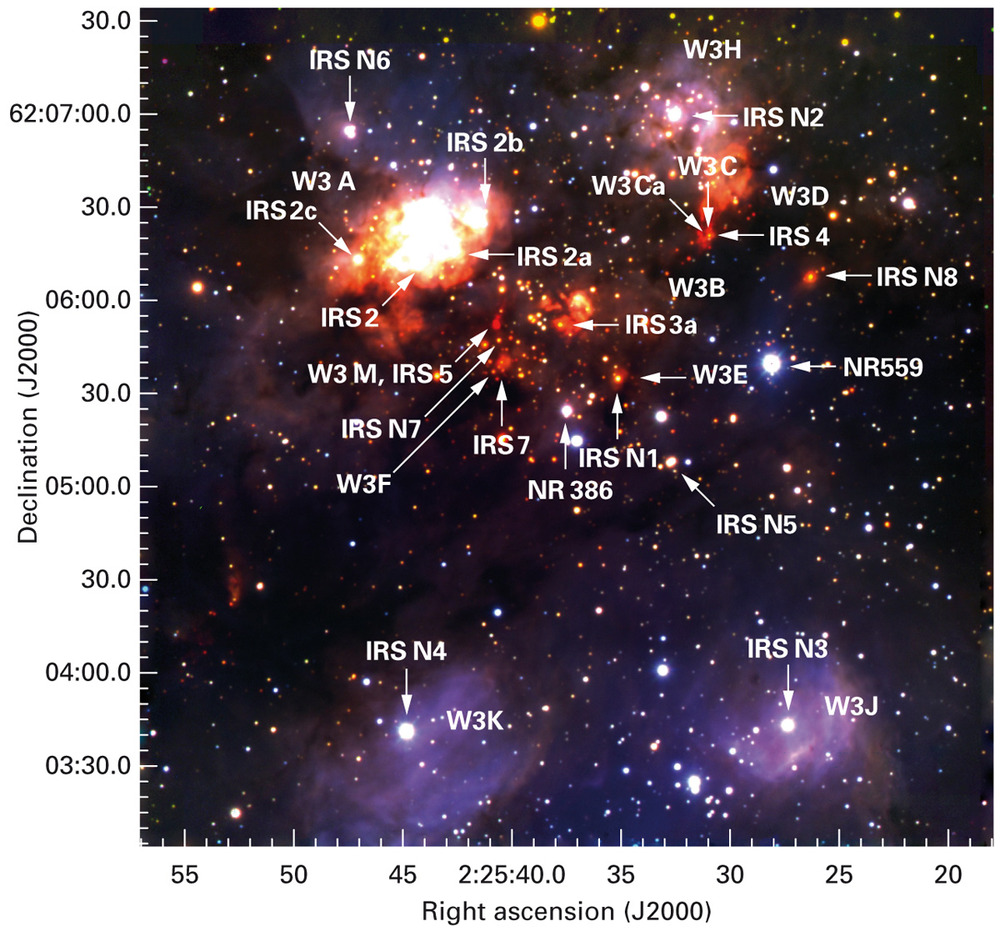
Massive stars in a cluster are not the same age!

Stars form from the gravitational collapse of interstellar clouds of gas and dust, and it has long been assumed that this implies that stars in a cluster have about the same age. A recent paper presents new observations of the well-known massive star cluster W3, and concludes that the ages of the stars in the cluster are quite different — from newly born stars to some that are 2 million years old.

This very nice piece of work was carried out by Arjan Bik and coworkers.I have very fond memories of Arjan who was my office mate in Amsterdam where we were both grad students; we had a good time!

You can read more about this in the Press Release; and here’s the ApJ paper. 


Riding a comet…..

One of Europe’s exciting cornerstone missions is Rosetta. Rosetta has been traveling through the Solar System since 2004, and is slated to meet up with comet 67P/Churyumov–Gerasimenko in 2014. From orbit and with a lander (named Philae), the comet will be studied as it becomes more active and swings around the Sun. Here’s a short description & a NASA sciencecast about the mission.

http://science.nasa.gov/science-news/science-at-nasa/2012/02feb_rosetta/

[youtube http://www.youtube.com/watch?v=FoePrO4-fGQ?wmode=transparent]

Carbon Monoxide Molecules Embedded in the Ten Million Degree Gas of a Supernova Remnant.

Much of the research I do involves  the warm and dense surroundings of stars that are not very massive, and that are nearing the end of their lives. These stars eject most of their stellar material into the vast “empty” space between the stars (called the interstellar medium) by means of slow and gentle, but massive stellar winds. In the immediate neighbourhood of these stars, temperatures and densities are ideal to produce large amounts of molecular gas: at much lower temperatures, the gas would freeze and form ices; but turn up the heat a notch, and the molecules dissociate. Molecular gas is easily detected at infrared wavelengths, and has indeed been studied in great detail by infrared (often space-based) observational progams

Last year though, I helped with the analysis of infrared observations of a different beast: the supernova remnant Cassiopeia A, shown here in full splendour:
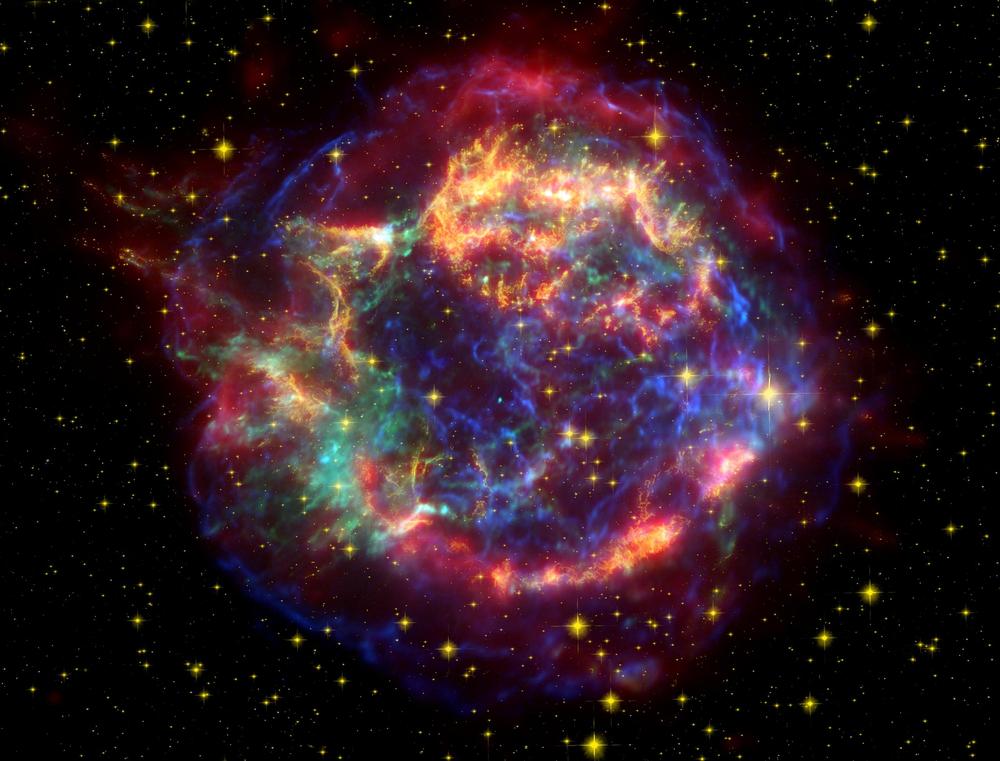
A supernova also signals the end of a stellar life, but it is by no means a slow and gentle event. A supernova explosion releases enough energy to temporarily rival the brightness of an entire galaxy, and these violent events result in ejecta moving at speeds of up to 10% the speed of light! The large (10 light years across) gas bubble that we call Cas A represents the expanding remains of a star that exploded as a supernova about 330 years ago. The event passed by largely unnoticed, probably because earlier mass ejections had created a thick shell of dust around the star that attenuated the light from the explosion. It is quite amazing that we can still observe the supernova explosion today, by looking at light echoes from the supernova explosion. Light echoes occur when a dust cloud acts like a mirror and reflects the light from the supernova explosion toward the Earth (check out this cool time-lapse sequence of light echoes of SN 1987A). By studying such reflections, astronomers have determined that the supernova that created Cas A was a type IIb supernova, and thus the collapse of a massive star.

You wouldn’t think that young supernova remnants like Cas A are good ponds to go fishing for molecules. The gas in Cas A is hot — millions of degrees — which is way outside any molecule’s comfort zone. Collisions between molecules and fast moving particles would break even the strongest molecular bond. Yet infrared spectra recorded by the Japanese spacecraft AKARI at different positions within Cas A clearly reveal the presence of CO  (carbon monoxide) — known on Earth as the silent killer. The shape of these molecular bands at infrared wavelengths is very sensitive to temperature and density (as you can see for yourself at SpectraFactory), and the wavelengths at which you see them is determined by their (radial) velocity. I modeled these bands, and so we found that the CO gas is quite hot as well (~2,000 K), and is moving fast, so it is clearly associated with the supernova remnant. The density that we derive is also fairly high; and thus we think that the CO possibly resides in very dense “pockets” or “bullets” of gas that are cooler than their surroundings and that offer a protective cocoon that shields the CO molecules. Further observations will hopefully be able to confirm this. One implication of this work may be that far less carbon dust is created in supernova explosions than is currently thought, because a large amount of carbon is locked up in the CO gas and can thus not be used to make carbon dust. If you want to know more about our results, here’s the full press release from the Japanese space agency, and our paper in ApJ Letters that appeared Feb 8, 2012.

 

Where will *YOU* be on June 5th?

On June 5th, the planet Venus will move in front of the Sun — a Venus transit. Transits of Venus are rare events, and if you miss this year’s transit, you will have to wait until the year 2117 to see one. Mark the date in your calendar! The transit will be visible from London (and we are planning to help you see it) , although the sun will set before the transit is over. If you want to see the entire event, you will have to travel a bit…. Use this site for more info:

http://www.transitofvenus.org/

Planet Population is Plentiful!

We’ve heard many new planet detections — now astronomers also include non-detections for some robust statistics. Conclusion: the average number of planets around a star is greater than one, so they are the rule rather than the exception.
“We used to think that the Earth might be unique in our galaxy. But now it seems that there are literally billions of planets with masses similar to Earth orbiting stars in the Milky Way,” concludes Daniel Kubas, co-lead author of the paper.


http://www.eso.org/public/news/eso1204/