All posts by Jan Cami

Comets colliding around Fomalhaut.

This post is one in the category “I know that dude”.

Fomalhaut is one of the brightest stars in the night sky, and a young star known to have a circumstellar disk around it. Hubble images have shown a fairly sharp inner edge to that disk, suggesting that a planet is keeping the dust belt in check. There’s been claims about direct imaging of a planet with Hubble, but that claim has been somewhat controversial.

Dust absorbs light of all sorts of wavelengths, and emits itself at infrared wavelengths. The dust disk of Fomalhaut is thus an ideal target for the Herschel space observatory. Bram Acke analyzed those observations. Bram is one of those fine, young Belgian astronomers that is also involved in oureach, and that likes playing music.

As is often the case, the dust properties inferred from those new observations at far-IR wavelengths were at first sight not compatible with those inferred from the Hubble Space Telescope. Fortunately, Bram is a smart guy and he figured it out: the dust must be fluffy, like dust particles ejected from comets. It also implies that comets must be colliding there all the time!

Another example of cool science at long wavelengths!

You can find the ESA press release here:


http://www.esa.int/export/esaSC/SEM1XBHWP0H_index_1.html


More dark matter problems?

I’m not an expert on dark matter, but I’ve always liked the idea of a Dark Entity that we can’t see, but whose influence is quite clear nonetheless. Here’s a paper now where the authors claim that in our galactic neck of the woods, there is no dark matter. I’m not sure what to think of it (please leave comments if you do!), but if this turns out to be correct, it adds another awesome twist. You just gotta love science when something strange becomes totally weird.

You can read the press release here, and there’s a link to the preprint on that page as well if you’re more hardcore.

The Space Shutte and me (part III).

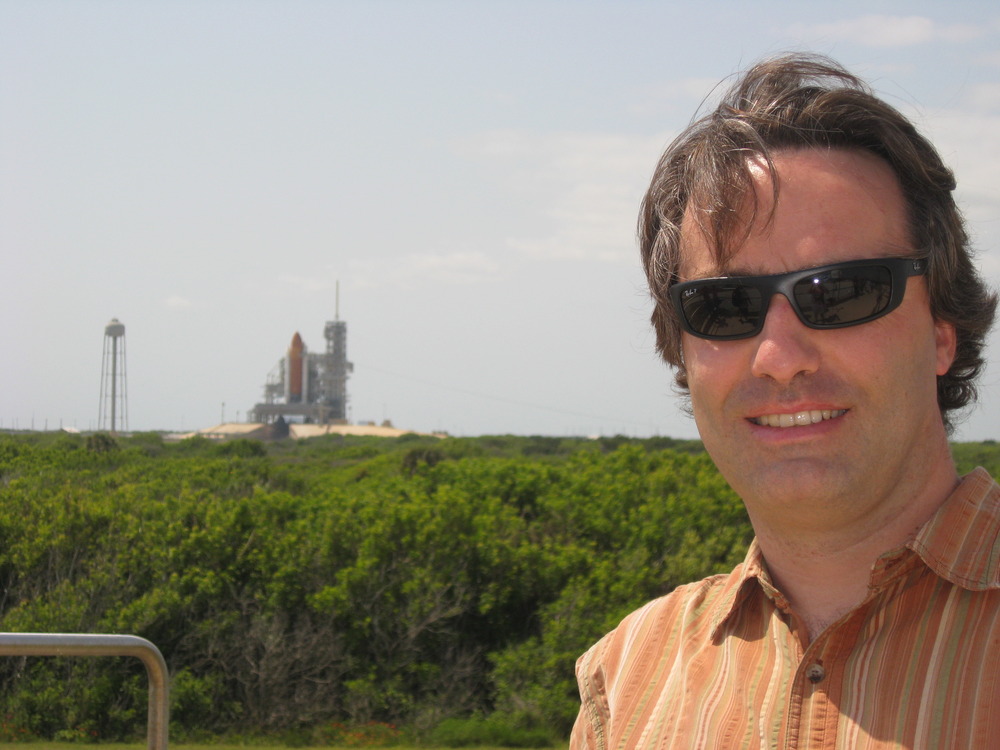
In April last year, a launch was scheduled after teaching duties were over and before travel season started: the last launch of the space shuttle Endeavour, slated for April 29th. When prospects looked good, we booked a last minute flight & hotel to Orlando, and soon found ourselves at the Space View Park in Titusville. It’s still quite a distance from the launch pad, but it offers a direct, unobstructed view of the launch pad. After a long wait, the launch was scrubbed and we extended our stay with a few days hoping to have a new attempt in the following days. That didn’t happen, and so we had a few days to explore everything Kennedy’s Space Center (KSC) has to offer (awesome^2!). As soon as the shuttle’s external fuel tank was drained, it was safe to offer the Discover KSC tours again, which offer the closest views of the launch pad (1.8 miles I believe) that tourist money can buy. A fortunate consequence of the scrubbed launch was that we not only got to see the launch pad — Endeavour was still on it!

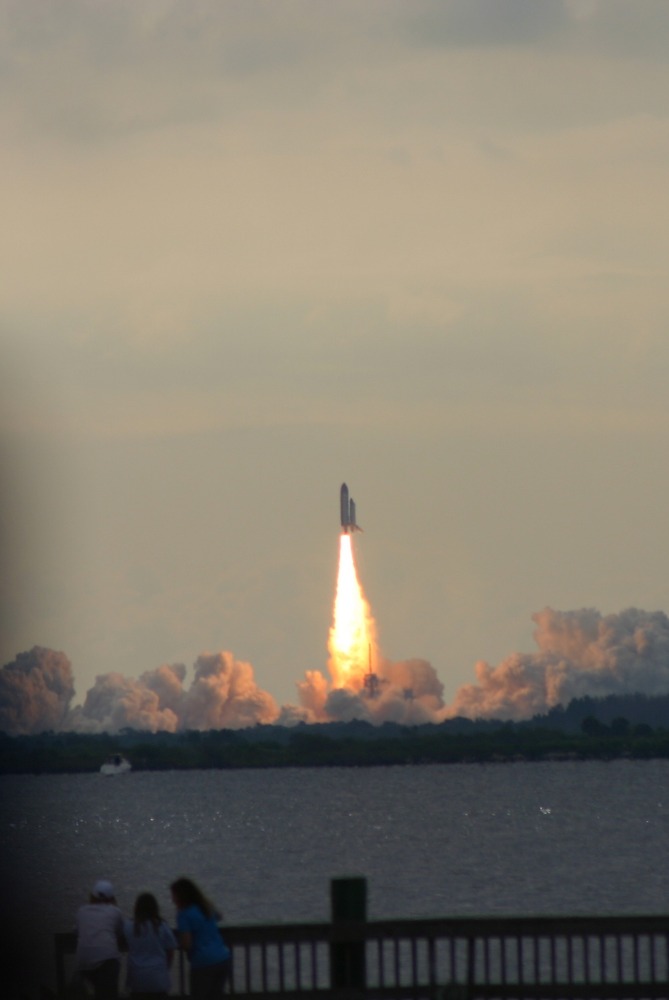
Two weeks later, things looked good again, and another last minute booking brought me back to Titusville on May 16 2011. That day, not only Endeavour commander Mark Kelly was having a beautiful day, The 8 year old in me was having a blast, watching the final launch of Endeavour with awe and joy. Even at that distance,it’s a most impressive sight — the shuttle outline being very clear, and the rocket going up much faster than I seemed to remember from televised launches. You really get a sense of the tremendous power involved in bringing such a massive machine to high speeds! Unfortunately, Endeavour disappeared into the cloud deck after about 15 seconds, and from then on, people in airplanes had a better look than we did. Her last goodbye that day was the shadow of the exhaust plume that the early morning Sun cast on the low cloud deck. But we would meet again soon. Two weeks later, in the early morning hours of May 31st (while tweaking my talk), I saw her again from my hotel room in Toledo, Spain, silently crossing the sky only a few degrees apart from the ISS, less than a day after undocking.

On launch day, I rewarded the 8 year old’s patience with a 60cm cast model of the shuttle Endeavour (ok, you’re right, so I also got a smaller model as well and posters and calendars and whatnot, what’s the big deal?). It’s in my home office, and you would not believe how much joy a grown up (?) can still have  from just watching a model of a pretty spacecraft at the start of each working day.


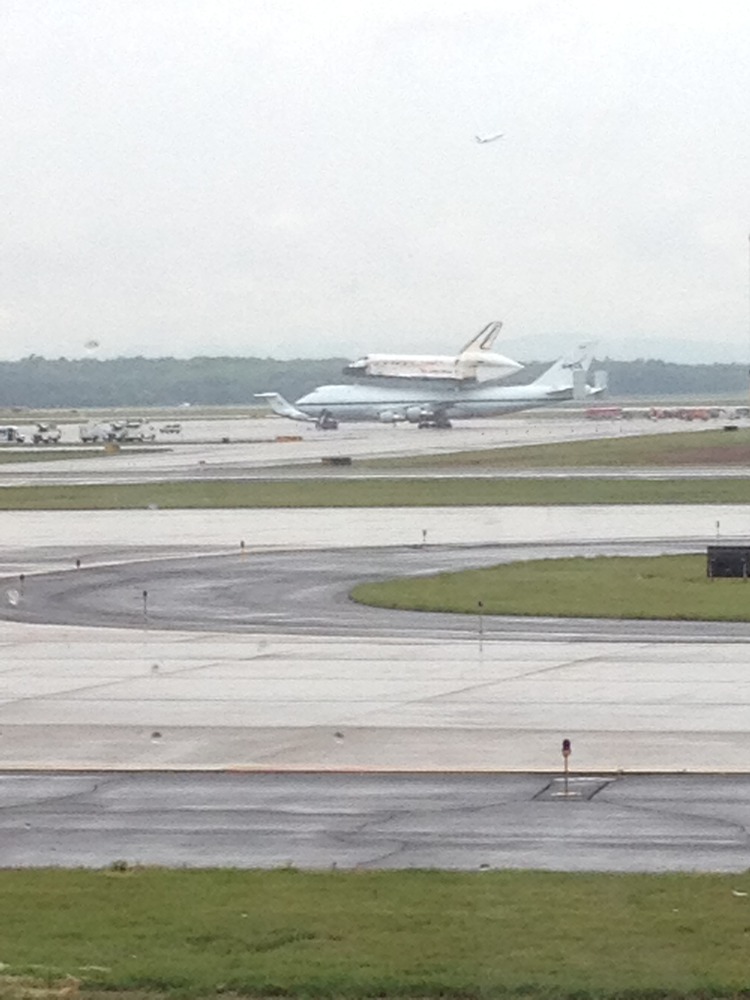
When the shuttle fleet retired, I thought that that would be the end of our story, but this week, there was a nice and surprising little epilogue. The space shuttle Discovery will be replacing the Enterprise in the Udvar-Hazy Center of the Smithsonian Air and Space Museum. As you may have heard in the news, Discovery was flown from KSC to Washington D.C. on Tuesday, and today (Thursday), Discovery was welcomed into the museum with a big ceremony. By some cosmic coincidence, I happened to fly into Washington Dulles on Wednesday. I was wondering whether I’d be able to catch a glimpse of Discovery. Sure enough, there she was, stacked on top of the shuttle carrier just a few hundred meters to my left as we reached the gate. And although I was in the right terminal for my connecting flight, I quickly decided to take the airport shuttle to a different terminal and back, since the airport shuttle’s route brought it much closer to Discovery’s temporary parking spot. And in case there was any doubt, the 8 year old in me is still alive and kicking (and excited, satisfied and happy). After more than 30 years, I’m still as much in love with space and the shuttle as I was back then.

.

The Space Shutte and me (part II).

I moved to the NASA Ames Research Center in California in July 2002 (and of course, they have a shuttle scale model on display). Fairly soon, on Feb 1st 2003, an interesting opportunity came up: the space shuttle Columbia was returning from space, and the re-entry track brought her over Northern California, promising a very bright overpass (the shuttle’s altitude being only 70 km or so). I was up at 5:30am, but alas, the dreaded marine layer (low clouds) prevented me from seeing anything, and it was only many hours later that I found out that Columbia had disintegrated. Ironically, the same orbiter that as a kid inspired me to go and work for NASA was the one that disintegrated pretty much above my head while I was working at NASA….
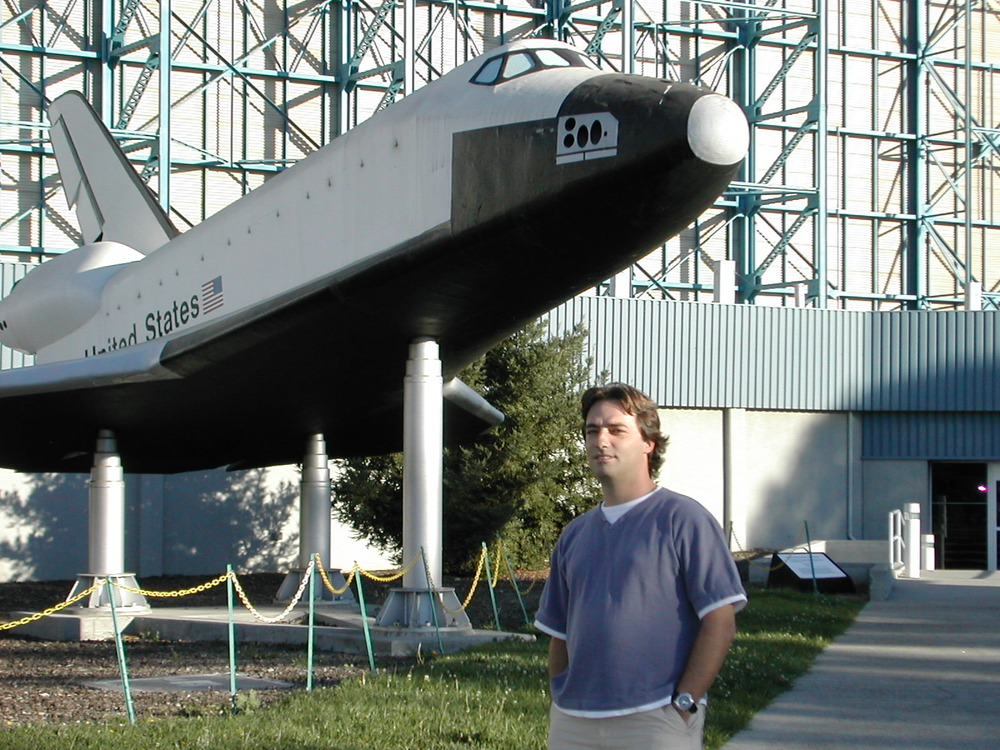
After the Columbia disaster, there were no more shuttle launches for a while, but there were still cool space and plane experiences, with a shuttle component. NASA Ames is located right next to Moffett Federal Airfield, and on Memorial Day 2004, the Air Show Network organized what seems to have been the last of the Moffett Airshows — but how cool is that really, an air show at work! In addition to P-51 Mustangs, F-15 Eagles, The Air Force Thunderbirds (flying F-16s), F/A-18 Hornets, and a flyby of the F-117 Nighthawk stealth fighter, the shuttle carrier was on display, to be explored on the inside and the outside.

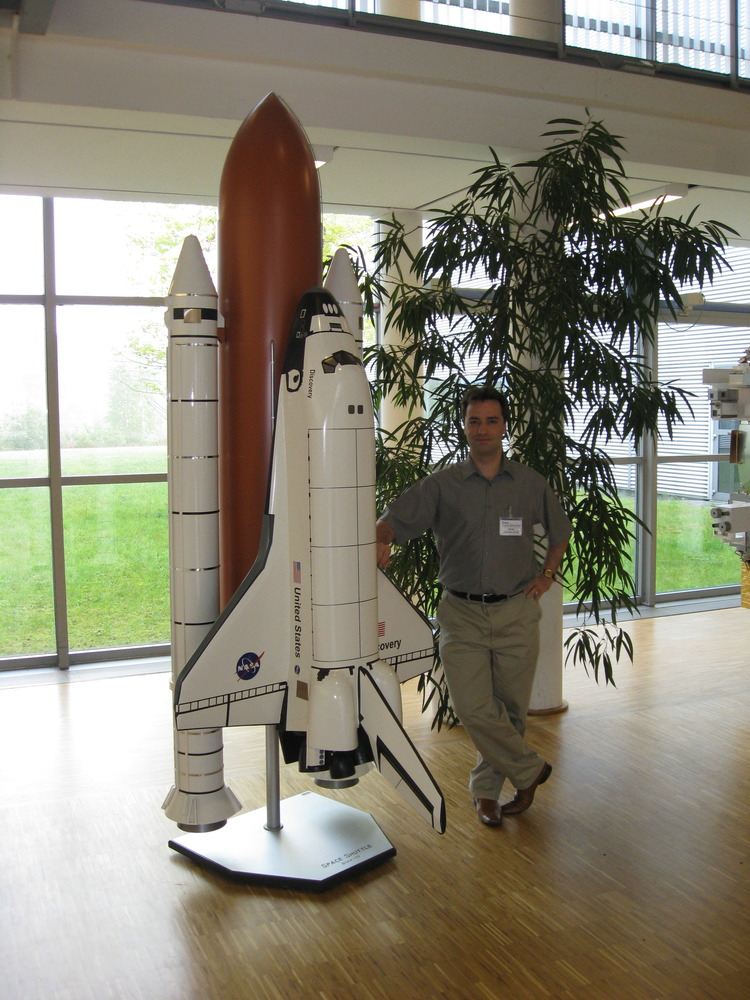
In 2008, the European Space Agency issued a call for astronauts, and of course the 8 year old in me made sure that I was one of approximately 10,000 candidates — over 8,000 of those were furthremore also qualified (i.e. had a graduate degree and work experience). The whole process in itself was quite interesting and unique, but unfortunately, I didn’t make the final cut. To my own amazement though, I made it to the last remaining group of 192 candidates after two rounds of tests in Germany; the last round being organized in the European Astronaut Centre in Cologne, Germany. There, the first thing that caught my eye was a large model of the shuttle, right under an equally impressive 1/20 or so scale model of the fully assembled ISS. 
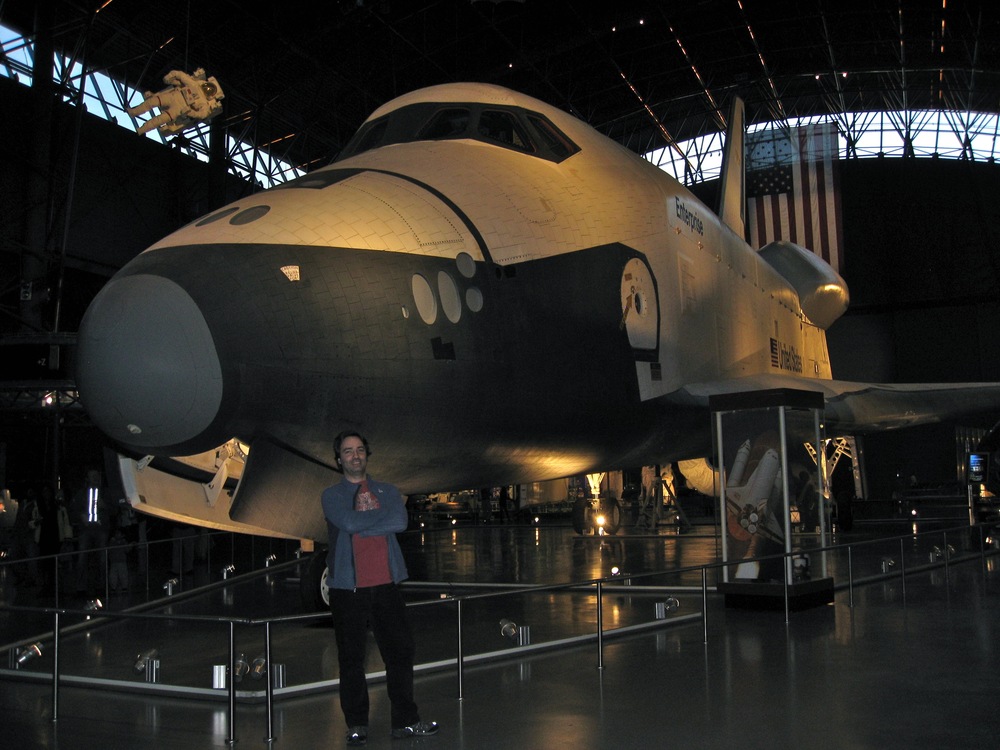
By the time the shuttle program had fully resumed late 2006, a busy teaching and travel schedule turned out to be 100% incompatible with the shuttle launch shedule. In November 2010 though, I finally got to see a shuttle up close and personal when after a work visit to NASA’s Goddard Space Flight Center, I visited the Smithsonian National Air and Space Musem (Steven F. Udvar-Hazy Center)right next to Washington Dulles international airport with my friend, colleague astrochemist and fellow space enthusiast Stefanie Milam. One of the centerpieces of that exhibit was the space shuttle Enterprise. Although the Enterprise has never been in space, it has been used by astronauts for test flights. It’s the real machine. If you’re into planes btw, and your travels bring you through Washington Dulles airport, try to get a layover of a few hours, take the shuttle to the museum, and enjoy the shuttle (Discovery) in addition to the Concorde, the SR-71 Blackbird, the Enola Gay, and many many many many more…

The Space Shutte and me (part I).

I’ve always had a special connection with the Space Shuttle. She’s been a source of inspiration and motivation in my life since my childhood, and by chance, our paths crossed again just yesterday. Here’s our story.

As is the case for many kids, I found space stuff pretty cool when I was about five years old. But I was born in the seventies, and not much was happening for the first few years of my life; I heard about the Moonwalkers, but I had essentially missed out on the mighty Apollo era. Space was not my only interest though — I also loved planes. There was a small airfield close to our house where I would spend happy days watching small planes and gliders take off and land. Maybe not surprisingly then, I was very much looking forward to the era of the Space Shuttle — after all, it would be pretty much like a space plane!

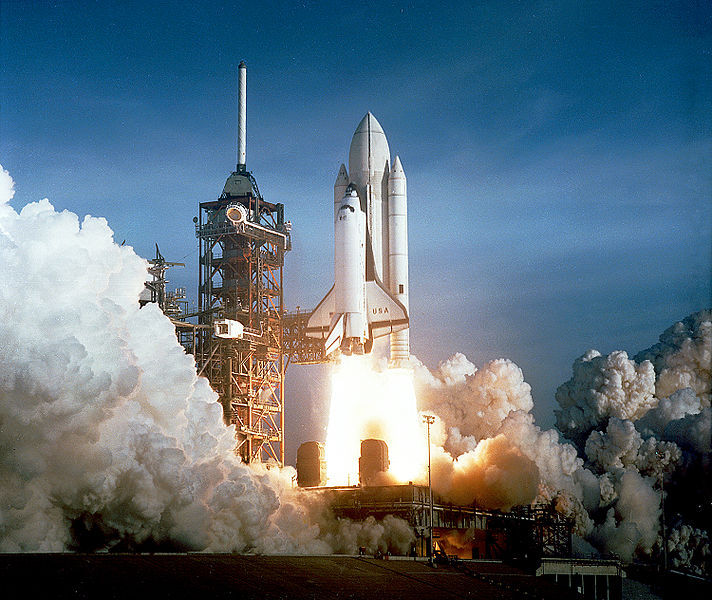
On April 12, 1981, launch day was finally there. We were having our Easter school break, and I was glued to the TV for the entire time of the mission. The first launch of the Columbia was awesome, and even the first landing of this aerodynamic brick at Edwards Air Force base was spectacular to me. It was certainly the most beautiful spacecraft ever built. I told myself (and anybody willing to listen) that one day, I would be there, at NASA’s Kennedy Space Center, for the launch. Hopefully at the controls.

There’s plenty of examples of how big an influence the shuttle was in my life. Drawing classes for instance were a nightmare to me. I couldn’t put anything on paper that even remotely looked like what I had in mind, and moreover I had a tendency to knock paint or ink over my finished work at the last minute. One of the very few times though that I got a very good mark was when I had made a drawing of the shuttle launch. I guess that somehow I spent more time at it, and wanted the drawing to be the pretty sight that I thought the space shuttle is.

Also my first ever computer program was shuttle related. At age ten or so, I joined the local amateur astronomy club called Sirius and found a small home computer (yes, these were the eighties!) in the corner. My first program: a drawing of the shuttle. It were really the older guys that wrote the program, and I guess in a Sheldon type of way quite fascinating: they were just talking to me in coordinates. As an amateur astronomer, I’ve of course also seen many shuttle flybys, including a few double flybys shuttle/Mir and shuttle/ISS. But as a kid living in Europe, the chances of seeing a shuttle up close and personal seemed very remote.

Plugging citizens into science, and putting the fun in funding!

One thing that keeps on surprising me is how often interested lay persons ask about possibilities to assist a scientist in his/her research. Non-scientists are often curious, interested and motivated, and so there is a huge potential for help, support and resources from all those interested folks! In the last two decades, there has been an exciting transformation in how citizens can become part of (and even guide!) scientific research. This is a great evolution, sicne it allows much more science to be done, and could even lead to a completely new funding model for scientific research as illustrated below.

In the mid-nineties, several researchers started developing programs to tap into this huge resource by designing programs for distributed computing — where a large number of home users contribute their computer spare CPU time by running a low-priority calculation, and so form a large and powerful computer network. There is indeed great power in numbers, and coincidentally, one of the first (if not the first) such projects was the Great Internet Mersenne Prime Search (GIMPS) project that is (still) searching for so-called Mersenne prime numbers.  For many years, I ran a Linux version of the mprime program on all computers that I had access to. One of the stimuli may have been the fact that there was a $100,000 award from the Electronic Frontier Foundation for the first prime number that has more than 10 million digits. The 45th Mersenne prime number was found in August 2008, and after rigorous verification, confirmed as the prize winner in November 2009. If you’re interested, the number is 243,112,609 – 1 and totals nearly 13 million digits. Interestingly, the 46th Mersenne prime number was found and was named as one of the best inventions of 2008 by Time magazine. Not a bad score for a number!

Since 1999, the University of California at Berkeley has been running another immensely popular distributed computing program called SETI@Home.A cleverly designed screensaver program uses your unused CPU cycles to analyze radio waves and search for possible extraterrestrial signals. This project has attracted well over 5 million users! More and more such projects have surfaced, and it is one way for scientists to access computing resources that are otherwise unaffordable. A great example is the world community grid which aims to be the world’s largest computer grid (more than half a million users to date), and which is funded and operated by IBM to support humanitarian research. If you’re looking for some honorable projects to donate your computer time to, go have a look! You could help find a cure for cancer!

More recently, social networks and mobile technology have played a big role in the success of a whole new series of citizen science projects. 2006 saw the launch of the Stardust@Home project, once more by UC Berkeley. This time, scientists weren’t looking for your spare CPU cycles, but asked you to scan microscope images to find interstellar dust particles in an aerogel. Why? Because the human brain is much much better at this than a computer is. Inspired by this approach, the Galaxy Zoo project took off in 2007 where now your help was asked to classify galaxies. The project was such a success that a whole series of similar projects is now hosted under the name Zooniverse — from galaxy classification to searching for interstellar gas bubbles to hunting for planets or finding targets for the New Horizons spacecraft once it’s done with Pluto. The Zooniverse project has now even expanded to include climate research, whale research and studies about the lives of ancient Greeks! More than 600,000 volunteers participate — and anyone can, since no science education is needed. There is in the meantime a long list of papers in the literature describing new discoveries done by these sorts of projects. In Astronomy 1021, we offer some of these as projects, and many students absolutely love the idea of taking part!

Very recently, I found out about another type of citizen involvement in research, this time through actively contributing research funding: petridish.org. It goes like this: scientists propose projects and include rewards for whoever backs their proposal up financially at a certain level.  Citizens can pledge whatever amount they see fit for whatever project they like. Again, large numbers that contribute small amounts make enough for funding your research! Who knows, maybe soon we’ll all be posting our research proposals on facbook!