
Much of the research I do involves the warm and dense surroundings of stars that are not very massive, and that are nearing the end of their lives. These stars eject most of their stellar material into the vast “empty” space between the stars (called the interstellar medium) by means of slow and gentle, but massive stellar winds. In the immediate neighbourhood of these stars, temperatures and densities are ideal to produce large amounts of molecular gas: at much lower temperatures, the gas would freeze and form ices; but turn up the heat a notch, and the molecules dissociate. Molecular gas is easily detected at infrared wavelengths, and has indeed been studied in great detail by infrared (often space-based) observational progams
Last year though, I helped with the analysis of infrared observations of a different beast: the supernova remnant Cassiopeia A, shown here in full splendour:
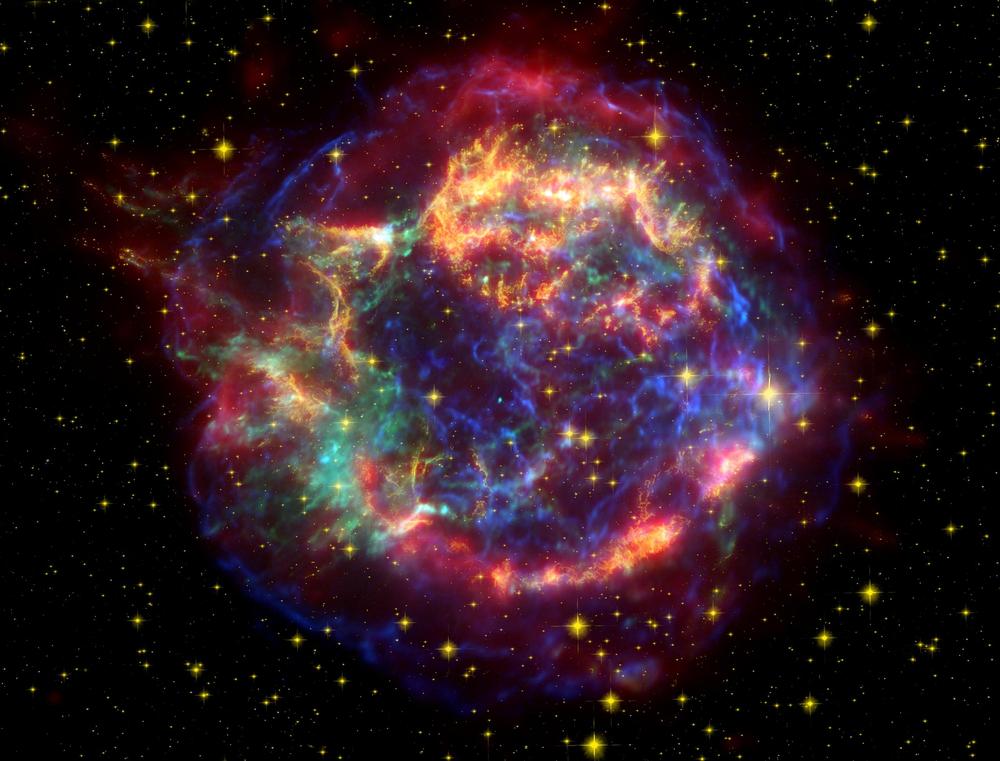
A supernova also signals the end of a stellar life, but it is by no means a slow and gentle event. A supernova explosion releases enough energy to temporarily rival the brightness of an entire galaxy, and these violent events result in ejecta moving at speeds of up to 10% the speed of light! The large (10 light years across) gas bubble that we call Cas A represents the expanding remains of a star that exploded as a supernova about 330 years ago. The event passed by largely unnoticed, probably because earlier mass ejections had created a thick shell of dust around the star that attenuated the light from the explosion. It is quite amazing that we can still observe the supernova explosion today, by looking at light echoes from the supernova explosion. Light echoes occur when a dust cloud acts like a mirror and reflects the light from the supernova explosion toward the Earth (check out this cool time-lapse sequence of light echoes of SN 1987A). By studying such reflections, astronomers have determined that the supernova that created Cas A was a type IIb supernova, and thus the collapse of a massive star.
You wouldn’t think that young supernova remnants like Cas A are good ponds to go fishing for molecules. The gas in Cas A is hot — millions of degrees — which is way outside any molecule’s comfort zone. Collisions between molecules and fast moving particles would break even the strongest molecular bond. Yet infrared spectra recorded by the Japanese spacecraft AKARI at different positions within Cas A clearly reveal the presence of CO (carbon monoxide) — known on Earth as the silent killer. The shape of these molecular bands at infrared wavelengths is very sensitive to temperature and density (as you can see for yourself at SpectraFactory), and the wavelengths at which you see them is determined by their (radial) velocity. I modeled these bands, and so we found that the CO gas is quite hot as well (~2,000 K), and is moving fast, so it is clearly associated with the supernova remnant. The density that we derive is also fairly high; and thus we think that the CO possibly resides in very dense “pockets” or “bullets” of gas that are cooler than their surroundings and that offer a protective cocoon that shields the CO molecules. Further observations will hopefully be able to confirm this. One implication of this work may be that far less carbon dust is created in supernova explosions than is currently thought, because a large amount of carbon is locked up in the CO gas and can thus not be used to make carbon dust. If you want to know more about our results, here’s the full press release from the Japanese space agency, and our paper in ApJ Letters that appeared Feb 8, 2012.
Tweet