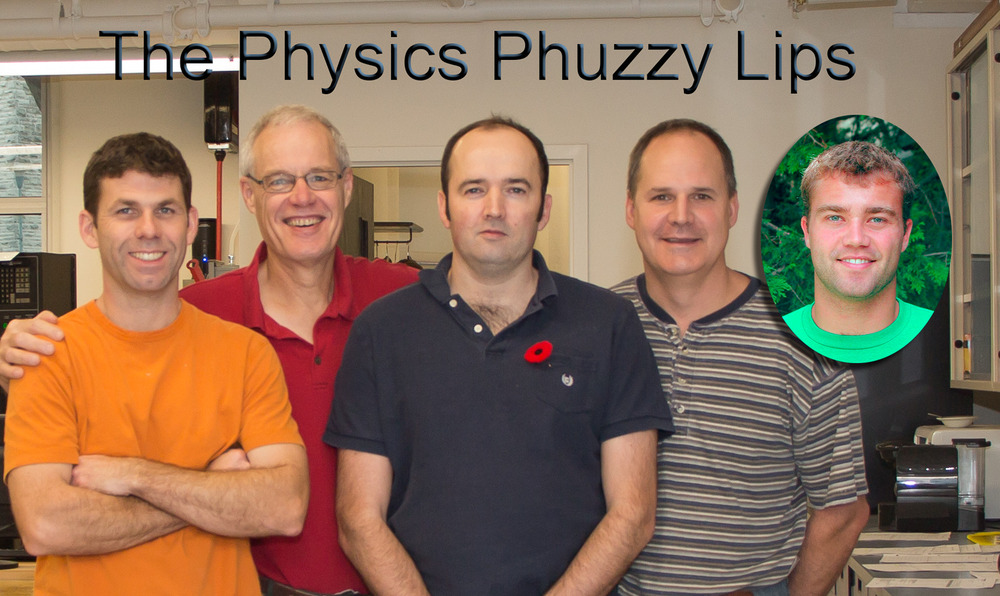
The Physics Phuzzy Lips bring you a very NANO Movember.

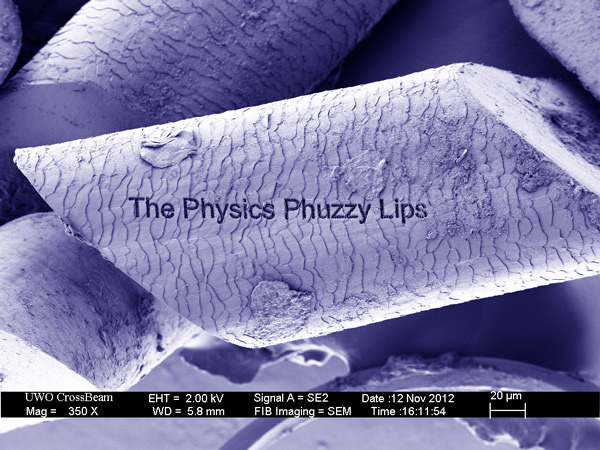
This is a scanning electron microscope image of real (shaved !) whiskers, taken by Dr. Todd Simpson in the Western University nanofab lab.

Our team name ‘The Physics Phuzzy Lips’ was then etched onto one whisker using a Focused Ion Beam. My goodness, it looks like a huge tree that has just been toppled.

Well done Todd !

You can help The Physics Phuzzy Lips in their Movember cause by visiting their team web page.

Movember_nov_8_lr-8


Get email updates on International Space Station flyovers from NASA

This comes from Michael Debruyne.

While the great web site ‘heavens-above.com‘ gives us wonderful information on flyovers of the International Space Station (ISS), it is possible to go one step further and to receive automated emails regarding ISS flyovers at our location.

NASA provides this web site; http://spotthestation.nasa.gov/index.cfm

All you need to do is to select your location and to register your email address.

Creative use of weather forecasting, and why you may want to get your local forecast from Norway !

Have you ever found yourself wanting more detailed weather information than is provided by Environment Canada?

Well you might have been fortunate enough to try The Weather Network, and there you would have across the wonderful ‘Hourly Forecast’, something not found from Environment Canada.

When visiting the Rockies this past September, I found even more imaginative use of the internet by the hikers and outdoors people who frequent the never dull weatherwise Great Divide region.

When moist westerly air hits the mountain peaks of the Great Divide, it usually means fog, rain, or more likely snow. The weather here changes rapidly.

One method that is used to get a bead on the changing mountain weather is to use the Hourly Forecasts from two or three of the closest weather stations, and then try to interpolate between them

So for example, I was  camped down in Peter Lougheed Provincial Park (PLPP) and had booked two nights up at high elevation Aster Lake. The objective was to scramble up Warrior Peak and Mount Cordonnier. There was a huge cold front moving in, accompanied by a big drop in temperature and a lot of rain and snow, so it was going to be important to know as closely as possible when this would happen. Because there is no weather station near the park, the idea was to use weather from the Nakiska Ski area 50km. to the north,  Invermere BC, 80km to the west, and Banff townsite, 80km to the northwest.  The park has a free internet kiosk and I could sit there in the warmth of the visitors centre and try to figure out the approaching weather in this way.

Later on, I found out that some of the knowledgable locals do something even more drastic in trying to get a better bead on the weather. They go to web sites from Norway and England, of course !

While this may seem surprising at first blush, I think that the tourism industry probably drives these web sites. In particular, the ski industry, in the case of the British site. I also assume that these sites use our local data, but use their own models to make their forecasts. So at the very least it gives us a second opinion on our weather.

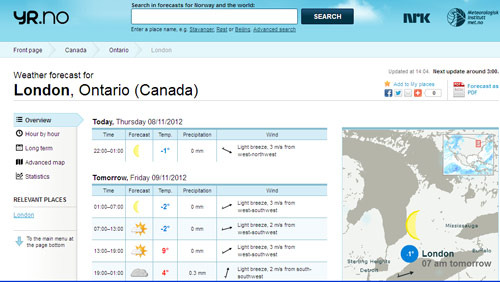
From Norway, we have ‘http://yr.no‘.  The word ‘yr’ means either ‘drizzle’, or ‘dizzy’ in Norwegian. This site is a partnership between the Norwegian Broadcasting Corporation and the Norwegian Meteorological Institute.

Have a look at our London, Ontario forecast from yr.  It’s a nice looking page.

The second site is ‘Mountain Forecast (http://www.mountain-forecast.com). This sure looks like a site meant for the hiking/climbing/backcountry skiing tourist. This site may well just be giving us other peoples’ weather information but they have compiled the weather with other useful information for people who go out into the back country, such as maps.

Here is where it gets really interesting.

When looking at the weather for the Aster Lake trip, I could have gone directly to the weather forecast for Mount Cordonnier itself! This peak is in the middle of a huge wilderness area, there being no ski resort anywhere close. yet, here is all of this information on it from England.  And even better, I could look at the weather at four elevations on this peak! And further, I could look at the weather and maps for the 8 closest peaks to this.

I hope that others find some fun with these weather sites too.

I owe all of these ideas to my old friend and mountain guru, Alf Skrastins!



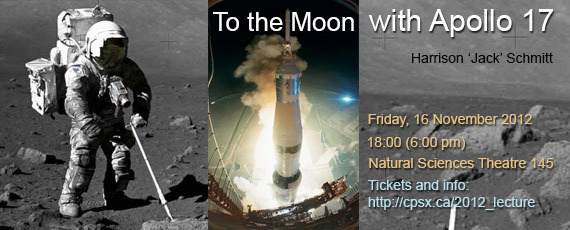
“To the Moon with Apollo 17” – Just over a week away. Order your tickets now.

Geologist, former senator, and astronaut, Harrison ‘Jack’ Schmitt will be speaking in just over a week’s time – on Friday, November 16, 2012.  Jack was the last Apollo astronaut to step down onto the moon’s surface.

The title of his presentation will be “To the Moon with Apollo 17”.

Get your tickets soon to avoid disappointment.

More information, as well as online ticket sales can be found at http://cpsx.ca/2012_lecture.

The Fabric of Reality by David Deutsch – A book review by Allan Angus

If you have a curiosity about quantum mechanics, classical mechanics, or the Theory of Everything, then not only will David Deutch’s new book ‘The Fabric of Reality’ be of interest to you, but I would urge you to delve into a very thoughtful book review by Allan Angus.

I had the fortune to do my graduate degree in electrical engineering with Allan at Calgary.

We both went to work for Noval Technologies, an R&D shop for Nova, an Alberta Corporation, where we worked on spinoffs of Allan’s physics MSc research in non-invasive capacitive flow rate measurements of hydrocarbons (my paraphrasing !).

Allan went on to work in the cellular phone industry and thence on to the development of paging systems. He is one of the brightest people I have ever had the pleasure of getting to know.

He now enjoys making beer, running a photography business, and thinking about the world in general from his home outside of Denver, Colorado.

I hope that some of us here can read Allan’s book review and perhaps initiate a good conversation on this topic on his blog or on ours!

Physics & Astronomy Colloquium – THURS. 15 Nov. – DR. DOUGLAS SCOTT, UBC

Poster: http://www.physics.uwo.ca/colloquia/Colloquia%20Notices/2012_2013/SCOTT%20Colloquium.pdf


Western University
DEPARTMENT OF PHYSICS AND ASTRONOMY


PHYSICS & ASTRONOMY COLLOQUIUM


Date:          Thursday, 15th November 2012
Time:          1:30 p.m.
Location:    Physics & Astronomy Seminar Room 100

Dr. Douglas Scott
Department of Physics and Astronomy

University of British Columbia


“The Standard Cosmological Model”


ABSTRACT


All empirical evidence relating to our Universe is currently well explained by a basic model which contains only a few key ingredients: the background is described by homogeneous and isotropic solutions within General Relativity, in which there is domination by vacuum energy and cold dark matter in a roughly flat expanding geometry; the density fluctuations appear to be nearly scale-invariant, adiabatic and Gaussian; and all of today’s structure grew through gravitational instability. Within this picture the Universe is described by about 10 numbers, and they are now mostly known to about the first digit. So what is left to do? How many digits do we need? Where did these values come from? Are there more numbers that we haven’t thought of yet? Is this model anything like the Standard Model of Particle Physics?

Coffee & snacks will be available.