Physics & Astronomy Colloquium – next THURS. 9th Feb. – DR. CHENG GUAN KOAY, U Wisconsin

Poster: http://www.physics.uwo.ca/colloquia/Colloquia%20Notices/2011_2012/KOAY%20Research%20Talk.pdf


Western University
DEPARTMENT OF PHYSICS AND ASTRONOMY


PHYSICS & ASTRONOMY COLLOQUIUM


Date:          Thursday, 9th February 2012
Time:          1:30 p.m.
Location:    Physics & Astronomy Seminar Room 22


Dr. Cheng Guan Koay
University of Wisconsin School of Medicine & Public Health

Madison, Wisconsin


“Diffusion Magnetic Resonance Imaging: From optimal acquisition design to signal extraction”


ABSTRACT


Diffusion Magnetic Resonance Imaging (MRI) in combination with functional MRI promises a whole new vista for scientists to investigate noninvasively the structural and functional connectivity of the human brain—the human connectome, which had heretofore been out of reach. As with other imaging modalities, diffusion MRI data are inherently noisy and its acquisition time-consuming. Further, a faithful representation of the human connectome that can serve as a predictive model requires a robust and accurate data-analytic pipeline. This talk will touch on recent advances on two important segments of a complex diffusion MRI data-analytic pipeline: temporally and spatially optimal acquisition design via deterministic approaches, and accurate signal extraction through a framework that is capable of breaking the noise floor.
No Ordinary Bubble

The video below, taken (incidentally nearby here in Southern Ontario) at Sea World (though not by me, no), is incredible in every sense of the word.

[youtube http://www.youtube.com/watch?v=TMCf7SNUb-Q]

Aside from the dolphins themselves, and the implications to the intelligence of what they are doing, there is a certain beauty for the ring bubble itself; for they seem to be no ordinary bubbles. Vorticies (confined, circular fluid flow) such as these form when two masses of fluids interact with sufficiently different velocities. That is, one fluid moves quickly through a mass of a relatively stationary second fluid (i.e., air moving through water, as depicted in the video); but can also occur if the “two” fluids are actually the same substance moving differentially with respect to itself.

Imagine an isolated bubble of air moving steadily through the water. As the water streams past, the outer most surface of the bubble is peeled away with the direction of motion. Once the surface tension of the bubble is overcome by this current, the spherical shape punctures into the doughnut shape seen. The larger surface area of the outer edge experiences greater stress than along the inner edge, causing the entire ring to rotate rapidly: the outer edge moving with the direction of motion, wrapping behind the ring, and up through it’s center against the direction of motion; stabilizing itself against further rupture.

Thus, in spite of the seeming complexity of its form, the nature of… well, nature… is that the ring bubble is precisely what one should expect to have formed; the no ordinary bubble, is in fact ordinary afterall, and spectacular for being so ; )

Camera Culture

In case you haven’t heard, photons are pretty quick; around 300,000 kilometers per second quick. Fast enough that a single photon could circumnavigate the Earth more than 7 times in one second. While photographing a single photon travelling through space would be impossible, using a series of 5,000 individual sensors firing with picosecond (1 trillionth of a second) separation the Camera Culture group at MIT has recently developed a novel technique for photographing pulses of light traveling through space; each frame recording instances in time between which the individual pulses travel a fraction of a millimeter per step.

[yohttp://www.youtube.com/watch?v=-fSqFWcb4rEutube ]

By repeating the experiment several times over, each sensor can gradually build up a full picture of how the pulse interacts with its environment as it propogates across the scene.

Shocking!

But not the electric kind.

I’m of course referring to those other beloved shocks, rapidly steepening non-linear wave profiles; shock waves!

The video below is one of my favorite examples from a recent competition to document fascinating examples of fluid behaviour. The formation of aerodynamically stable jets by particles caught up in an expanding shock wave is a common feature of explosive dispersals, but is not understood very well. This video, prepared by a group from McGill University, sheds some light on the matter by demonstrating how the formation of those jets varies as a function of the particle properties.

[youtube http://www.youtube.com/watch?v=78l4cU5F2YE]

Courtesy of the American Institute of Physics’ Gallery of Fluid Motion.

Peter Frank receives Western Award of Excellence

[photo: Paul Mayne, Western News] [see full announcement in Western News]

Peter Frank is one of seven recipients of the Western Award of Excellence for 2012. This is the top honour for staff members at Western.

You can attend the 2012 Western Award of Excellence Presentation Ceremony and Reception set for Thursday, February 16 at 2:30 p.m. in the Great Hall in Somerville House by RSVP at the presentations web site. See details in the Western News. [photo: Paul Mayne, Western News]

Try your hand at GPX Riding Art and use #SpecialRelativity

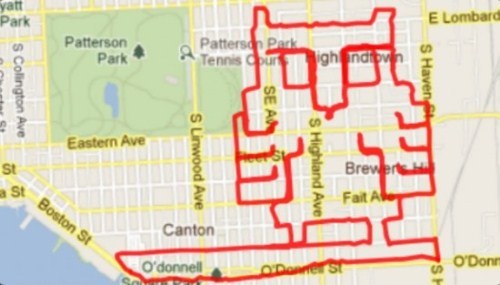
So check this out: http://funnymike.posterous.com/creative-artist-makes-artworks-with-gps-maps

This guy from Baltimore, Michael Wallace, uses his GPS to create art using the waypoint information! Check out his images. I ride and run with a GPS watch all the time but never thought to get creative with my routes to this extreme.

It’s funny, you can buy the hardware to do this for about what you would spend on art supplies to make traditional drawings!

And a good time to mention that GPS is the only practical application of special relativity I know of. Without the time corrections required by the special theory the GPS satellite system would be useless.


Physics & Astronomy Colloquium – next TUESDAY, 7th Feb. – DR. TODD STEVENS, Robarts

My apologies for having the wrong year in the previous notice!              

Poster: http://www.physics.uwo.ca/colloquia/Colloquia%20Notices/2011_2012/STEVENS%20Research%20Talk.pdf


Western University
DEPARTMENT OF PHYSICS AND ASTRONOMY

PHYSICS & ASTRONOMY COLLOQUIUM

Date:          Tuesday, 7th February 2012
Time:          1:30 p.m.
Location:    Physics & Astronomy Seminar Room 22

Dr. Todd Stevens
Robarts Research Institute
Imaging Research Laboratories

“Accelerated high angular resolution diffusion imaging using compressed sensing: Crossing fiber data you can trust in a time you can afford”

ABSTRACT

There are a large number of neuroscience and neurology applications that would benefit from robust functional brain connectivity information. To substantiate and enhance functional MRI (fMRI) analyses of neural circuitry, diffusion–weighted MRI can provide information about the underlying white matter connectivity architecture. However, conventional diffusion tensor imaging (DTI) techniques are not capable of characterizing the diffusion of voxels that contain multiple crossing fibers—a situation that is known to occur in up to 30% of voxels acquired with typical diffusion imaging resolutions. Consequently, network tractography information generated from DTI data is prone to inaccuracies.

High angular resolution diffusion imaging (HARDI) schemes more finely sample the diffusion field to allow for more complete characterization of intra–voxel crossing fibers. The principal drawback of HARDI techniques is long scan times that preclude the acquisition of both fMRI and diffusion data in a reasonable exam time. Advantageously, diffusion information is amenable to dramatic acquisition accelerations using a new approach called compressed sensing (CS). Using CS–based acquisitions, accurate tractography maps based on HARDI information can be acquired at the lower acquisition costs of typical DTI.

This talk will introduce the concepts of CS-HARDI as well as provide details on the development roadmap for establishing and validating this technique, and will briefly describe some potential applications of this technique in the context of existing research interests at Western.