Dr. Leonard C. Feldman of Rutgers University spoke on “The Materials Revoluton”.
Image gallery.
—

Pauline gave a public lecture last week on the 2011 Nobel Prize-winning work of Perlmutter, Schmidt, and Riess, for the discovery of the accelerating expansion of the universe.
Did you miss it; here’s a fun live-comic narrated by physicist Sean Carroll explaining how that work was done, and briefly what it implies about the nature of our universe’s constituency.
A beautifully rendered video by digital-artist Cristóbal Vila that illustrates the facility of geometry as an explanatory tool.
http://www.youtube.com/watch?v=IKPzDFDnmuw
Set to music (“Often a Bird”) by Belgian composer Wim Mertins.
I notice embedding has been disabled; do follow the link though, and I’ll see if I can work around that later =P
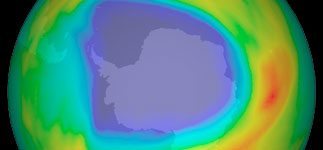
Need some science to get you through your commute? Download this Planet Earth podcast about the summer’s BORTAS campaign which flew out of Halifax. In this podcast Sara Moller talks about the global effects of forest fires.
On a local note, the Purple Crow Lidar has measured smoke particles in the upper troposphere and lower stratosphere (e.g. about 15 km altitude) and been able to show this smoke was associated with forest fire activity a few days earlier in Saskatchewan. This smoke can affect the production of ozone in the stratosphere.
[warning: post contains graphic images, view at your own choosing]
The American Geophysical Union (AGU) Fall Meeting is the largest worldwide conference in the geophysical sciences, attracting nearly [over] 20,000 Earth and space scientists, educators, students, and policy makers. This meeting showcases current scientific theory focused on discoveries that will benefit humanity and ensure a sustainable future for our planet.
UWO P&A’s own Crown Emily is at wits end with deep Fear and Loathing over her advisor’s insistence she get her poster to the printer by EOB yesterday for printing (see photo). Emily worked past 4 (pm) last night making crucial decisions on the poster (she decided on Times New Roman over Times) and picked up today at the crack of noon, when she decided it would be wise to do that analysis she had written about so lavishly last September for her abstract.
“Bob is such a nudge-nik on these things, he thinks just because there are 5,000 posters in the queue to be printed by Monday morning mine won’t be ready. As if, I’m at Western, not like ***** (institutional name deleted at publisher’s insistence).”
Crows Robin and Justin were not available for comment, as they had finished their posters last week and were last seen heading out to play squash.
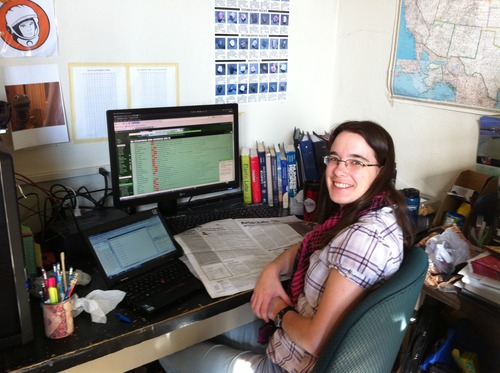
The Old Crow has the honor (?) of being on the AGU Fall Meeting Blog Roll and intends to type up a storm down there next week (Dec 5 to 9) as he roams the poster hall. Follow @robin_wing, Emily and I via twitter (@purplecrowlidar), facebook (The Purple Crow Lidar) or directly on our blog, Scatterings.
La Nina promises most of Canada a colder & more snowy winter this year. But not Southern Ontario, at least yet. La Nina is the cold/wet phase of the global ENSO cycle. The El Nino – Southern Oscillation cycle results from the Pacific Ocean sloshing back and forth like a giant bathtub affecting the circulation and has been found to influence temperature even in the polar stratosphere! You can read more about ENSO here: http://en.wikipedia.org/wiki/El_Ni%C3%B1o-Southern_Oscillation
My boards are all ready to go as soon as Circle R gets some snow!
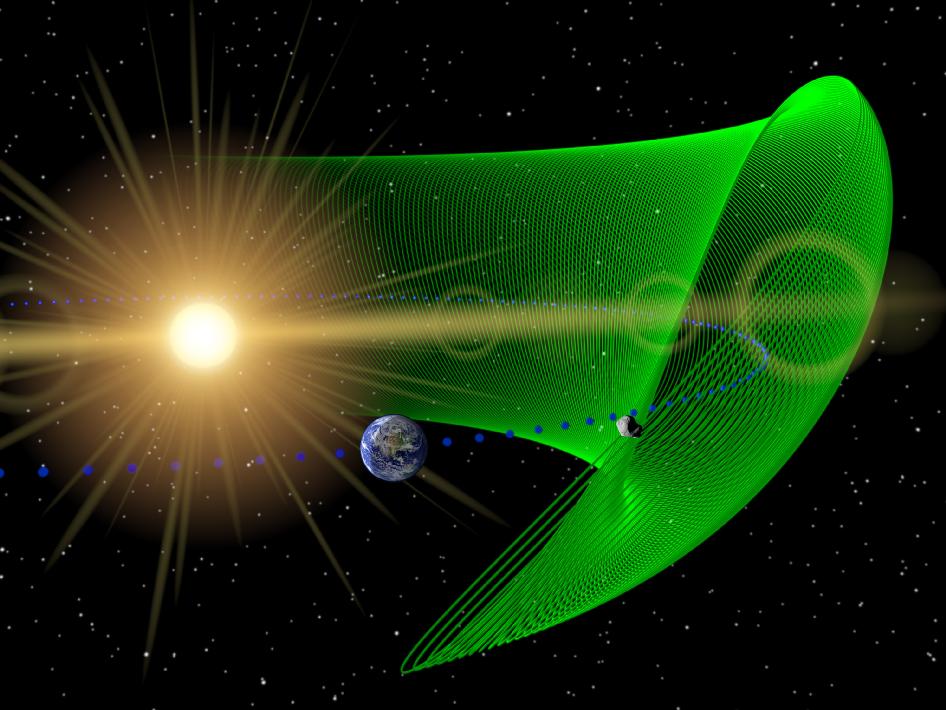
Paul will talk to us today at Western’s Centre for Planetary Science and Exploration weekly meeting about the studies he and his colleagues have done to find the first Trojan asteroid found to share Earth’s orbit. This result was featured on the July 28 issue of the journal Nature.

TODAY
The University of Western Ontario
DEPARTMENT OF PHYSICS AND ASTRONOMY
ELIZABETH LAIRD MEMORIAL LECTURE
Thursday, 1st December 2011
3:30 p.m. in the McKellar Room (UCC290)
Dr. Leonard C. Feldman
Professor of Physics and Materials Science and Engineering
Rutgers the State University and Vanderbilt University
“The Materials Revolution”
Abstract: Modern materials research includes engineering with atoms, the molecule-by-molecule attack of a cancer growth, collecting the sun’s energy with nanocrystals, exploiting the quantum world for computing, defining a stem cell by mechanical deformation and bringing the quantum world to the human experience in an ultra-small solid!
Materials science is the prime example of interdisciplinary research at its best. Extraordinary accomplishments range from Nobel prizes in chemistry and physics to society-changing applications. These accomplishments are underpinned by the technology revolution that brought us to this point in time, and will drive societal changes for the foreseeable future. Currently, the forefront of materials science is at the nano-scale. The nanometer, about four atoms long, exploits the progress of the last century in understanding the atom, and the collection of atoms that constitute a solid. Advances in nano-scale materials are envisioned as the solution to some of the dominant technological problems facing our world¾conservation of energy and environment, water purification and propagating the information revolution. This talk highlights research directed to these advances, including new results in organic electronics, nano-scale desalination and the sophisticated control of materials interfaces for efficient energy use. But, as in all research, it is the future serendipitous discoveries of creative young scientists at well-prepared institutions that will extend the revolution to new ways of thinking and breath-taking new technologies.
As everybody may have heard, one of our PDFs and a graduate student will participate in the new NASA Mars Science Laboratory Mission. Check out this interview with Dr. Alain Berinstain about the mission and Canada’s role in exploring Mars: http://www.cbc.ca/video/#/News/Technology_and_Science/1244504143/ID=2171047166
The agency’s latest Mars rover – a six-wheeled, one-armed robot – took off Saturday morning from a launch pad in Cape Canaveral, Fla.
It was up to an unmanned Atlas V rocket to do the heavy lifting and launch the rover on an eight-and-a-half month voyage to the Red Planet.
“I HAVE LIFTOFF!” read a message posted to the explorer’s Twitter account as the actual rover hurtled into the sky.
The rover, named Curiosity, is equipped with a mobile laboratory which will come in handy during its mission sampling soil and rocks on Mars.
“It is by far the most sophisticated vehicle we have ever sent to Mars,” Paul Delaney, a York University astronomy professor, told CTV News Channel on Saturday.
Curiosity is tasked with scouring the Red Planet for evidence of microbial life, a quest that costs roughly USD$2.5 billion.
Part of the reason the cost is so steep, said Delaney, is because the project has run over its scheduled timeline.
“If you’re going to make that kind of investment in trying to understand Mars, you want it to work properly,” said Delaney.
“NASA pushed the timeline to make sure they could prepare the vehicle as thoroughly and as completely as they possibly could.”
Earlier Saturday morning, NASA had reported some concern over cloudy weather conditions. But those concerns were quelled moments later.
“The forecasters declared conditions are now “GO” for launch after the clouds over the launch site scattered enough to allow a launch,” a representative from NASA’s Kennedy Space Center wrote in a message posted to Twitter.
Curiosity is expected to land in Gale Crater, a 154-kilometre-diameter area on the Red Planet.
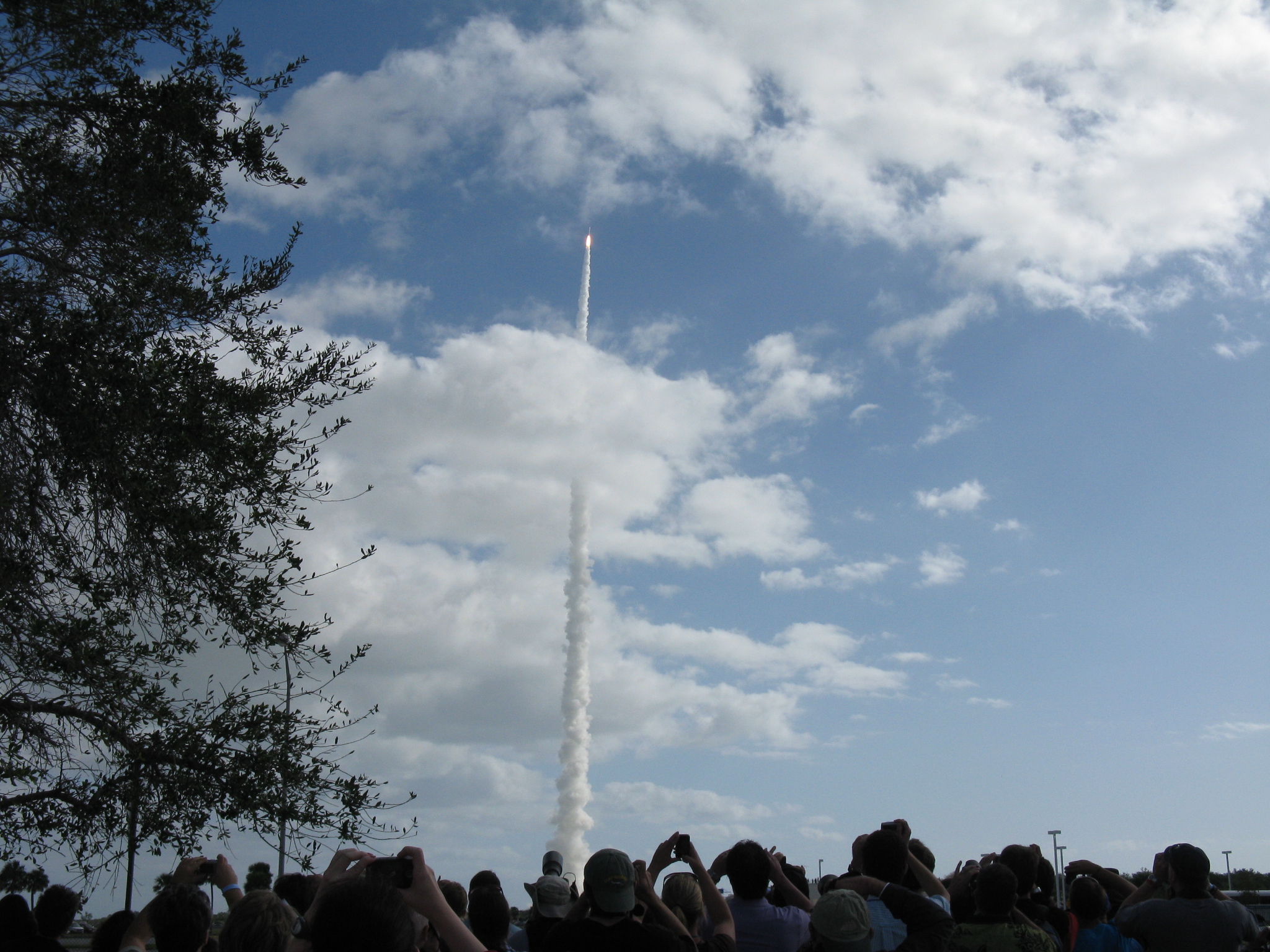
Phot of the MSL launch taken by Dr. Phil McCausland.