Scientists at Western were part of an international research study that has made a huge leap forward in our ability to interpret functional MRI scans.
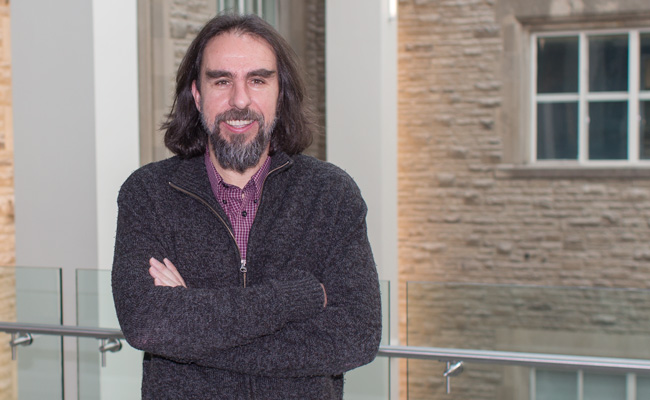
Medical physicist Andrea Soddu and his graduate student Demetrius Ribeiro de Paula, along with Adrian Owen, the Canada Excellence Research Chair in Cognitive Neuroscience and Imaging at Western’s Brain & Mind Institute, were principal investigators in the study.
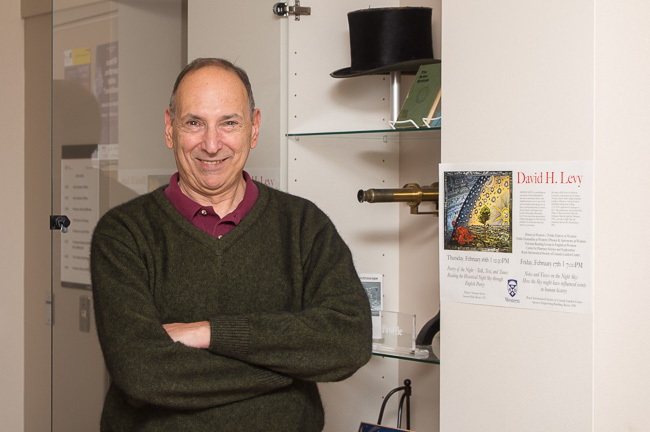
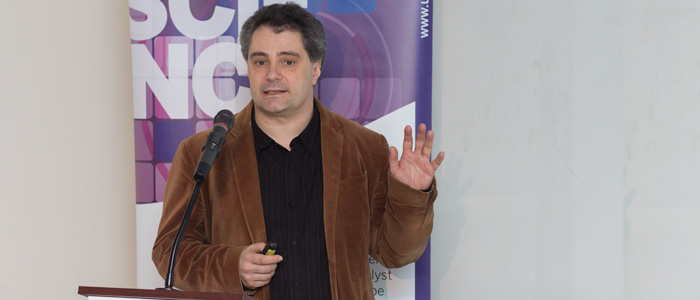
One of the world’s most successful comet hunters, David Levy, spoke in the Department of History on Thursday 16 February 2017.
David conveyed his passion forthe night sky in a talk which was titled, “Poetry of the Night — Talk, Text and Tunes: Reading the Historical Night Sky through English Poetry”.
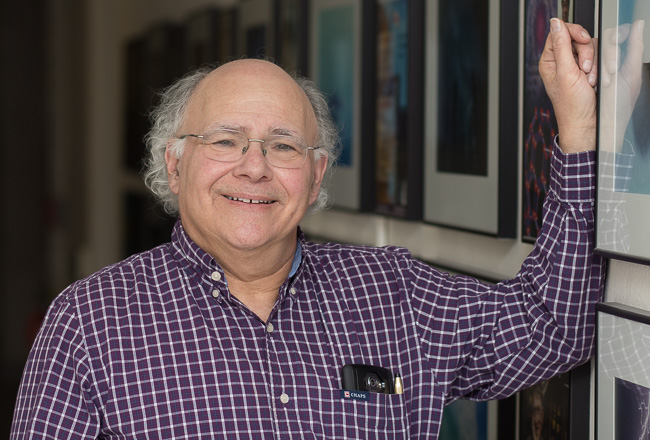
The annual Canadian Association of Physicists (CAP) Lecture was given by Professor Emeritus Stanley Greenspoon of Capilano University.
In the audience were members of the senior undergraduate seminar course, as well as a number of specially invited prospective undergraduates, along with staff, faculty, researchers, and graduate students.
Prof. Greenspoon’s talk was titled, “What’s New in the Search for Exoplanets and Extraterrestrial Life“.
A pizza reception was held in the atrium after the talk. Many Physics and Astronomy faculty members, Prof. Greenspoon, and senior students were on hand to answer questions from the prospective undergraduates.
A one hour film special is being produced by a Japanese network on the story of the 18 January 2000 Tagish Lake fireball event.
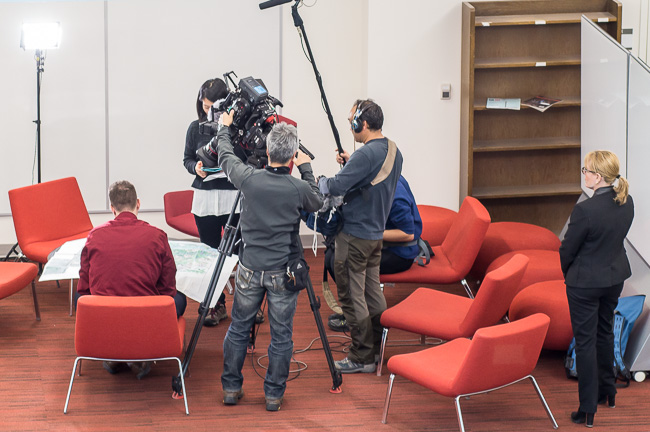
A film crew rolled into town on Monday to interview Peter Brown, one of the leading researchers of the Tagish Lake event. The film crew then flew to Calgary to visit Alan Hildebrand, having been to NASA to interview Mike Zolensky, and to Brown University to film Takahiro Hiroi and Carle Pieters.
There will also be filming on site at Tagish Lake B.C. with Jim Brook and Alan Hildebrand.
The one hour special should air in April of this year.
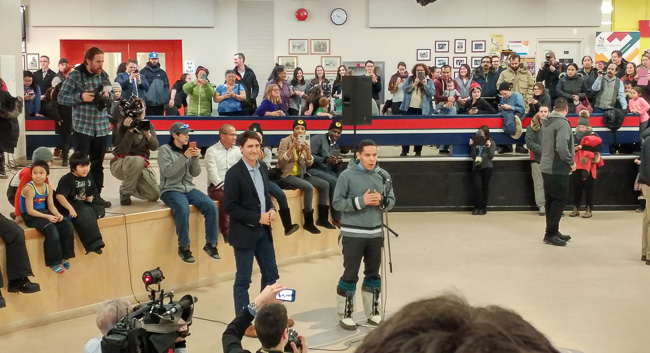
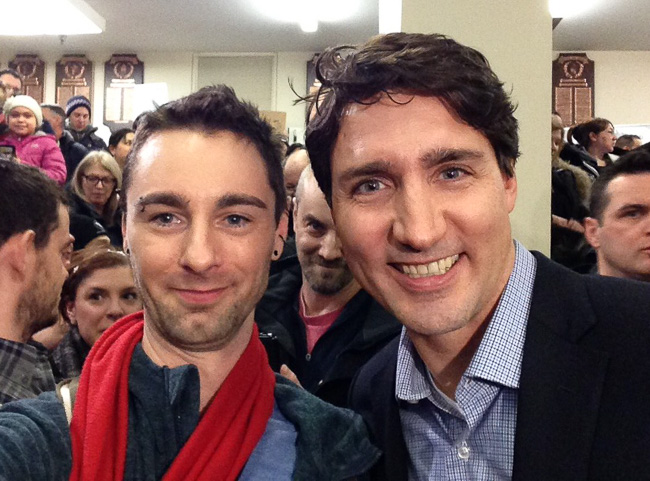
While there, the PM got a chance to meet three CANDAC members, one of whom is our own Purple Crow Shannon Hicks, along with U of T grad student Dan Weaver, and Aubryn O’Grady (CANDAC outreach coordinator), who were visiting Iqaluit as part of the NSERC CREATE program.
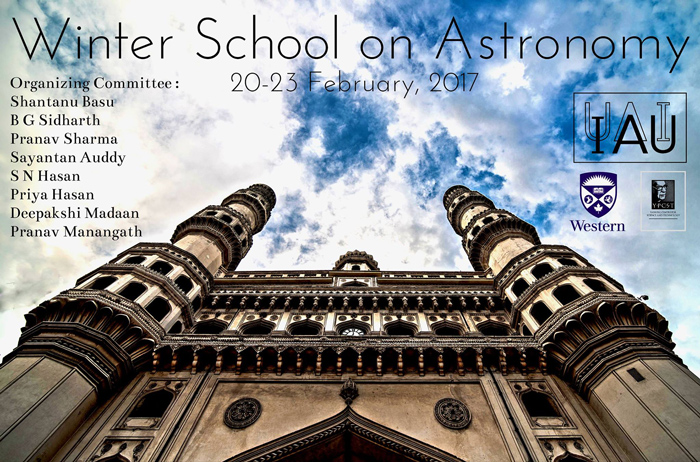
The Winter School on Astronomy is a four-day educational and cross-cultural rendezvous of astronomy targeted to university students. The school intends to inspire and breed a new generation of astronomers.
Our goal is to bring opportunities for astronomy training and discussion with high-level experts for the young bright minds in the developing world. Invited lecturers will teach various topics in theoretical and observational astronomy. Hands-on exercises will equip the students with various tools in astronomy and data analysis. The last day will feature a a research workshop on stellar clusters that will introduce students to the latest developments in the field.
The school is unique in many ways, including its inclusivity of all disciplines. It is the second in a series, with the inaugural school being held in Agra, India. This school, held in Hyderabad, India, has participants from most states of India and from many developing countries. In total, students from nine different countries are registered. The event also promotes cultural exchange and awareness between students from the developed and developing world. Interaction between
students and between lecturers and students are high priorities. Career counseling by lecturers through discussion groups and informal interactions is another important part of the school.
With almost one hundred participants, this is a unique event that reaches out to all of Asia and beyond.
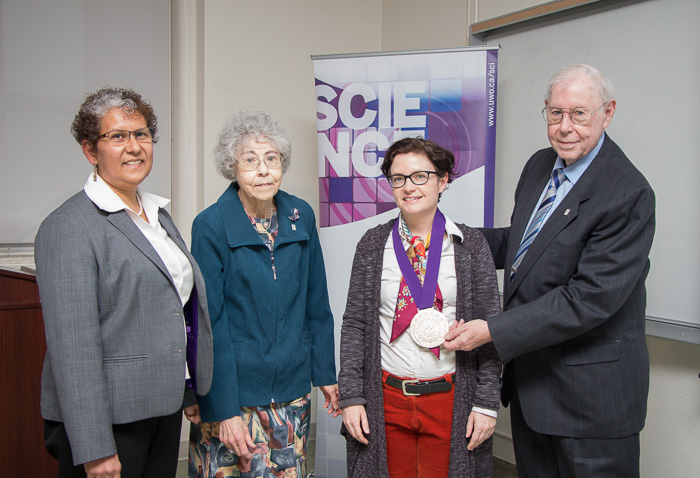
The 3rd annual Fallona Family Science Interdisciplinary Research Showcase (2017 program PDF) was held in the Physics and Astronomy building on Monday, January 16, 2017.
We all again have to thank the generous contribution of the Fallona family, specifically brother and sister James and Mary Catherine Fallona, whose vision is that multi-disciplinary science research can be so much larger than the sum of the individual disciplines.
Fallona medal winner for this year was Western Chemist and Biochemical Engineer Professor Beth Gillies, who have a keynote address titled, “Triggered Degradation of Plastics: From Pharmaceuticals to Agricultural Products.”
Physics and Astronomy was well represented. Professor Giovanni Fanchini gave a presentation “Game Changing Organic Polymers: Expanded Memory in a Flash.”
Short presentations were also given by Western chemists Professors Paul Ragogna and T.K Sham.
The Physics and Astronomy atrium the scene of 100 poster displays by Science faculty, graduate students, and research groups, from whom 3 prize winners were chosen.
The generosity of the Fallona family enabled the presentation of several thousands of dollars in monetary prizes, to be used for research travel by the winners.
First prize winner was Biology student Freda Qi (supervisor Kathleen Hill). Second place award went to André Galvao Duarte (supervisors Danielle Way and Fred Longstaffe), while 3rd place prize winner was Brendan Daisley (supervisor Gregor Reid).
2017 Fallona Medal winner Dr. Beth Gillies (2nd from right), with James Fallona (right), Mary Catherine Fallona (2nd from left), Science Dean Charmaine Dean (left)
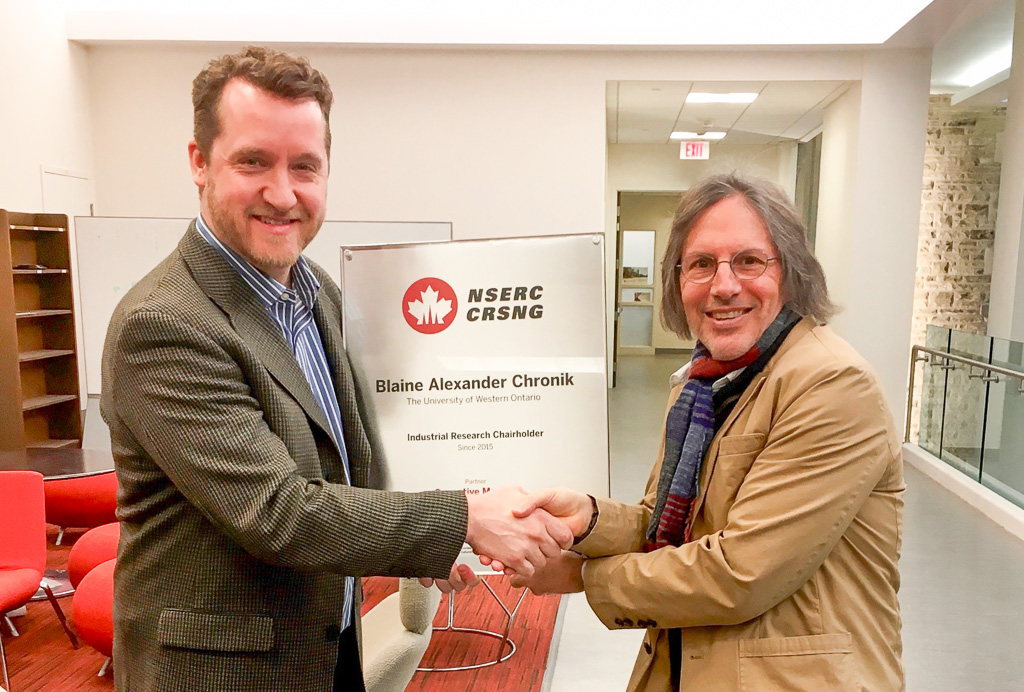
Department Chair Bob Sica (right) congratulates Blaine Chronik (left) on his having been awarded an NSERC Industrial Research Chair (IRC) grant. (photo by Justin Petersen)
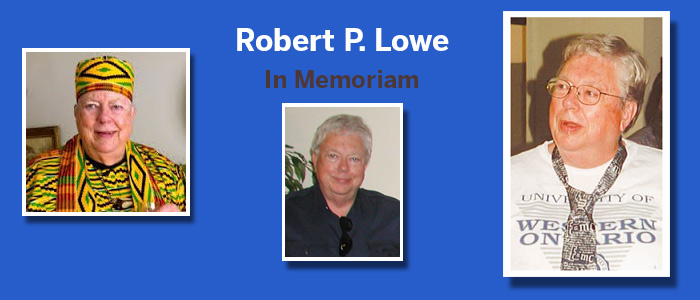
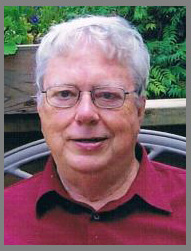
Professor Emeritus Bob Lowe passed away peacefully in his home in London, Ontario, at 11:00pm on Saturday, 7 January 2017. He had been battling cancer.
Robert P. (Bob) Lowe was born in England, and grew up in Port Stanley. As an Honors Mathematics and Physics undergraduate at Western, he may well have been a regular commuter on the London Port Stanley train. He graduated from Western in 1957 and began working for the Defence Research Board (DRB) in Valcartier, Quebec. During his tenure at DRB, Bob continued his studies in atmospheric physics at Western under the supervision of Ralph Nichols, eventually graduating with a PhD in Physics in 1967. Bob began as a faculty member in Western’s Department of Physics in 1968, retiring from the recently formed Department of Physics and Astronomy in 2001.
Bob focused his research on the infrared airglow produced by the Hydroxyl radical. He became a world-renowned expert in satellite based observations of airglow. At one stage he used airborne-ready equipment borrowed from the DRB at Elginfield Observatory, collaborating with Jim Moorhead and William Wehlau on various astronomy projects, observing the infrared spectra of a comet, as well as the Orion Nebula and stars in its environs. Bob also used the Canada France Hawaii Telescope (CFHT) to observe HeH+ in planetary nebula NGC 7027.
Bob Lowe did not let retirement hamper his research efforts, just recently publishing a paper with co-author and his former PhD student, Dave Turnbull. Bob’s research legacy can be partially viewed on his ResearchGate web site.
Bob had a brilliant mind, and a big heart, combined with sophisticated sense of humour. His world-wide travels as a scientist allowed him to indulge in his love of international cuisine.
Department of Physics and Astronomy faculty and staff attended a special post-Christmas retreat at Ivey Spencer Leadership Centre on January 4, 2017.
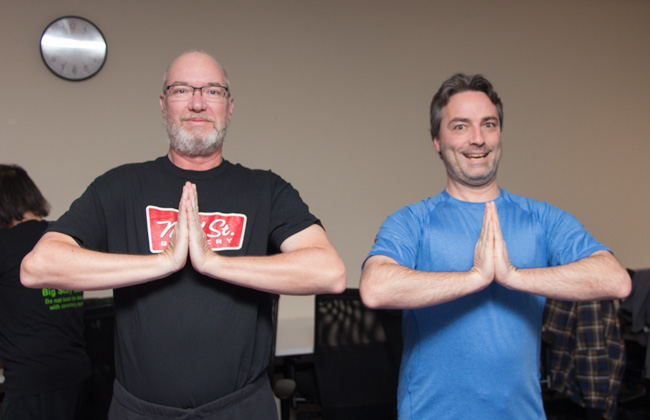
The day began with a wonderfully relaxing hour-long yoga class from teacher Michel. Everyone thoroughly enjoyed it.
With stress levels dissipated, the freshly energized retreat goers went on to a another activity, the head chef’s challenge. Placed in front of each of 4 groups of challengers was a table of sweets, candies, various fruits, graham crackers, skewers, some royal icing, and some thinner consistency icing, along with parchment pastry / piping cone paper. The idea was to have each of the teams not only assemble a creation on a 30cm. by 50cm. plate, but to concoct a story line around the creation. They were given 45 minutes to complete their chefs d’oeuvre.
Group 1 came up with a graham cracker Keck telescope and a spiral galaxy containing an assortment of sweet galactic residents. Pauline Barmby was the group presenter, and did a fine sales job.
Group 2, the overall chef’s pick for winner, had a theme of ‘Solar Eclipse Aug. 21, 2017 at Cronyn Observatory’. This display had everything, including a pineapple Sun, chocolate Moon, melon and cracker observatory, Alumni traffic circle, telescope, and a basement filled with historic artifacts. Jan Cami was sales person for this project, and it is rumoured that he payed off the chef.
Group 3’s presentation was titled “Worlds Collide” and was a well presented mishmash of Sci-Fi lore, including Dr. Who’s Tardis phone booth, a Borg Cube, as well as a small collection of Sci. Fi. characters. Brian Davis did the sales work on this one.
Group 4’s sales pitch was done as a group effort, with a Star Trek theme. The story line has the crew of the U.S.S. Enterprise visiting a planet that is filled with tasty alien life forms.
Lunch followed in DK’s Lounge.
After lunch the group was treated to a very interesting talk by Western Political Science professor Rado Dimitrov. Professor Dimitrov has been the Bulgarian representative to the E.U. during the recent international climate talks, culminating in the Paris Agreement. The audience was given a wonderful taste of the Paris meetings, as well as some insights into the science and diplomacy centred on the global warming issue. There were lots of questions from the audience.
The final item on the agenda was a brainstorming session on several important departmental topics, projects, and initiatives. This was led by Chair Bob Sica.