Category Archives: Physics and Astronomy at Western What’s Happening

Opinions, news, and events for the Department of Physics and Astronomy at Western University.

Rant to our #Padawans on New Year’s morn #westernu

It’s the New Year and thus given Day 1 in the blog rotation I sense a need to offer some life advice for the our padawans. Let them know there is a purpose to what they are doing beyond the next assignment. I take this responsibility with great fear and loathing, but if your wakeup bell hasn’t been rung yet allow me. And if I offend any sensibilities along the way so be it.

You might be worried about a job. You’ve already got one. You’re a citizen of Earth and here to make this a better place then when you arrived. So how are you going to do that?

By pursuing some esoteric path of N-dimensional fantasy theory of everything? Trying to find an Earth clone 100,000 light years away we can’t learn from? Higgs Boson? A better cherry-flavor cola substitute?

I got life advice once. I was your age working the summer at Fermilab, thinking I would do real (e.g. particle) physics when if I grew up. The lab manager took me aside one day and said, “you seem like a smart kid, get out of this field it’s a dead end.” He was right. The grad students were in their late 20s, the PDFs in their 40s and, truth be known, the science was really not relevant to things that matter like hunger or disease. I was soon gone to Alaska to become an atmospheric scientist.

Dave Kendall from the Canadian Space Agency was down here last month talking to the students and challenged them to take risks. That’s an excellent way to put it. Staying in school and studying something with no goal to make this Planet a better place to live is safe and easy and Wrong. If you have a passion or an idea run with it. Believe in yourself. Visionaries like Frank Zappa, Larry Page, Steve Schneider, Ken Kesey, Steve Jobs, etc. did not sit on their fannies and wait for someone to tell them what they wanted to do was “OK”.

Don’t turn your back on Gaia now. There is a war on out there with battles being fought on the fronts of climate, health, social justice, to name a few. You can name more. Pick one that burns in your belly and fight it.

Don’t

  • go to grad school just to go.
  • make the purpose of your education education. Empower yourself for a fight and jump into it. Kill cancer. Fix the mess on Reserves. Clean the air.
  • buy into the BS that knowledge for knowledge’s sake is important and will pay off down the line. We are in deep stuff right now and need your talents now. Focus.

Do

  • Fight the “good fight”
  • remember, if you compromise now you’ll live you life on your knees.
  • Your permanent record won’t follow you for the rest of your life. Be free.

I’m not trying to be an irrational doomsayer here but if we look farther than our FirstWorldProblems to the big picture there is much work to be done to make our home a better place. I am not a gear in an Economic Engine and don’t encourage you to be either.

One person can make a difference, and it starts today with you. We at P&A will do our best to prepare you to succeed at whatever challenges you dare.

Happy New Year.
 

TEDMED talks on non-invasive surgery and a prosthetic eye

Most people I’m sure are already aware of the TED (Technology, Entertainment, and Design) talks.


Here are two interesting TED MED talks on


non-invasive ultrasound surgery, using focused ultrasound + MRI guidance


and
a prosthetic eye to treat blindness

The Kinetic Sculptures of Theo Jansen

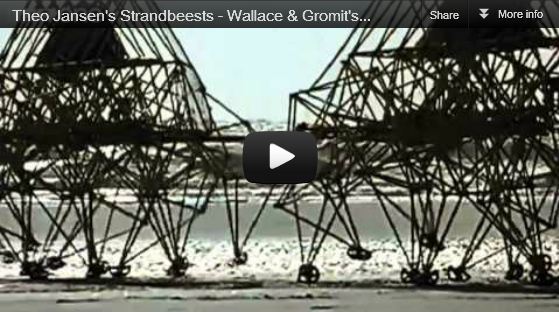
I am not sure why I like Theo Jansen’s kinetic sculptures so much.

[youtube http://www.youtube.com/watch?v=HSKyHmjyrkA]

It could be the almost miraculous way in which they come to life in a strong wind.

There is also something about Theo Jansen himself.  Is he a mathematician, engineer, artist, or mix of each?

But it is the seeming simplicity of the design of his famous ‘mechanism’ that also enchants me. It strikes the same chords (pun intended) as listening to Glen Gould or Andres Segovia play Bach.

There is also something about longevity and stick-to-it-ive-ness of the artist and musician that I admire in people like Theo Jansen. He has publicly given away the details of his movement mechanism, and one could easily understand if this alone, in terms of fame, would have satisfied Mr. Jansen.  But he has continued working on his kinetic creatures for 20 years, making it a life long passion – not unlike Gould, Segovia, or Bach.

Alex D. has already made an interesting posting in our blog about ‘the golden ratio’ and the Fibonacci sequence in nature, and I would be curious to know if any of the lever arms in Mr. Jansen’s design have similar ratios. In fact if one looks at the Jansen mechanism, it has a curvature that is not dissimilar to portion of a nautilus shell.

Then again, such a simple work of geomety perhaps also harkens back to the days when engineers and physicists creatively designed all kinds of machines containing ingenious cams, gears, governors, and other mechanisms,


Why does the sun shine?

As explained by They Might be Giants in this catchy tune (and adorable video).

If you were wondering what carbon, nitrogen (and oxygen) have to do with turning hydrogen into helium, the process is known as the CNO cycle.   The CNO cycle isn’t actually the most important process for fusing hydrogen to helium in the Sun (that would be the proton-proton chain).  Although some of the helium in the Sun is created through this reaction, it plays a much more significant role in stars more massive than our Sun.

Physics and astronomy knittery

This past summer, the stitching group Stitch London (located in the other London) held an event called Stitched Science at the Science Museum.  This event featured a knitted/felted model solar system (including Martians for Mars) as well as a knitted nebula and a crocheted Marie Curie and Galileo among many other sciencey stitched pieces.

However, these examples don’t include all instances of physics or astronomy acting as inspiration for knitted or crocheted projects by a long shot.  There are crocheted space shuttles.  There are knitted solar system sweaters, Galileo mittens, atomic orbital plushes.  There’s even a knitted a Higgs boson and a scarf featuring the CMBR power spectrum.

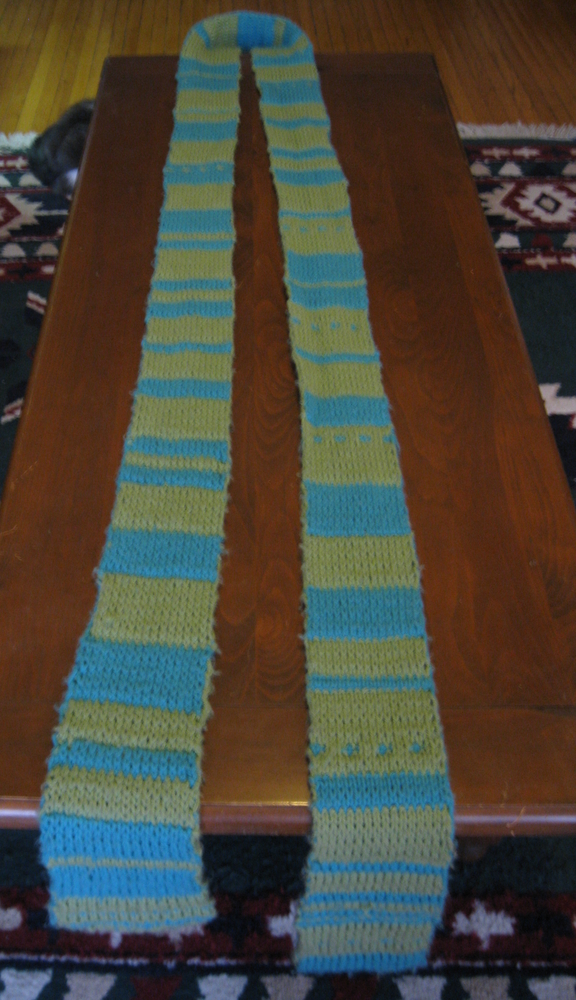
If we look at more mathematically inspired projects, there are mobius scarves, irrational constant mittens, Lorenz manifold mobiles and pi scarves, such as this one I made last year:

The stripes each represent one digit. There are 101 digits of pi represented in this scarf.

So next time someone tries to tell you that physicists aren’t the creative types, you can point to the abundance of physics-inspired knitting and prove them wrong.

Getting a Handle on Star Formation with ALMA

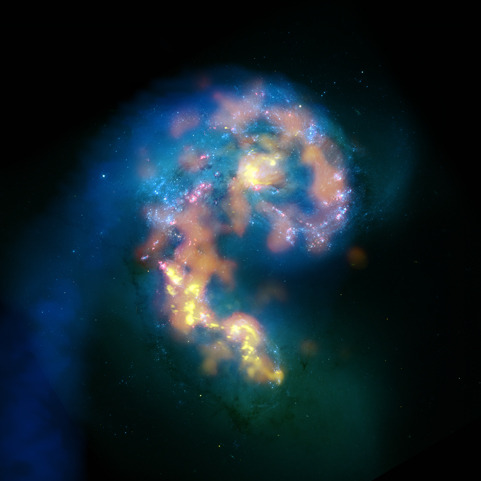
ALMA, the Atacama Large Millimeter Array, is the newest and most advanced millimetre and sub-millimetre telescope in the world. Located on the Chajnantor Plateau in Chile, the observatory is still under construction and will not be completed until the end of 2012. It is an international collaboration between countries in Europe, North America, Eastern Asia, and the host country Chile. By observing at these wavelengths, we see the signatures of molecules in space. It’s only in cold, dense environments where molecules can form, and we know these to be the sites of star formation.

The image shown above was released to the public in October, 2011, and is the first image to be released from ALMA as part of their Early Science observing cycle. It shows a well known collision between two galaxies named The Antennae observed in various parts of the electromagnetic spectrum: optical from the Hubble Space Telescope in white/pink; radio emission from the Very Large Array in blue; and millimetre emission from ALMA in orange/yellow. The ALMA data tell us that large, massive resevoirs of molecular gas (specifically carbon monoxide in this image, a proxy for observing molecular hydrogen) lie along the ridge in the bottom of the image, while more spread out molecular gas exists along the upper rim. This gas will eventually collapse due to the force of gravity and repeatedly fragment into smaller and smaller clouds until stars are eventually born.

Still under half complete, ALMA surpasses the capabilities of any other millimetre/sub-millimetre facility in the world. We eagerly wait to see what new surprises this innovative instrument has in store for us in the near future and after it is fully operational.