Category Archives: Colloquium or presentation

PhD Public Lecture – MON. 17th Sept @ 10 a.m. – ERIC BARBAGIOVANNI

Department of Physics and Astronomy


PhD Public Lecture


Eric Barbagiovanni
Supervisors: Dr. Lyudmila Goncharova and Dr. Peter Simpson


“Influence of Quantum Dot Structure on the Optical Properties of Group IV Materials Fabricated by Ion-Implantation”


DATE:             MONDAY, 17th September 2012
TIME:              10:00 a.m.
PLACE:            P&A New Seminar Room PAB 100


All are welcome to attend.

Physics & Astronomy Colloquium – THURS. 13th Sept. – DR. MICHAEL CUSHING, U TOLEDO

Poster: http://www.physics.uwo.ca/colloquia/Colloquia%20Notices/2012_2013/CUSHING%20Colloquium.pdf


Western University
DEPARTMENT OF PHYSICS AND ASTRONOMY


PHYSICS & ASTRONOMY COLLOQUIUM


Date:           Thursday, 13th September 2012
Time:          1:30 p.m.
Location:    Physics & Astronomy
*New* Seminar Room 100

Dr. Michael Cushing
Ritter Astrophysical Research Center
University of Toledo


“The Discovery of Y Dwarfs with WISE”


ABSTRACT


One of the primary science goals of the Wide-field Infrared Survey Explorer (WISE)—a NASA mission that surveyed the sky at four mid-infrared wavelengths—is to identify very cold (Teff < 1000 K) brown dwarfs. With atmospheric conditions similar to that of giant planets, brown dwarfs are ideal exoplanet analogs that can be observed free from the contaminating light of host stars. The study of these cold brown dwarfs will also provide constraints on the low-mass stellar mass function and on the lower mass limit of star formation, two critical constraints on theories of star formation. To date, we have identified roughly 170 new brown dwarfs with WISE, 13 of which are so cold (Teff < 500 K) that the creation of a new spectral class—dubbed ‘Y’—was required. I will discuss the discovery of the Y dwarfs as well as our initial constraints on the substellar mass function.

Physics & Astronomy Colloquium – THURS. 6th Sept. – DR. PAULINE BARMBY, Western

Poster: http://www.physics.uwo.ca/colloquia/Colloquia%20Notices/2012_2013/BARMBY%20Colloquium.pdf


Western University
DEPARTMENT OF PHYSICS AND ASTRONOMY

PHYSICS & ASTRONOMY COLLOQUIUM

Date:           Thursday, 6th September 2012
Time:          1:30 p.m.
Location:    Physics & Astronomy *New* Seminar Room 100

Dr. Pauline Barmby
Department of Physics and Astronomy
Western University

“Andromeda’s coat of many colours”

ABSTRACT

Andromeda is the nearest large galaxy and provides the best view of what our own Milky Way might look like from the outside. Although Andromeda’s nearness makes it possible to see the fine details of its internal structure and stellar populations, only recently have observational facilities been able to also provide a global portrait at many wavelengths. Finally we can begin to compare and contrast Andromeda and the Milky Way on both large and small scales in order to understand how local environment shapes a galaxy’s history. I will discuss how multi-wavelength observations of Andromeda’s stars, star-forming regions, and stellar clusters are shaping our picture of this touchstone galaxy.

Physics & Astronomy Colloquium – THURS. 26th April – DR. SHELLEY WRIGHT, Dunlap Inst., UofT

Poster: http://www.physics.uwo.ca/colloquia/Colloquia%20Notices/2011_2012/WRIGHT%20Colloquium.pdf


Western University
DEPARTMENT OF PHYSICS AND ASTRONOMY


PHYSICS & ASTRONOMY COLLOQUIUM


Date:          Thursday, 26th April 2012
Time:          1:30 p.m.
Location:    Physics & Astronomy Seminar Room 22


Dr. Shelley Wright
Department of Astronomy & Astrophysics
and Dunlap Institute of Astronomy & Astrophysics
University of Toronto


“Studying Galaxies in the Early Universe with Innovative Astronomical Instrumentation”


ABSTRACT


Studies of galaxies in the early universe (z > 1) have greatly benefited from recent advances in diffraction-limited techniques on 8-10m telescopes using adaptive optics (AO) and integral field spectroscopy. These innovative spectrographs have led to significant scientific achievements and are stimulating the design of future instrumentation. My talk will focus on development and use of the latest near-infrared instruments behind Keck Observatory’s AO system. I will present OSIRIS and Keck AO observations of spatially resolved optical emission lines (e.g., Halpha, and [N II]) from high-redshift (1 < z < 3) star forming galaxies. These results are part of an ongoing survey to study the dynamics, chemical abundances, and active galactic nuclei (AGN) in early galaxies. The high spatial resolution and 2D capability of an integral field spectrograph has allowed the discovery of some of the lowest luminosity AGN known at this epoch, and I will discuss their potential impact on high-redshift metallicity studies and galaxy formation. Lastly, I will discuss future instrumentation upgrades for OSIRIS and development of new instrumentation on extremely large telescopes (30m), which will offer extraordinary potential to probe the dynamics, assembly, and abundances of galaxies in the early universe.


Coffee & cookies will be available, courtesy of PASA.

P&A Special Undergrad Level Talk – NEXT TUESDAY – DR. NICOLAS COWAN, Northwestern University

The University of Western Ontario
DEPARTMENT OF PHYSICS AND ASTRONOMY


Special Undergraduate LevelTalk


Date:          Tuesday, 17th April 2012
Time:          10:30 a.m.
Location:    Physics & Astronomy Seminar Room 22


Dr. Nicolas Cowan
Center for Interdisciplinary Exploration and Research in Astrophysics (CIERA)

Northwestern University, Illinois


“Tortured Climes: Infrared Observations of Hot Jupiters”


ABSTRACT


The discovery of gas giant planets in few-day orbits around their host stars posed serious challenges to theories of planet formation. In the last half-decade, our ability to probe the atmospheres of these hot Jupiters has likewise challenged our notions of climate. Many of these worlds have extremely eccentric orbits, leading to seasons that make Earth’s obliquity-driven seasons seem like a joke. For most Solar System planets, the dominant driver of heat transport is the equator-to-pole temperature gradient. On hot Jupiters, it is the huge day-night temperature contrast (from hundreds to thousands of degrees) that drives atmospheric circulation, potentially leading to transonic winds. Their atmospheres are slightly ionized, making magnetohydrodynamics relevant. Some of the shortest period gas giants have severely warped shapes due to tidal effects. In short, these planets are unlike anything climate scientists have thought much about.

I will present observational studies that can help constrain the mysterious workings of these planets. I will show how we can use time-resolved infrared photometry to learn about hot Jupiters.

Physics & Astronomy Colloquium – MONDAY, 23rd April – DR. STANIMIR METCHEV, Stony Brook University

Poster: http://www.physics.uwo.ca/colloquia/Colloquia%20Notices/2011_2012/METCHEV%20Research%20Talk.pdf


The University of Western Ontario
DEPARTMENT OF PHYSICS AND ASTRONOMY


PHYSICS & ASTRONOMY COLLOQUIUM


Date:          Monday, 23rd April 2012
Time:          1:30 p.m.
Location:    Physics & Astronomy Seminar Room 22


Dr. Stanimir Metchev
Department of Physics and Astronomy

Stony Brook University, New York


“Exoplanetary Worlds: Atmospheres, Architectures, and Evolution”

ABSTRACT


The detection of global weather phenomena in irradiated extrasolar hot Jupiter planets has provided tremendous insights into their atmospheric structure. Non-irradiated substellar atmospheres probe weather in an entirely different regime, where global atmospheric flows result primarily from a combination of rapid rotation and internal convection—e.g., as in the atmosphere of Jupiter—rather than from external forcing. Isolated brown dwarfs are ideal targets for such investigations because they possess planet-like atmospheric dynamics, yet have greater intrinsic brightnesses and lack nearby bright stars to contaminate observations. I will overview recent results on non-irradiated brown dwarf and planetary atmospheres, and will present the prospects for the direct characterization of extrasolar planets with the coming generation of extreme-contrast imaging telescopes.

Physics & Astronomy Colloquium – NEXT MONDAY, 16th April – DR. NICOLAS COWAN, Northwestern University

Poster: http://www.physics.uwo.ca/colloquia/Colloquia%20Notices/2011_2012/COWAN%20Research%20Talk.pdf


The University of Western Ontario
DEPARTMENT OF PHYSICS AND ASTRONOMY

PHYSICS & ASTRONOMY COLLOQUIUM

Date:           MONDAY, 16th April 2012
Time:          1:30 p.m.
Location:    Physics & Astronomy Seminar Room 22

Dr. Nicolas Cowan
Center for Interdisciplinary Exploration and Research in Astrophysics (CIERA)

Northwestern University, Illinois

“Divining the Climate of a Pale Blue Dot”

ABSTRACT


Temperate rocky planets are being discovered around nearby stars but we know precious little about them aside from mass, incident stellar flux, and sometimes bulk density. To understand what these worlds are like we will need to know their climate. This will most likely require one or more expensive space missions, and it is worth studying which measurement suites best constrain simple climate models. I will describe how the changing colour and brightness of an exoplanet—at both optical and thermal wavelengths—can be used to constrain its surface conditions and climate.

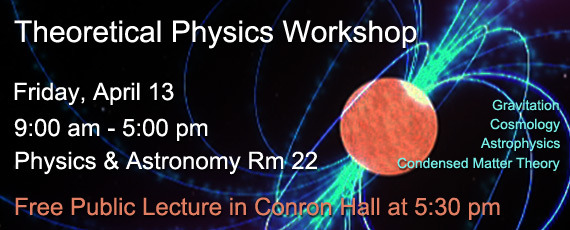
Theoretical Physics Workshop – Friday, April 13, 9am-5pm

A Theoretical Physics Workshop is being held all day Friday, April 13, 2012 in the Physics and Astronomy building.

Registration is at 9:00am in PAB 22. Talks begin at 9:30am.

Interested students who are not on the participants list are welcome to attend and listen to the talks.

[Workshop web site]

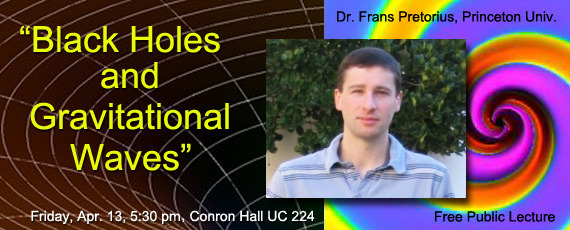
Note that immediately after the workshop there will be a free public lecture in Conron Hall (University College 224) at 5:30 pm.

The guest speaker is Dr. Frans Pretorius of Princeton University. The talk is titled “Black Holes and Gravitational Waves“.

REMINDER: JOINT Phys&Astr / CPSX Seminar – TODAY (5th April) – DR. NIKKU MADHUSUDHAN, Yale

TODAY @ 1:30


JOINT SEMINAR—the Department of Physics and Astronomy and the Centre for Planetary Science and Exploration (CPSX)

Date:           Thursday, 5th April 2012
Time:          1:30 p.m.
Location:    Physics & Astronomy Seminar Room 22

Dr. Nikku Madhusudhan
Yale Center for Astronomy and Astrophysics
Yale University

“Chemical Characterization of Exoplanetary Atmospheres”

ABSTRACT

Recent advances in exoplanetary science are leading to unprecedented constraints on chemical compositions of exoplanetary atmospheres. Molecular and elemental abundances derived from exoplanetary spectra provide critical clues on the chemical and dynamical processes in exoplanetary atmospheres, on the compositions of their interiors and formation environments, and on the potential habitability of rocky exoplanets. In this talk, I will present emerging constraints on chemical abundances for an ensemble of exoplanetary atmospheres, and their implications for atmospheric processes, interiors, and formation conditions of exoplanets. Strong constraints are emerging on mixing ratios of carbon and oxygen based molecules and on the elemental C/H, O/H, and C/O ratios in giant exoplanetary atmospheres. In particular, the C/O ratio critically influences the H2O abundance, with major repercussions on atmospheric chemistry and thermal inversions, and on the compositions of ices and rocks in planetary interiors and protoplanetary formation zones. Some of the first constraints span C/O ratios of unity or higher, opening the exotic possibility of carbon-rich planets (CRPs). The properties and formation scenarios of CRPs will be discussed in this talk. Such compositional estimates of extrasolar planets open new research avenues at the intersections of geosciences, planetary science, and astronomy. I will discuss some frontier areas in this direction, along with an overview of observational campaigns, from ground and space, and theoretical and experimental efforts.


Coffee & cookies will be available, courtesy of PASA.