All posts by catschroedinger

The Future of the Canadian Space Agency

Here I will share an email I received this morning from the Canadian Astronomical Society (CASCA).

Budget expectations for the Canadian Space Agency (CSA) show a dramatic decrease in the funding to space astronomy programs. The extent of the cuts will jeopardize the future of space astronomy in Canada and undermine the credibility of the CSA as a partner in international space missions.

All Canadian astronomers are urged to sign the petition, that can be found at the following URL:
http://tinyurl.com/CSA-petition   (Edited, thanks to the comments below)

This will cut funds to (among others) all space astronomy projects (such as JWST, Herschel, Planck, Astrosat, Astro-H, etc..).

The Final Countdown… Month 12

In the next 12 months I hope to bring you monthly updates on my final year (or so I hope) of my PhD.  In this time, I intend to give a little insight into not only the crazy world of thesis writing and submission but also, and more interestingly, into the process of the post Grad-school work applications.

I will post not only detail of the positions for which I apply but also positions that I think are interesting outside of Astrophysics and academia.  Although I do intend to do a PostDoc, I think it is nice to see what else is out there and this, I think, is worth sharing.

A little personal homework for myself over Christmas and a perfect place to start: preparing an academic and non-academic CV for Physics and Astronomy graduates.  Next month I will include hints and tips and probably a link or two.  But for this month I will leave you with some food for thought; what skills does one acquire while studying Physics?

  • Communications – from giving seminar talks to your peers, to running a lab or tutorial, to writing a research proposal, to writing a scholarship application we communicate on many levels with many different audiences.  Being able to communicate complex ideas easily and concisely is a skill that is useful far beyond academia or science.
  • Time Management – those of us who have had courses to take, while TAing various courses, while carrying out intensive or time consuming research perform a precarious juggling act.  It is never easy, but in the long run we gain from such experience.  Eventually we become more efficient and not just in our research or our courses or our teaching.  Again these are lessons that are more far reaching.
  • Independence – a good academic supervisor guides us in our research they do not lead.  They allow us to make our own decisions under their guidance, and eventually without it.  As far as our research is concerned we might have some one guiding the reigns and checking our progress but we also learn to be our own bosses.  If we do not pull our weight in the end we fail only ourselves.  This should leave us with a great ability to work under our own iniciative.
  • Computer Literate – for the most part this speaks for itself but in addition to what most of the world consider to be computer literate we have probably all picked-up at least two programming languages along the way and with that the basics of a few others.  Similarly given the technological nature of modern research I also imagine that many of us are pretty tech savvy to boot.
  • Technical Experience – what you are good at here, obviously depends on your area of choice, but we each have something.  Depending on what you have been doing for the past few years, you’ll know what it is you are learned in here.  But consider the extra bits and pieces that go into that experience.
  • Problem Solving – I mean thinking on your feet, not algebra.  Many of our activities involve doing this: your results do something terribly unexpected, your computer freezes up in the middle of you doing the most important piece of work you have done that week, the target doesn’t appear in the guiding camera.
  • Technical Writing – journal articles, need I say more.
  • Teaching – not just communicating but actually conveying information.  Personally I see this as one of the best skills a grad student will acquire.  Obviously useful in a future academc career, but also in many other things.  Paying attention to how students learn arms you with the information on how anybody/everybody learns.  This is useful in training of any variety both within and without the work place.  The insights you gain from student-TA interactions  can be useful in many other places.

Happy Holidays!!

Limer(phys)icks

I haven’t settled on a theme for my Posterous entries yet, so for now here are some limericks I wrote today about a few famous inter-scientist feuds.


Newton VS Leibniz –
Sir Newton roared “I am the brainiest!
Leibniz’ false claims are extraneous!”
This lewd calc feud brewed…
So to lighten the mood,
Lorentz said “Perhaps simultaneous?”


Darwin VS Alfred Wallace
Sir Wallace made Darwin look surlier.
The latter, dumbfounded, said “surely your
work’s not involving
each species’ evolving!
I sure wish I’d spoken up earlier!”


…
Let’s try that again
…


Both Darwin and Wallace had luck,
Showing complex forms started from muck,
But though they both solved
How we have evolved
Better writing meant glory for Chuck!


Einstein VS Bohr
Einstein could not reach a junction
With Bohr’s mysterious wave function
This logical trap,
He thought was such crap,
He administered Neils’ Extreme Unction.


(I think they actually just agreed to disagree, but that doesn’t rhyme with ‘wave function’…)


Happy holidays to everyone!

Certificate of Academic Engagement

The Student Development Centre (SDC) at Western offers many useful learning skills services.  One service that I found particularly helpful during my undergraduate carreer here was their free series of workshops including writing workshops, learning skills workshops, and psychological services workshops.  The content covered in these workshops covers everything from strategies to write exams (particularly multiple choice exams), referencing your paper, writing in the sciences, and writing a thesis statement to managing and regulating your emotions and managing anxiety and stress (something I think all of us need a little help with during exam time).

There are also GradWRITE interactive workshops, where participants are encouraged to bring their own work in progress to get help with writing a literature review, creating an abstract, writing effective proposals, and polishing their writing.

The certificate part?  Well, not only do these workshops help you in your studies, but if you attend four of them (between September and April of the same school year), the SDC will issue you a Certificate of Academic Engagement; a regonition to students who “make the effort to be their academic best”.

Find out more information about the Certificate of Academic Engagement, the workshops offered by the SDC, and other services offered by the SDC at: http://www.sdc.uwo.ca/learning/.

(originally posted by Mel Wright)

Study Advice

Ideally, you should go through your class notes every night and spend at least another two hours (per hour of class) solving problems.  Realistically, you have a life; it’s not likely that you can devote that kind of time commitment to each course.

Keep good, organized notes
Write your notes out neatly, perhaps in a bound book (available at the book store for roughly $4) or type them up on your computer.  Don’t just copy what the professor says; turn it into your own words so that next time you read over them you will understand concepts and steps quicker and better.  Neat, good, organized notes are easier to understand than loose papers, especially if you only have half of those papers…  Plus, you never know when they are going to come in handy!

Review your notes
Spend about 10 minutes per class hour each night reviewing what you covered in class earlier that day.  This enables you to see the material again and become more familiar with it.  If you didn’t understand a concept in class, go through it slower on your own and see if you can “decode” what your professor did in class.  Don’t have time?  Read them on the bus to/from school or while waiting for the bus.  You would be amazed at how much time you waste on the bus and waiting for it–that’s how I read all 11 novels for my first year English class!

Ask questions
Don’t understand something?  Ask questions!!!  Ask your professor questions, your TA, other students in your class.  Don’t be worried about “appearing stupid”; everyone has questions (except for perhaps Gauss).  You’re in science.  The whole point of science is to ask (and try to answer, through observation) questions about stuff we don’t know.

All of the above is great advice, but they are things you need to do throughout the school year, not suddenly at exam time.  My advice for those exams that you really have to cram for:
Determine the exam content
 You could always try the brute force method of simply asking your professor what is on the exam, but don’t be surprised if it doesn’t work.  Think back to lectures and assignments.  What did you spend a lot of time on?  What did the professor emphasize?  Chances are that will be tested.

Determine what kind of examiner your professor is
Think back to midterms and tests.  Does your professor prefer to test your knowledge through derivations, problems, or conceptual questions?  Will the test be long answer, multiple choice, or a combination?

Determine your weak points
Determine what you don’t know or understand too well.  Determine what you need to know in order to understand the tougher/more advanced material.  Focus on the more basic stuff first.

Acknowledge your strengths
So you understand a concept really well.  Yes, it feels nice to finally be able to get the same answer as the back of the book or practice test solutions or to see how that derivation is “trivial”, but you understand that material; do a couple questions and move on.  If later on during your study session you start to get discouraged, do another one of these problems to boost your confidence!

Make a “cheat sheet”
Even if you aren’t allowed to use it on the exam, make a “cheat sheet”.  It is a good way to summarize concepts and equations that you need to know.

Reward yourself
Sit yourself down in an area with few to no distractions.  Set a time that you are going to work until or a section that you are going to get through.  If it is a time, set a timer and don’t look at your watch while studying.  If it is a section/chapter, put a post-it note in your book at that spot.  Before you begin studying, also set what you will get as your reward, such as two Mario Kart races, a walk around the block, preparing a snack while listening to your favourite song, whatever.  I find the best breaks are relatively short (5-10 minutes) and do not involve brain power.  When your break is done, acknowledge that it is done; sit yourself back down, set a new study goal, and another reward, then work for it.

Eat healthy–maybe even healthier than normal
Pick up carrots, celery, cucumber, apples, pineapple, watermelon, berries, broccoli, cauliflower, etc. to snack on, rather than junk food.  I find I feel a lot better with veggies and fruit in my system.  You also won’t run into a sugar crash.

Maintain your work-out schedule
Even though you are swamped with work, yes, you still have time to go to the gym for your daily swim.  It is a good study break and healthy for you.  If you don’t feel like you have time to head to the gym, then take a walk around your neighbourhood instead.

Avoid coffee and energy drinks 
Okay, so the caffeine in coffee and energy drinks helps you stay awake so you can cram more information into your brain, but is it actually helping?  Are you retaining that information?  A good night’s rest followed by serious studying is more beneficial than spending the night hyped up on caffeine, watching three youtube videos for every two minutes of work, and being completely and utterly drained the next day.

Get a good night’s rest
While you are studying and especially the night before an exam, get a good night’s sleep.  You will feel refreshed and your head will likely be clear and willing to accept more information.

Different things work for different people
 My advice isn’t the only advice out there–I bet your parents, professors, TAs, and friends all have advice.  I know Raffi has a Study Guide on PASA’s website at 
http://pasa-uwo.com/studytips.php.  Try out different methods of studying and see what works best for you.

Good luck!!!

(originally posted by Mel Wright)

Learning to Gradschool Ep. 1

If I could condense this post into one idea it would be, counter-intuitively perhpas, “Take time off.”

After finishing my undergraduate degree I decided to spend some time some time living abroad in Japan. I’ve always had a fancy for other languages, but Japanese seemed reasonably complicated. With its three “alphabets”, I decided I would need to spend considerable attention studying the language in it’s own environment if I was to learn how to read-write-and-speak it with any degree of adequacy. So, away I went, 10,563 km, from Toronto to Nagoya.

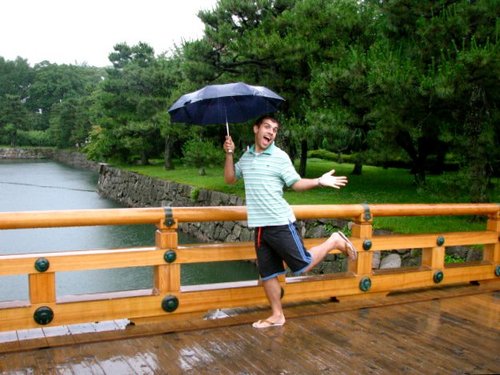
Singing in the rain on a bridge in Kyoto, Japan.

I spent considerable amounts of time huddled over books in libraries and bookstores, writing furiously over cups of coffee in cafes, and striking up conversations with anyone that would pause long enough to listen… to my horrible defacement of the language; though I did get better in time. You get to meet some incredible people when you put down your guard for the simple sake of wanting to have a conversation (a challenging feat when that conversation is in a language you’re struggling to understand): my still-good-friends, graphic designers, Takashi and his wife, Chieko, and I would go cross-country (motor)cycling through the mountains, visiting wonderfully isolated shops and restaurants in the Japanese countryside. I try to visit still, when my schedule, and pocket-book, afford.

With time away from school, you begin to build a life for yourself apart from attending classes and finishing assignments. Yet a part of me could not escape that want for knowledge. On camping trips, I would point out the planets among the stars, and tell stories of the constellations; and my friends would always encourage me, aware of my interest in physics, turning to me for explanations of topics they had heard about on the news, or read in a newspaper, wanting to know more about this-or-that discovery. Perhaps most tellingly for myself, at the end of the day I would return home and almost ritually, with a cup of coffee, browse the arXiv to learn of the latest developments being made by the physics-community.

I have thought of becoming a scientist since I was little boy. But no experience more blatently underscored that desire to me than when I took time away from that trajectory to explore something else. I realized that I didn’t just want to learn about the universe, it was something I needed to do.

Travel is certainly not for everyone, and Japan is a little too far away for many. But the lesson, and perspective, I have found to be essential to encouraging my own focus, now, as an actual graduate student: I don’t just think, but know, I would not want to be doing anything else.

‘Learning to GradSchool’ is a recurring series written by Alexander DeSouza, with posts once-per-month, of his experiences/reflections navigating graduate school/foraging for free food, and learning how to be a better scientist.

(originally posted by Alexander DeSouza)

Mars, Ice, Water, Life . . . Ethical Dilemma?

In the past few years, discoveries of ice on Mars, and evidence appearing to show proof of liquid water on the planet, have raised the serious possibility of Martian (microbial) life, either now or sometime in the past. Then a little less than two weeks ago, NASA’s Curiosity rover successfully launched. Its primary goal is to dig up more evidence that suggests life, or the holy grail – evidence of life itself.

All of this raises a whole host of other issues, including, and importantly, ethical ones. If life is found on the red planet, what should we do about it? Are we obligated to abandon exploration or give up on an idea of expanding to Mars, to let it follow its own path? After all, humanity’s track record when it comes to colonizing new worlds is not impressive, so do we get the right to more? And what sort of interference with the evolutionary process (if any) might be acceptable? On Earth we experiment on single-celled life all the time. We encourage our children to do so. Would it make a difference – should it make a difference – if the life we’re looking at came from somewhere else? And if the answer’s yes, doesn’t that imply something about how we define life in the first place?

Just a few questions without answers. At the moment they’re fairly trivial, but if Curiosity finds something, or when, eventually, something somewhere is found, they’re going to be very important. Looking forward to that day.

(originally posted by LizGray)

Ultimate Death Wish: Comet Lovejoy will dive into the Sun today!

Comet Lovejoy is a Sun-razer, which was discovered by an Australian amateur astronomer Terry Lovejoy on 27th November 2011. Comet Lovejoy will make the closest approach to the Sun today at 7p.m. EST. It will narrowly miss the Sun by passing just ~140,000 kilometers from the Solar Photosphere. It will likely vaporize before narrowly missing the Sun.

Here is an article’s on Discovery!!!