
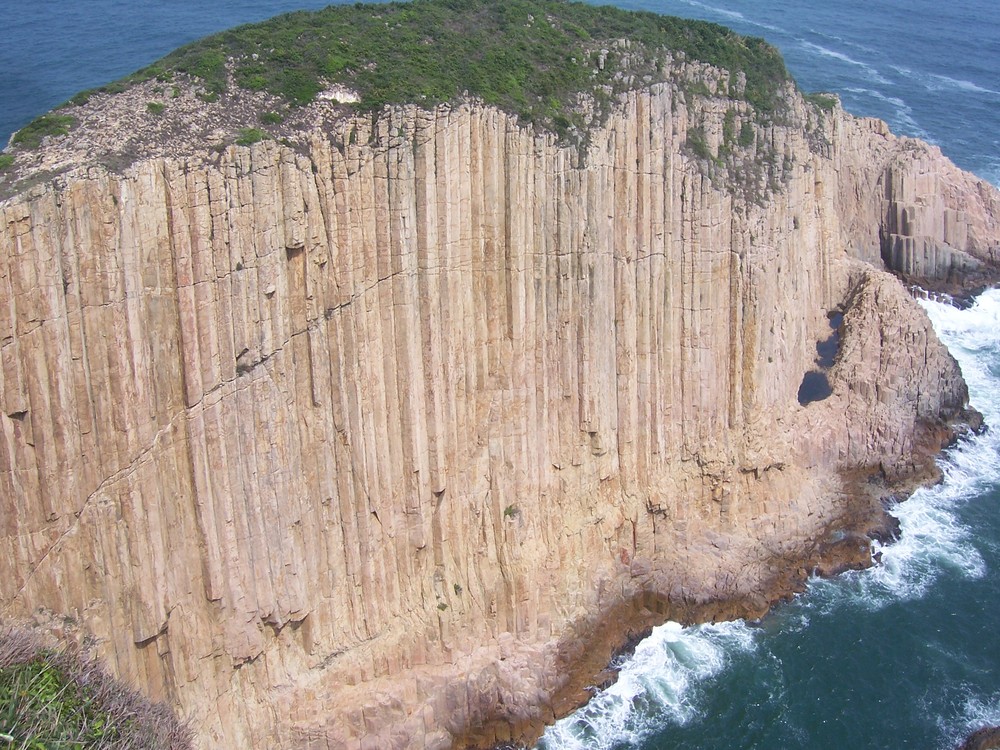
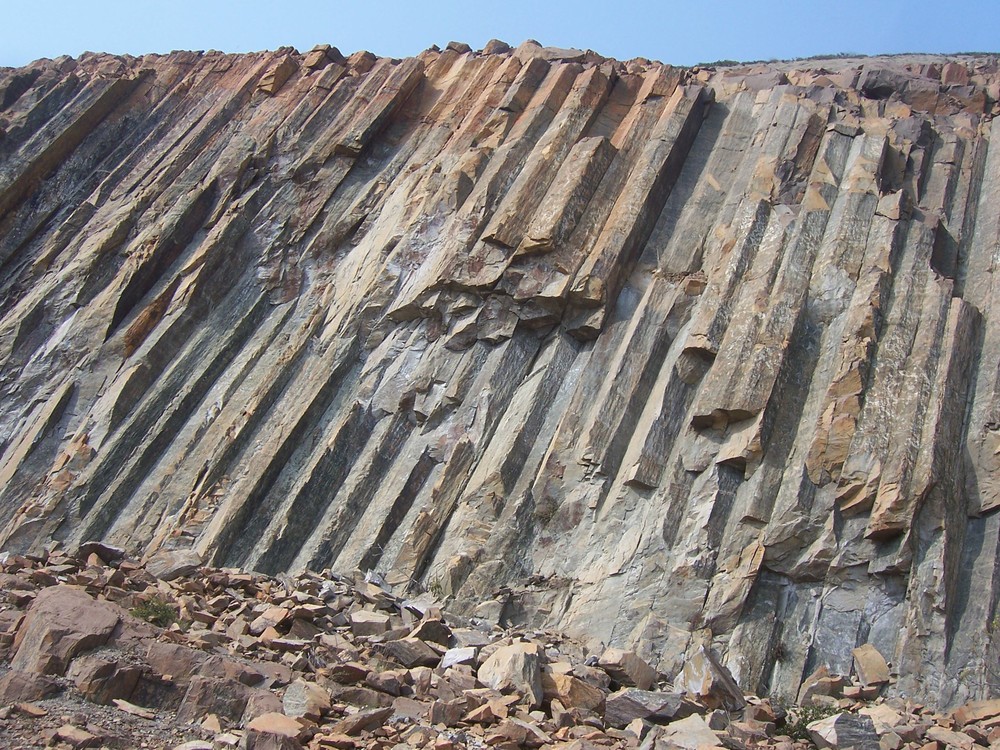
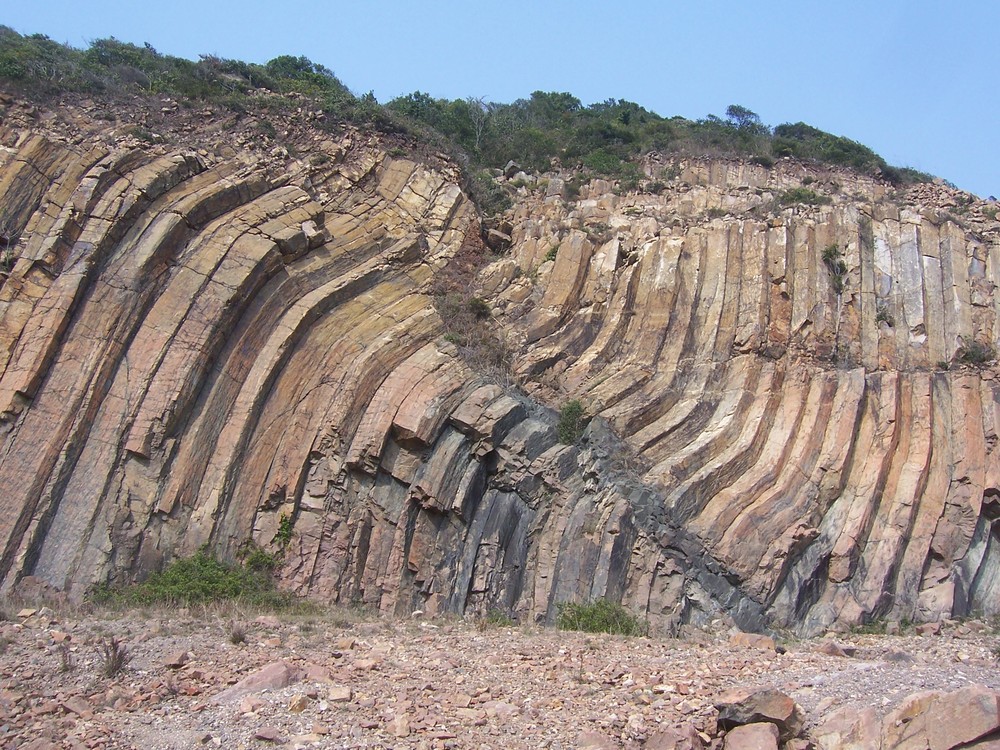
The physics of columnar jointing is interesting, too, and I published a paper on related phenomena a few years back. Let’s first consider a thin layer of lava that has solidified, but is still very hot. As the rock cools, it shrinks. This results in stress building up in the rock, and when the stress at some point gets bigger than the strength of the rock, it cracks. These cracks initially form randomly. Once you get a few cracks, however, these pre-existing cracks influence the location of the next cracks that form: The normal component of the stress is zero at the crack and biggest half-way between cracks, so new cracks tend to form half-way between old cracks. New cracks also tend to meet old crack at right angles, since they propagate in the direction of the stress gradient. The result of this is that as the pattern of crack develops, the spacing between them tends to become more uniform. Now extend this to three dimensions, i.e., think about a deep layer of cooling lava. The cracks will initially form at the top surface, where the cooling is fastest, but they will propagate downwards into the rock as the subsurface rock cools and contracts. The interactions between the cracks makes them organize very quickly into a hexagonal pattern, resulting in the columnar joints you see in the pictures. My friend Stephen Morris from U. of T. has done some beautiful experiments which mimic this process using drying mixtures of water and corn starch – the diffusion of water replaces the diffusion of heat, but otherwise the physics is very much the same.
Tweet