I am on administrative leave this year. This is NOT a year-long holiday. It just means I have no classroom teaching duties – all of my time is for research. Nonetheless I am taking advantage of the opportunity to do some work-related traveling. I have just returned from two months in Rio de Janeiro, where I was working in the Department of Mechanical Engineering at the Pontifical Catholic University of Rio (referred to as “Pooky” by those in the know). My host/friend/colleague/collaborator there was Paulo de Souza Mendes. We have a lot of research interests in common. In particular, we both like to do fluid dynamics experiments using a material called Carbopol, which is the main ingredient in hair gel. Much of Paulo’s research is funded by Petrobras, the Brazilian oil company. Petrobras is required by law to use some fraction of their (extremely large) revenues to fund research and other cultural endeavors, and as a result they have a large presence in the research labs of the country. Paulo does experiments that model situations important in the oil extraction business. For example, I was involved in an experiment with Paulo and his graduate student Alexandra Alicke that was concerned with bubbles rising up through Carbopol. Why is this interesting? First of all, Carbopol is a yield-stress fluid, meaning that it behaves like a solid if you don’t push it very hard, but it flows if you push it hard enough. Like hair gel, or margarine, or toothpaste … or freshly poured cement. After an oil well is drilled, a pipe is cemented into the wellbore to isolate the well from the surrounding rock. Bubbles of gas or air can get into the cement before it hardens, rise up a bit due to buoyancy, and then get stuck as the cement hardens. This results in voids in the cement. Sometimes the rising bubble can even leave a long trail behind it as it rises through the not-quite-hard cement. This can weaken the cement and, in the worst case, lead to a catastrophic failure of the well. Paulo and Alexandra use Carbopol to model the properties of the cement. By studying the behavior of the bubbles in their experiment, they can learn more about how bubbles will behave in cement a kilometer under the surface of the ocean, and maybe learn how to prevent expensive and potentially dangerous problems.
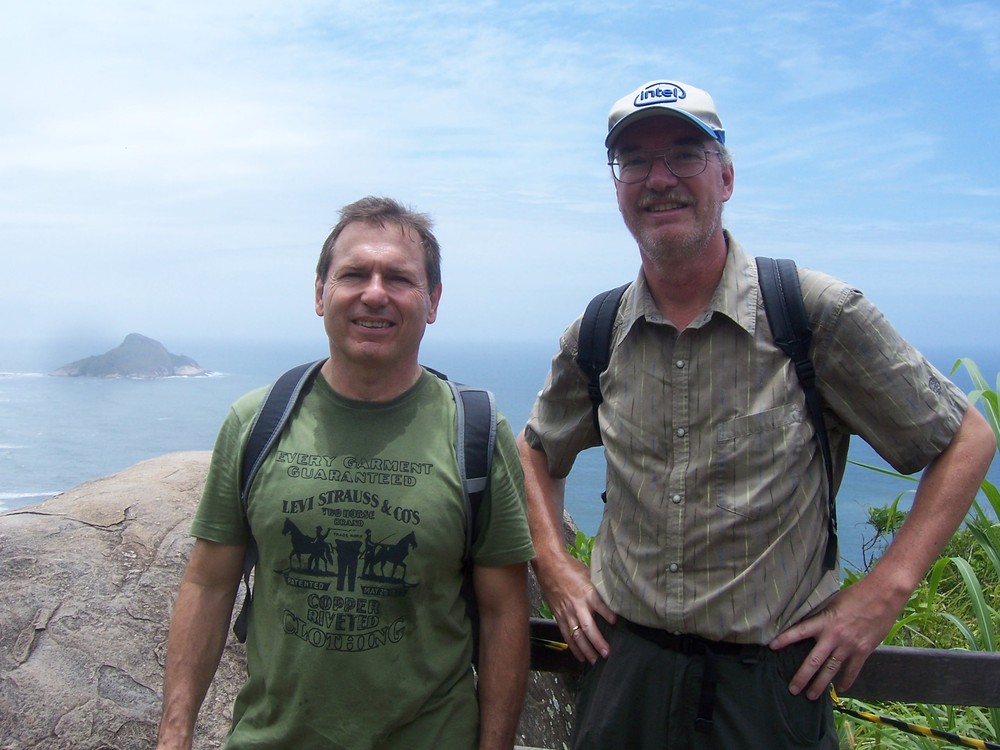
Paulo also likes hiking. Here’s a picture of us in a park a bit south of Rio.