
It’s been busy times for skywatchers. Two weeks ago, on May 5, we had the “Supermoon”: the coincidence of a full moon with the closest approach the Moon makes to the Earth on its elliptical orbit, and which makes the Moon appear larger and brighter in the night sky. Tomorrow, May 20, there will be a solar eclipse, as was posted here before. It is not a coincidence that the Moon happens to be quite far away from the Earth now, and thus the Moon’s apparent size is not big enough to cover the Sun completely, and an annular eclipse is the result in a path that runs over China, Taiwan, southern Japan and parts of the USA. Technically, we should be able to witness a very small partial eclipse in London, but only for less than half an hour before sunset, and only if you have a clear view of the northwestern horizon.
To top it off, the skies offer a very rare Venus transit on Tuesday June 5th, starting a bit after 6pm here in London: the planet will move in front of the Sun and appear as a little black dot that moves across the face of the Sun in just a few hours. Venus’ orbit is inclined with respect to the Earth’s orbit, and as a result, transits are very rare events (as explained in this two-minute video), and follow an unusual cycle as displayed here:
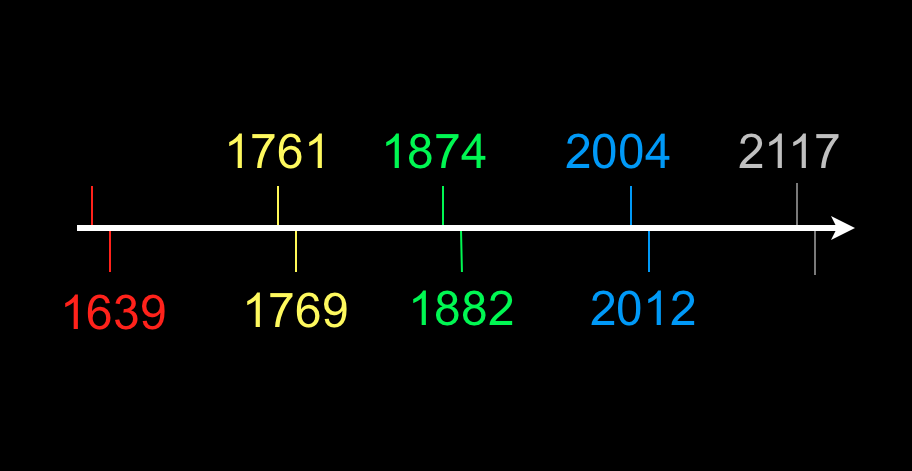
Transits happen in pairs that are separated by 8 years. Between those pairs though, there are big gaps of either 105.5 or 121.5 years without transits. After the June 2012 transit, we will have to wait until December 2117 to see the next one, and so it’s probably safe to say that the upcoming event is the last chance to see a Venus transit in your lifetime! If you want to know more about Venus transits, you can come out to the Cronyn observatory’s open house on June 2nd and listen to a talk about the Venus transit.
You can see this historical event for yourself, but be careful not to look at the Sun directly without adequate eye protection — the lens in your eye will focus the sun’s light onto your retina, and cause damage in seconds (and you wouldn’t notice since it’s painless). There’s various ways to safely observe the event, and we will offer you several options on Western’s campus! The Department of Physics & Astronomy (with support from PASA) is once more collaborating with the Centre for Planetary Science and Exploration and with the Royal Astronomical Society of Canada to make sure you have the best possible observing experience.To begin with, we will be handing out eclipse glasses that allow you to see the event directly with your very own eyes!
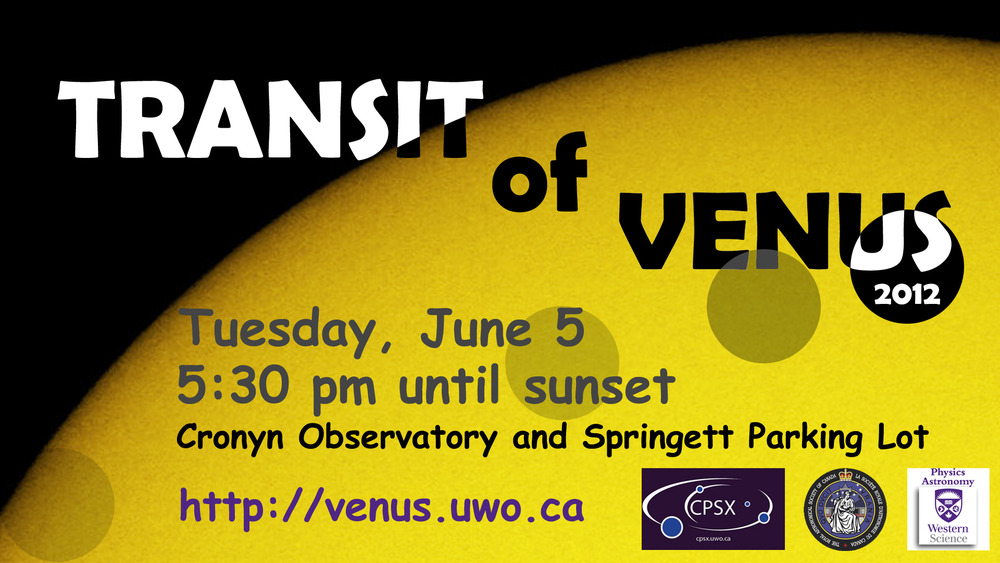
But there’s much more than that. We will be opening up the Cronyn observatory from 5:30pm on. One of the safest ways to observe the Sun is by projection, and that’s what we’ll do with the main refractor at the observatory. Unfortunately, buildings are obstructing our view of the western horizon, and se we won’t be able to observe the transit for very long from Cronyn.Therefore, we will also set up a second observation station in the southeast corner of the Springett parking lot. In addition to projection, we will also use direct views using several telescopes with special filters, including a solar telescope using an Hα filter. Between the Cronyn observatory and the Springett lot, a planet path will show you the solar system to scale. In the conference room of the Cronyn observatory, we will set up a small exhibit around Venus, and we will also broadcast a live stream of the event. If you get asked about the event, point your interested friends and family to http://venus.uwo.ca/.
Although a Venus transit is maybe not as spectacular as a total solar eclipse, it’s a unique opportunity to get a sense of the scale of the solar system. Think about it as you watch that little black dot move: that little black dot is nearly as big as our fair planet!