
First draft for release:
Brown dwarfs are astronomical objects that have too little mass
to be called stars and too much mass to be called planets.
They were only a theoretical concept until discovered in the
mid-1990s and several hundred have now been identified through
infrared telescopes and surveys.
The origin of brown dwarfs is a major open issue of investigation
in modern astrophysics. One theory posits that they are formed like
stars through the direct collapse of interstellar gas cloud fragments.
However the required low mass of such fragments poses a challenge
to that theory. Another theory is that brown dwarfs are formed as
part of multiple systems resulting from the collapse of massive cloud
fragments, and then ejected as a result of many-body
interactions. This theory can also explain why some brown dwarfs
are isolated objects that are not orbiting a parent star. However, the
high ejection speeds in models of this process pose a problem in
comparison with observations, and there should be no proto-brown-dwarf
fragments within interstellar clouds in this scenario.
In a new paper appearing in The Astrophysical Journal, Shantanu Basu
of the Department of Physics and Astronomy at Western University and
Eduard Vorobyov of the Institute of Astrophysics at The University
of Vienna present a new model of brown dwarf formation that unites the
best features of existing theories and has far-reaching implications for
our understanding of the population of low mass objects in the universe.
Employing numerical simulations, carried out in part using the SHARCNET
consortium facilities at Western, they show that the evolution of the
swirling nebular disk of gas around a newly formed protostar is key to
brown dwarf formation. Such a disk of gas has long been postulated to
exist around the early Sun, and the planets in the Solar System are
thought to have condensed out of such a disk. In this work,
Basu and Vorobyov show that the early life of a disk is
characterized by the formation of multiple fragments that orbit
the central protostar, and that the interaction of fragments leads to
the ejection of some proto-brown-dwarf fragments. The ejection speeds
in this mechanism are much lower than in a model where ejections occur
only for finished brown dwarfs, and provides a more favorable comparison
with observations that show that brown dwarfs are present in close
proximity to young stars.
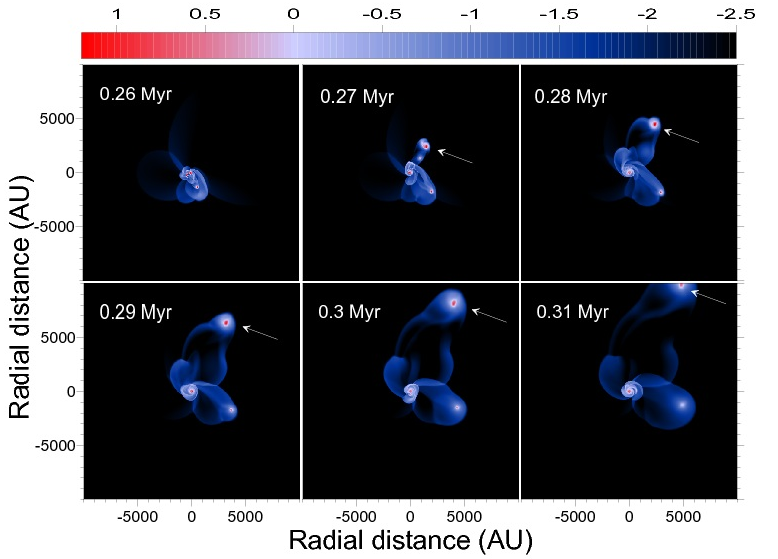
If proto-brown-dwarf fragments are routinely ejected from nebular disks
around protostars, they are potentially much more numerous in the universe
than current estimates. Although current observations establish that
brown dwarfs are less numerous than proper stars, their faintness has
made a complete census difficult. New ongoing infrared surveys may
find many more brown dwarfs, and this theoretical result has the implication
that they could be more numerous than previously thought.
In that case, there could be significant mass in the universe that is
locked up in brown dwarfs, and contribute at least part of the budget for
the missing “dark matter”. Furthermore, the common idea that the first stars
in the early universe were only of very high mass may need revision.
The paper appears in the 1 May 2012 issue of The Astrophysical Journal,
Vol. 750, p. 30, and can be accessed directly at
<a href=”http://stacks.iop.org/0004-637X/750/30.
http://stacks.iop.org/0004-637X/750/30.<br/>