
One of the highlights of my trip to Brazil was a visit to Manaus, on the Amazon River. My wife and I took a one-day tour on the river and in the rainforest, during which we saw, among other things, sloths, monkeys, an anaconda, caimans, piraracu (the worlds largest freshwater fish) and went fishing for piranha. The physics highlight is shown in the picture. This is the “meeting of the waters,” where the Rio Negro and the Rio Solimoes join to form the Amazon. The water in the Negro is almost black (hence the name), warm (about 26 degrees) and has a current of about 2 km/hr. The Solimoes is brown from the large amount of sediment it carries, cooler (22 degrees) and faster (6 km/hr). When the rivers meet, the boundary between them is very distinct, and when we stuck our hands in the water while the boat drove across the boundary, the temperature difference was very sudden and easy to feel.
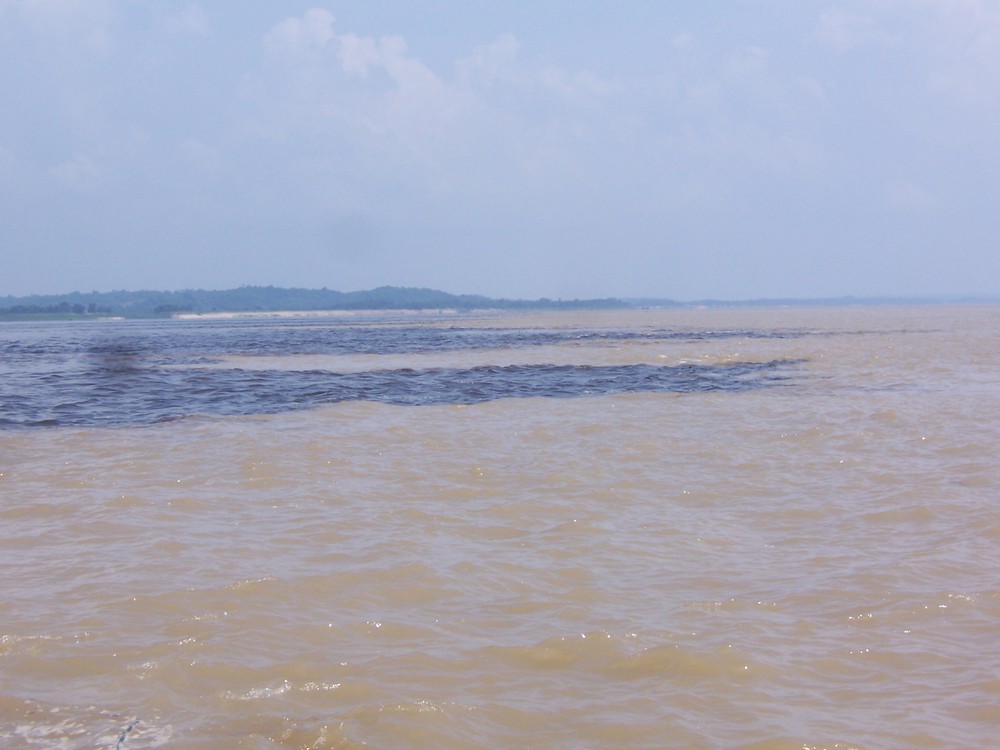
If you look at this location in a satellite photo (e.g., on Google Maps) you’ll see that the boundary between the two colors of water stays distinct for something on the order of 20 kilometers downstream. Why do they mix so slowly? Actually this is the wrong question to ask! If we assume that the two rivers mix by diffusion alone, then the boundary should broaden to a width d of, say, 10 m in a time t = d^2/D, where D = 2e(-9) m^2/s is the diffusion constant of water. This calculation gives a mixing time on the order of 10^11 seconds, which is thousands of years! Diffusion is a very slow process; far too slow to explain what is happening here! The right question to ask is clearly “Why do they mix so quickly?” or, in other words, what process other than diffusion is at play here?
You can see a hint of the answer in my photo, but it’s a lot more clear if you zoom in on the satellite photo on Google Maps. The line separating the black and brown water is not straight – it’s wavy, and it becomes more so as you move downstream. The initially flat interface between the two streams is unstable. Swirls and waves develop and grow at the interface as it flows downstream. This makes mixing much faster for a couple of reasons. First, swirls make the surface area of the interface bigger, so there is more diffusion across it. More importantly, the water gets stirred by the swirls, and this mixes the streams just like stirring your coffee mixes in the cream.
This is a great example of what’s called the Kelvin-Helmholtz instability, and it can be analyzed in detail mathematically. Exactly the same instability gives rise to the parallel rows of clouds you often see in the sky!
Want to know more? Take fluid dynamics next year!
Tweet
Something like this maybe:http://news.yahoo.com/giant-tsunami-shape-clouds-roll-across-alabama-sky-1921…