
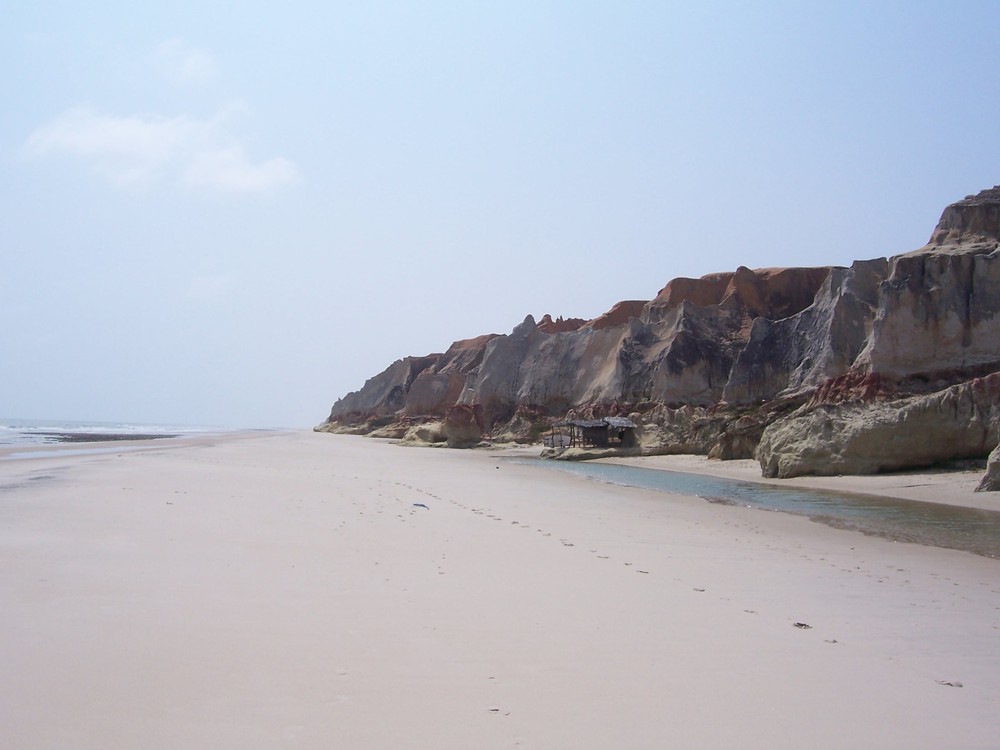
While I was in Brazil this fall, I visited Raimundo Costa Filho at the University of Ceara in Fortaleza. Raimundo was a prof at Western for a couple of years. Fortaleza is only three degrees south of the equator, and the weather there is the same all year round: sunny, temperature in the low to mid 30s, with a nice breeze blowing off the ocean to keep things from getting too hot. Lovely! And the beaches around Fortaleza are absolutely spectacular.
While he was at Western, Raimundo and I talked about some work I was doing with my PhD student Simon de Vet on the formation of impact craters in granular materials. Since then, Raimundo and one of his former students have been working on numerical simulations of the impact process. I’m looking forward to seeing their paper.
I gave a talk about our crater work in Fortaleza. The experiments Simon did are quite simple – he dropped a ball into a bucket of tiny glass beads, and looked at the crater that results. Our granular craters look just like craters on the moon: Small ones are smooth bowls with a raised rim, and bigger ones have a peak in the middle. Simon and I were interested in the extent to which the process we were studying really mimicked the formation of craters by a meteor impact. The energy scale in our case was some 20 orders of magnitude smaller, and many of the details were dramatically different, but nonetheless the end product was very similar. There were also some theoretical reasons to think that our experiments really did have something to say about “real” impact craters. Simon’s work focused on the granular flows that took place after the impact. We think that the fluid dynamics is essentially the same as it is in a meteor impact, and that’s why the shape and morphology of the craters is the same. On the other hand, Simon found that the (appropriately scaled) energetics of the crater-formation process were quite different in the two cases. In big lunar craters, essentially all of the kinetic energy of the projectile is used to excavate the crater, while in our granular impacts it’s about 0.1%. Where does all the energy go in the granular case? Friction, and inelastic collisions between the grains. I spent part of my time in Brazil writing a paper about some of Simon’s work.
I won’t write about Brazil any more, becasue next month we are going to Hong Kong.