Have you ever found yourself wanting more detailed weather information than is provided by Environment Canada?
Well you might have been fortunate enough to try The Weather Network, and there you would have across the wonderful ‘Hourly Forecast’, something not found from Environment Canada.
When visiting the Rockies this past September, I found even more imaginative use of the internet by the hikers and outdoors people who frequent the never dull weatherwise Great Divide region.
When moist westerly air hits the mountain peaks of the Great Divide, it usually means fog, rain, or more likely snow. The weather here changes rapidly.
One method that is used to get a bead on the changing mountain weather is to use the Hourly Forecasts from two or three of the closest weather stations, and then try to interpolate between them
So for example, I was camped down in Peter Lougheed Provincial Park (PLPP) and had booked two nights up at high elevation Aster Lake. The objective was to scramble up Warrior Peak and Mount Cordonnier. There was a huge cold front moving in, accompanied by a big drop in temperature and a lot of rain and snow, so it was going to be important to know as closely as possible when this would happen. Because there is no weather station near the park, the idea was to use weather from the Nakiska Ski area 50km. to the north, Invermere BC, 80km to the west, and Banff townsite, 80km to the northwest. The park has a free internet kiosk and I could sit there in the warmth of the visitors centre and try to figure out the approaching weather in this way.
Later on, I found out that some of the knowledgable locals do something even more drastic in trying to get a better bead on the weather. They go to web sites from Norway and England, of course !
While this may seem surprising at first blush, I think that the tourism industry probably drives these web sites. In particular, the ski industry, in the case of the British site. I also assume that these sites use our local data, but use their own models to make their forecasts. So at the very least it gives us a second opinion on our weather.
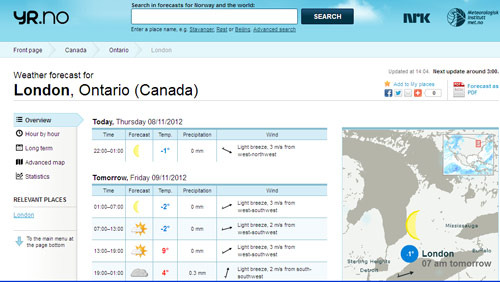
From Norway, we have ‘http://yr.no‘. The word ‘yr’ means either ‘drizzle’, or ‘dizzy’ in Norwegian. This site is a partnership between the Norwegian Broadcasting Corporation and the Norwegian Meteorological Institute.
Have a look at our London, Ontario forecast from yr. It’s a nice looking page.
The second site is ‘Mountain Forecast (http://www.mountain-forecast.com). This sure looks like a site meant for the hiking/climbing/backcountry skiing tourist. This site may well just be giving us other peoples’ weather information but they have compiled the weather with other useful information for people who go out into the back country, such as maps.
Here is where it gets really interesting.
When looking at the weather for the Aster Lake trip, I could have gone directly to the weather forecast for Mount Cordonnier itself! This peak is in the middle of a huge wilderness area, there being no ski resort anywhere close. yet, here is all of this information on it from England. And even better, I could look at the weather at four elevations on this peak! And further, I could look at the weather and maps for the 8 closest peaks to this.
I hope that others find some fun with these weather sites too.
I owe all of these ideas to my old friend and mountain guru, Alf Skrastins!