
Gazette Staff
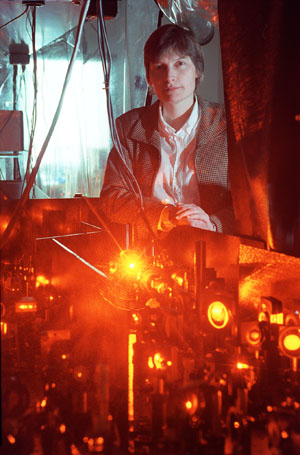 |
| Lene Hau and her colleagues created a new form of matter to bring a light beam to a complete stop, then restart it again. (Staff photo by Kris Snibbe) |
“Two years ago we slowed it down to 38 miles an hour; now we’ve been able to park it then bring it back up to full speed.” Lene Hau isn’t talking about a used motorbike, but about light – that ethereal, life-sustaining stuff that normally travels 93 million miles from the sun in about eight minutes.
Less than five years ago, the speed of light was considered one of the universe’s great constants. Albert Einstein theorized that light cannot travel faster than 186,282 miles per second. No one has proved him wrong, but he never said that it couldn’t go slower.
Hau, 41, a professor of physics at Harvard, admits that the famous genius would “probably be stunned” at the results of her experiments. Working at the Rowland Institute for Science, overlooking the Charles River and the gold dome of the state Capitol in Boston, she and her colleagues slowed light 20 million-fold in 1999, to an incredible 38 miles an hour. They did it by passing a beam of light through a small cloud of atoms cooled to temperatures a billion times colder than those in the spaces between stars. The atom cloud was suspended magnetically in a chamber pumped down to a vacuum 100 trillion times lower than the pressure of air in the room where you are reading this.
| |
“It’s nifty to look into the chamber and see a clump of ultracold atoms floating there,” Hau says. “In this odd state, light takes on a more human dimension; you can almost touch it.”
She and her team continued to tweak their system until they finally brought light to a complete stop. The light dims as it slows down, so you think that it’s being turned out. Then Hau shoots a yellow-orange laser beam into the cloud of atoms, and the light emerges at full speed and intensity.
Inspired by Hau’s success at slowing light, researchers working on a wooded hill a few miles away at the Harvard-Smithsonian Center for Astrophysics (CfA) used a similar technique to stop, then restart, a light beam. That team was headed by Ronald Walsworth and Mikhail Lukin, both associates of Harvard College. Their success was independent of Hau’s effort.
“We didn’t have much contact,” she notes, “just a few e-mails.”
Stopping cold
Besides stirring a research rush to explore exotic forms of matter, such experiments open the door to some practical applications. These include vastly more powerful computers as well as the possibility of communications that are much more secure from hackers and people trying to steal your credit and bank card numbers.
“We hope for wonderful things,” says David Phillips, who worked on the CfA “stop light” project. “Our imagination hasn’t figured out what the possibilities are yet.”
Hau, a tall, slender scientist educated as a theoretical physicist in Denmark, had a hunch several years ago that intensely cold atoms would become a hot area in physics. In the mid-1990s, she and her colleagues became excited about experiments aimed at crowding atoms so close together that unusual things happen. The key is to cool them to within a billionth of a degree of minus 459.7 degrees F. Called “absolute zero,” this is the temperature at which atoms have the least possible energy, and they all but cease to move around.
Hau was one of several researchers who succeeded in creating this novel state of matter. She corresponded with a colleague, Stepen Harris at Stanford University, and they came up with the idea that it might be possible to use a small ball of cold atoms to slow down light.
Hau and her group then figured out a way to make it work. Using sodium atoms and two laser beams, they made a new kind of medium that entangles light and slows it down. The laser beams glow yellow-orange like sodium streetlights, and the cigar-shaped cloud of atoms is about eight-thousandths of an inch long and about a third as wide.
Working with Chien Liu, a postdoctoral fellow at Rowland, and Harvard graduate students Zachary Dutton and Cyrus Behroozi, Hau kept tweaking the atoms until they completely stopped laser light. This happens when a second laser beam directed at right angles to the cloud of atoms is cut off. When that laser is switched on again, it abruptly frees the light from the trap and it goes on its way.
Hau explains that light entering the atomic entanglement transfers its energy to the atoms. Light energy raises the atoms to higher energy levels in ways that depend on the frequency and intensity of the light. The laser illuminating the cloud at right angles to the incoming beam acts like a parking brake, stopping the beam inside the cloud when it is shut off. When it is turned on again, the brake is released, the atoms transfer their energy back to the light, and it leaves the end of the cloud at full speed and intensity.
Hau’s team stopped light for one-thousandth of a second. Atomically speaking, “this is an amazingly long time,” Hau notes. “But we think it can be stopped for much longer.”
The CfA researchers used an easier method. They shot laser beams through a dense cloud of rubidium and helium gas. (Rubidium, in its solid or natural form, is a soft, silver-white metal.) The light bounced from atom to atom, gradually slowing down until it stopped. No supervacuum or ultra-cold was needed. In fact, the chamber where the light stopped was at a temperature of 176 degrees F.
This convenience comes at a cost, however. Only half of the incoming light was stored, then recovered, and the storage time was much shorter.
Think of both contraptions as sophisticated light switches that control not just light but information. Incoming light can carry information expressed by changes or modulations of its frequency, amplitude, and phase. When the light stops, that information is stored just like information is stored in the electronic memory of a computer. To access the information, you turn on a control laser, and out it comes.
Shrinking computers
Computers operating by these so-called quantum effects are much more efficient that those available today, or even on the drawing board. (“Quantum” refers to changes in the energy levels of the atoms.) Today’s machines represent information in bits, electronic combinations of zeros and ones. Bits represented by quantum states of atoms could carry much, much more information. Cubic inch for cubic inch, quantum computers could tackle problems that would stymie the most super of conventional computers. For example, they could perform many calculations simultaneously.
Another thing they could do would be to encrypt information in complex codes impossible to crack without extremely expensive and time-consuming methods. Financial and other information would be prodigiously safer with a quantum computer.
As marvelous as they are, however, both the Rowland and CfA systems take up more space and power than would be practical. Hau’s experiment requires a small room, CfA’s needs a large tabletop.
CfA researchers need to solve this problem and to make sure all the light is stored – not just half. That will take many years.
Hau has already started ordering and installing equipment with which she plans to construct a quantum light stopper no bigger than a fingernail. She envisions ultracold and supervacuums being achieved with devices less than one-thousandth of an inch in size. These would be built on chips no bigger than the Pentium IV that runs many of today’s small laptop and palm-sized computers.
“Wouldn’t that be nifty!” Hau says. She and her colleagues describe their experiment in detail in today’s issue of the journal Nature.