Not sure what to make of this theory, but its nice to see one can make contributions from outside academia.
http://www.telegraph.co.uk/science/large-hadron-collider/3314456/Surfer-dude-…

Not sure what to make of this theory, but its nice to see one can make contributions from outside academia.
http://www.telegraph.co.uk/science/large-hadron-collider/3314456/Surfer-dude-…
First draft for release:
Brown dwarfs are astronomical objects that have too little mass
to be called stars and too much mass to be called planets.
They were only a theoretical concept until discovered in the
mid-1990s and several hundred have now been identified through
infrared telescopes and surveys.
The origin of brown dwarfs is a major open issue of investigation
in modern astrophysics. One theory posits that they are formed like
stars through the direct collapse of interstellar gas cloud fragments.
However the required low mass of such fragments poses a challenge
to that theory. Another theory is that brown dwarfs are formed as
part of multiple systems resulting from the collapse of massive cloud
fragments, and then ejected as a result of many-body
interactions. This theory can also explain why some brown dwarfs
are isolated objects that are not orbiting a parent star. However, the
high ejection speeds in models of this process pose a problem in
comparison with observations, and there should be no proto-brown-dwarf
fragments within interstellar clouds in this scenario.
In a new paper appearing in The Astrophysical Journal, Shantanu Basu
of the Department of Physics and Astronomy at Western University and
Eduard Vorobyov of the Institute of Astrophysics at The University
of Vienna present a new model of brown dwarf formation that unites the
best features of existing theories and has far-reaching implications for
our understanding of the population of low mass objects in the universe.
Employing numerical simulations, carried out in part using the SHARCNET
consortium facilities at Western, they show that the evolution of the
swirling nebular disk of gas around a newly formed protostar is key to
brown dwarf formation. Such a disk of gas has long been postulated to
exist around the early Sun, and the planets in the Solar System are
thought to have condensed out of such a disk. In this work,
Basu and Vorobyov show that the early life of a disk is
characterized by the formation of multiple fragments that orbit
the central protostar, and that the interaction of fragments leads to
the ejection of some proto-brown-dwarf fragments. The ejection speeds
in this mechanism are much lower than in a model where ejections occur
only for finished brown dwarfs, and provides a more favorable comparison
with observations that show that brown dwarfs are present in close
proximity to young stars.
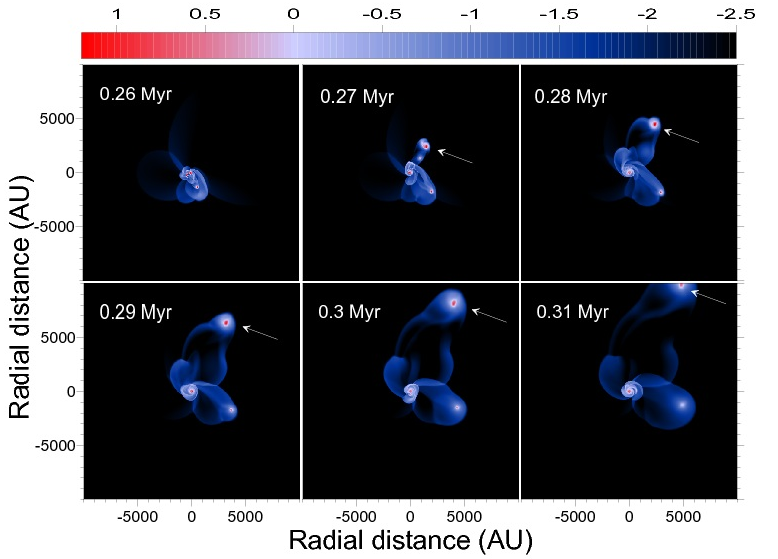
If proto-brown-dwarf fragments are routinely ejected from nebular disks
around protostars, they are potentially much more numerous in the universe
than current estimates. Although current observations establish that
brown dwarfs are less numerous than proper stars, their faintness has
made a complete census difficult. New ongoing infrared surveys may
find many more brown dwarfs, and this theoretical result has the implication
that they could be more numerous than previously thought.
In that case, there could be significant mass in the universe that is
locked up in brown dwarfs, and contribute at least part of the budget for
the missing “dark matter”. Furthermore, the common idea that the first stars
in the early universe were only of very high mass may need revision.
The paper appears in the 1 May 2012 issue of The Astrophysical Journal,
Vol. 750, p. 30, and can be accessed directly at
<a href=”http://stacks.iop.org/0004-637X/750/30.
http://stacks.iop.org/0004-637X/750/30.<br/>
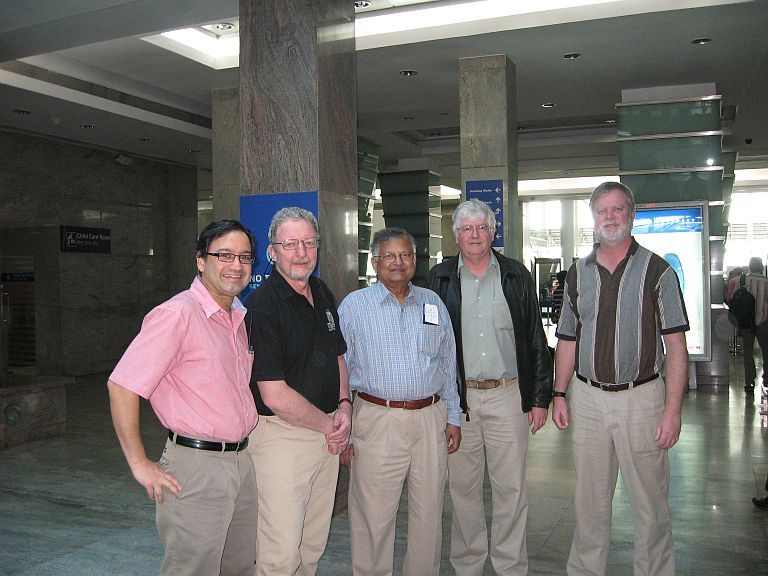
My first major stop was Pune, in Maharashtra state, and about 150 km southeast of Mumbai. Here, I visited the Inter-University Center for Astronomy and Astrophysics (IUCAA). This is India’s top research institution for astrophysics, and runs a very active visitors program for faculty snd students, as well as frequent workshops and conferences. IUCAA is involved in many major international astronomy projects, and is on track to garnering the next Advanced LIGO gravitational wave detector for India. Faculty and graduate students are welcome for extended stays, ideally centered around a workshop related to their work. Guest accommodations and meals are available at IUCAA itself – Dr. Ajit Kembhavi, Director, is happy to host you, so you just have to pay your way to get to Pune! The beautiful courtyard at IUCAA, pictured here, and containing statues of Galileo, Newton, Einstein, and the ancient Indian astronomer Aryabhatta, really lends itself to thought and reflection.
What about undergraduate students? Any undergraduate student that is considering an exchange visit to India should seriously consider Pune University. (IUCAA is also located on the Pune University campus.) This university has a beautiful sprawling campus that is set apart from the city traffic, and has Departments in most major subjects, including Physics. It is also home to the Indian office of the Ontario-Maharashtra-Goa exchange program. Vaishali Potnis, OMG India Coordinator, is happy to help any students settle into Pune. There are already about 10 Ontario undergraduate students on exchange at Pune University in any given year. The OMG program website (http://www.omgprogram.org/)describes how to apply for travel grants.
Later in my trip, in New Delhi, I visited the Indira Gandhi National Open University (IGNOU; http://www.ignou.ac.in). This is the largest distance studies university in the world, with 3.5 million students! IGNOU also operates in 40 other countries besides India. I met with Dr. Ravi Singh, who holds a PhD in Physics from Western, supervised by Prof. Mahi Singh. Ravi is Director of the Regional Services Division at IGNOU, and shared his vision of expanded offerings in distance education. Considering that India currently has 12% rate of postsecondary education, and wants to get to about 30% like the USA and other developed countries, the only feasible way to approach such numbers in the next decade or two is by relying on distance education. Here, distance education does not mean fully online education, as there are test-taking centers across the country and also access to regional laboratory facilities. Ravi felt that Western and other foreign universities could join in this effort by offering summer courses on site (e.g., at Western) and also creating new online courses not covered in IGNOU’s current curriculum.
I also visited the Sharda University (http://www.sharda.ac.in/), a new private university in Greater Noida, Uttar Pradesh, some 40 km east of New Delhi. Private universities are a new phenomenon in India, operating on a for-profit basis and offering an entryway to university education for those who cannot get into top government schools but have the money to pay for an education. In a country with very limited spaces in the top public univerisites, there is a big market for private providers. Sharda University opened only in 2009, but boasts impressive new facilities and already operates with many domestic and international students. I was hosted by Prof. Sunil Kumar Mishra, who organized a very lavish reception, and gave me a chance to talk about Western and also some of my group’s work on star and planet formation. Dr. Mishra is Director of the Research and Technology Development Center, and the science effort here is very much in the applied sciences. Due to its nice atmosphere, facilities, and existing group of international students, this university also seemed an interesting destination for Canadian undergraduates seeking an exchange term in India.

Overall, a very informative trip to a rapidly changing country. I found New Delhi to be completely transformed from my last visit in 2004, with a bright gleaming new airport, new highways, monuments, glass-paneled office towers, and public transport options. Western stands to benefit by staying engaged with India and indeed all the emerging economies of the world.
You’ve heard of radial velocity techniques and the transit method, but here is an article about an exoplanet detection method of the future. Those wanting to ride the cusp of the next wave, or the just curious, should read this article and the previous one that is linked in the first line.
http://www.astroengine.com/2011/04/screaming-exoplanets-detecting-alien-magne…
Anticipating 2012 will be a very good year for news that we can share with our non-physics friends and colleagues.
Just back from annual AAS winter meeting, held in Austin, Texas this year. A great place to connect with friends and colleagues, if you can find them amongst ~ 3000 people! Here is an article on one of the interesting press releases at the meeting.
http://earthsky.org/space/mapping-dark-matter-from-ripples-of-passing-satellites
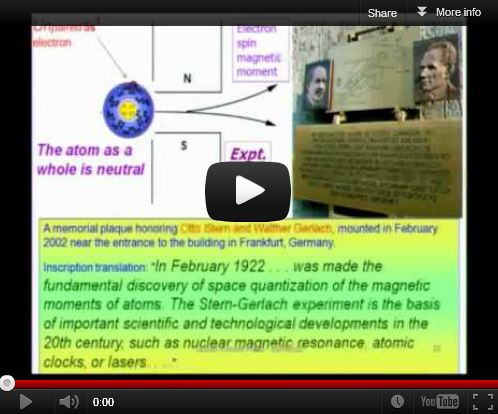
A lecture on atomic physics by our own Visiting Professor Pranawa Deshmukh, which was originally broadcast to many of the Indian Institute of Technology campuses. Our Classical Mechanics (P3151) students got the benefit of his lectures this term.
[youtube http://www.youtube.com/watch?v=2sP5C7Eh8HY?wmode=transparent]
Why did the chicken cross the road?
Archimedes: Give me a place to stand, and I can move the chicken across the road.
Albert Einstein: Do not worry about your troubles with chickens; I can assure you that mine are greater.
Pierre de Fermat: I have found an admirable explanation of this, but the margin is too narrow to contain it.
Kurt Godel: It cannot be proven that the chicken crossed the road.
Issac Newton: If chickens have been able to cross the road, it is because they have stood on the shoulders of giants.
Zeno: It went halfway, then half again, then half yet again…but the chicken never got to the other side.
These are from the book Math Jokes 4 Mathy Folks. A website with a subset of the jokes in the book can be found at www.mathjokes4mathyfolks.com. Great fun for the mathematically minded, and a some jokes related to physics are there as well.
The Dalhousie Diversity Faculty Awards – go to the link below. There is also a specific current opportunity at Dalhousie for African-Canadians who have recently obtained a PhD. Please contact me for more information and I can connect you with the relevant person at Dal.
http://www.dal.ca/news/2011/04/01/a_commitment_to_diversity.html