
All posts by Jodi Guthrie

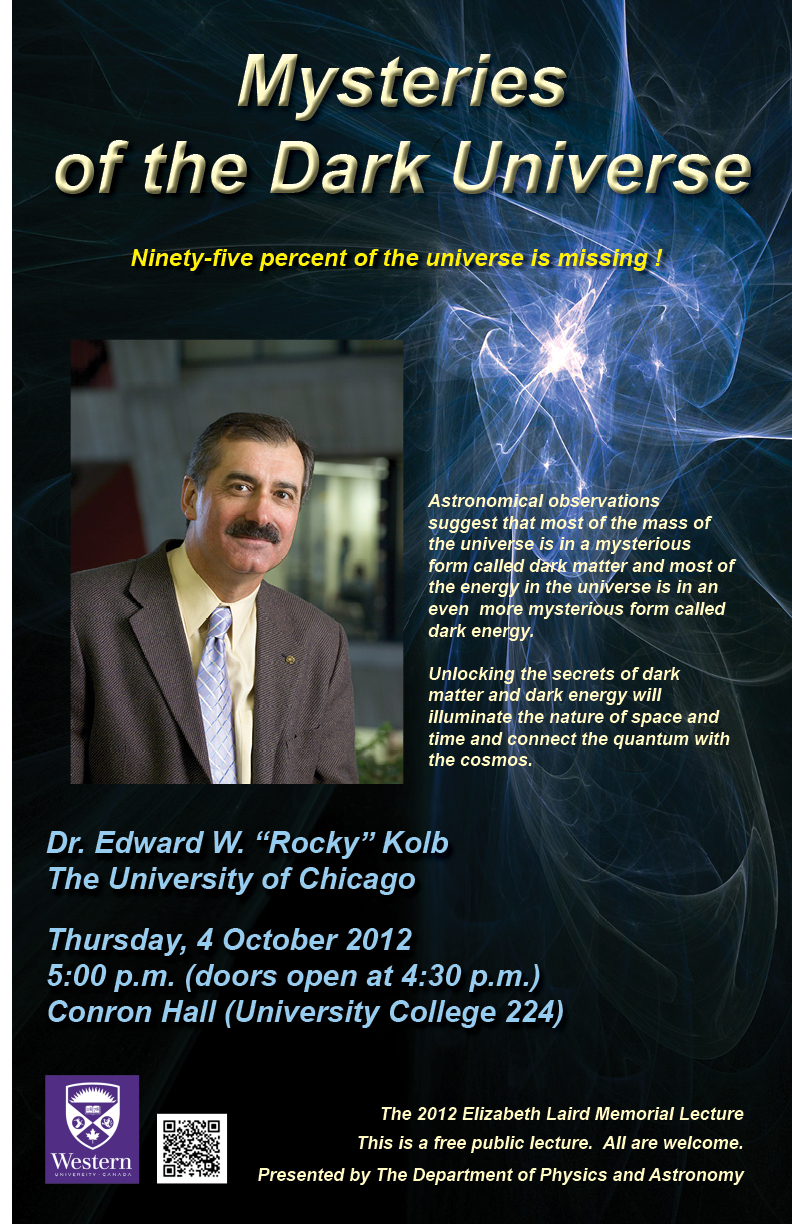
REMINDER: Laird Memorial Lecture – TODAY (4 Oct.) @ 5 p.m. – DR. ROCKY KOLB, U Chicago

TODAY

Western University
DEPARTMENT OF PHYSICS AND ASTRONOMY

ELIZABETH LAIRD MEMORIAL LECTURE

Thursday, 4th October 2012
5:00 p.m. (doors open @ 4:30) in Conron Hall (University College rm. 224)

Dr. Edward W. “Rocky” Kolb
Department of Astronomy and Astrophysics

The University of Chicago

“Mysteries of the Dark Universe”
Ninety-five percent of the universe is missing!

Astronomical observations suggest that most of the mass of the universe is in a mysterious form called dark matter and most of the energy in the universe is in an even more mysterious form called dark energy. Unlocking the secrets of dark matter and dark energy will illuminate the nature of space and time and connect the quantum with the cosmos.


Brief Bio: Edward W. Kolb, known to most as Rocky, is the Arthur Holly Compton Distinguished Service Professor of Astronomy & Astrophysics and the Chair of the Department of Astronomy & Astrophysics at the University of Chicago, as well as a member of the Enrico Fermi Institute and the Kavli Institute for Cosmological Physics. In 1983, he was the founding head of the Theoretical Astrophysics Group and, in 2004, the founding Director of the Particle Astrophysics Center at Fermi National Accelerator Laboratory in Batavia, Illinois. His field of research is the application of elementary-particle physics to the very early Universe. In addition to over 200 scientific papers, he is a co-author of The Early Universe, the standard textbook on particle physics and cosmology.
Physics & Astronomy Colloquium – THURS. 11 October – DR. FRED ADAMS, U Michigan

Poster: http://www.physics.uwo.ca/colloquia/Colloquia%20Notices/2012_2013/ADAMS%20Colloquium.pdf


Western University
DEPARTMENT OF PHYSICS AND ASTRONOMY


PHYSICS & ASTRONOMY COLLOQUIUM


Date:           Thursday, 11th October 2012
Time:          1:30 p.m.
Location:    Physics & Astronomy Seminar Room 100

Dr. Fred C. Adams
Department of Physics

University of Michigan


“Constraints on the Birth Environment of the Solar System”


ABSTRACT


Most stars—and hence most solar systems—form within groups and clusters. The first objective of this talk is to explore how these star forming environments affect solar systems forming within them. The discussion starts with the dynamical evolution of young clusters with N = 100 – 3000 members. We use N-body simulations to study how evolution depends on system size and initial conditions. Multiple realizations of equivalent cases are used to build up a robust statistical description of these systems, e.g., distributions of closest approaches and radial locations. These results provide a framework from which to assess the effects of clusters on solar system formation. Distributions of radial positions are used in conjunction with UV luminosity distributions to estimate the radiation exposure of circumstellar disks. Photoevaporation models determine the efficacy of radiation in removing disk gas and compromising planet formation. The distributions of closest approaches are used in conjunction with scattering cross sections to determine probabilities for solar system disruption. The result of this work is a quantitative determination of the effects of clusters on forming solar systems. The second objective of this talk is to use these results to place constraints on the possible birth environments for our solar system.

Elizabeth Laird Memorial Lecture – next THURS. 4th Oct. @ 5 p.m. – DR. ROCKY KOLB, U Chicago

Poster & Speaker Bio: http://www.physics.uwo.ca/colloquia/Colloquia%20Notices/2012_2013/LAIRD%20Lecture%20-%20Rocky%20KOLB.pdf

Alternate poster attached.

Western University
DEPARTMENT OF PHYSICS AND ASTRONOMY

ELIZABETH LAIRD MEMORIAL LECTURE

Thursday, 4th October 2012
5:00 p.m. (doors open @ 4:30) in Conron Hall (University College rm. 224)

Dr. Edward W. “Rocky” Kolb
Department of Astronomy and Astrophysics

The University of Chicago

“Mysteries of the Dark Universe”
Ninety-five percent of the universe is missing!

Astronomical observations suggest that most of the mass of the universe is in a mysterious form called dark matter and most of the energy in the universe is in an even more mysterious form called dark energy. Unlocking the secrets of dark matter and dark energy will illuminate the nature of space and time and connect the quantum with the cosmos.


Brief Bio: Edward W. Kolb, known to most as Rocky, is the Arthur Holly Compton Distinguished Service Professor of Astronomy & Astrophysics and the Chair of the Department of Astronomy & Astrophysics at the University of Chicago, as well as a member of the Enrico Fermi Institute and the Kavli Institute for Cosmological Physics. In 1983, he was the founding head of the Theoretical Astrophysics Group and, in 2004, the founding Director of the Particle Astrophysics Center at Fermi National Accelerator Laboratory in Batavia, Illinois. His field of research is the application of elementary-particle physics to the very early Universe. In addition to over 200 scientific papers, he is a co-author of The Early Universe, the standard textbook on particle physics and cosmology.
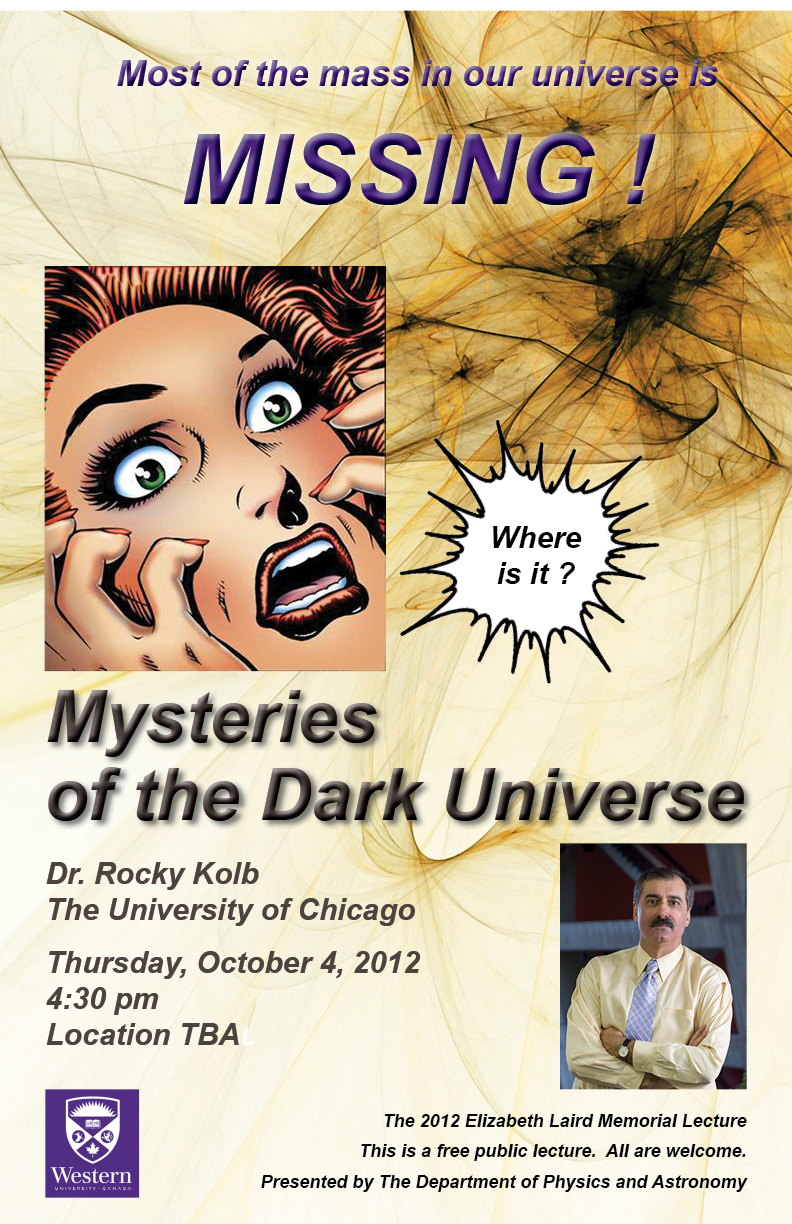
Large LAIRD poster 2 (Kolb).pdf Download this file

Joint Seminar – CPSX/Physics & Astronomy – TUES. 9th October – DR. JAY MELOSH

JOINT SEMINAR—the Department of Physics and Astronomy and the Centre for Planetary Science and Exploration (CPSX)


Date:          Tuesday, 9th October 2012
Time:          1:30 p.m.
Location:    Physics & Astronomy Room 100


Dr. Henry (Jay) Melosh
Department of Earth and Atmospheric Sciences
Purdue University


“Tiny Worlds of Ice and Grit: Results from NASA’s Most Recent Comet Missions”


ABSTRACT


NASA’s most recent successes in exploring new worlds took place on November 4, 2010 and February 14, 2011 when two spacecraft made close passes by comets Hartley 2 and Tempel 1. Although small, Hartley 2 turned out to be a feisty customer, blasting huge quantities of CO2 gas and water vapour into space, along with dust and tarlike organic material. Images from the spacecraft show an elongated nucleus about 2.0 km long, shaped like a peanut. It is divided into two major lobes separated by a smooth collar. The lobes are sources of powerful jets of gas and dust that loft chunks of material into space. Its surface is pitted, ridged and littered with blocks of ice and dust tens of metres in diameter. Tempel 1—the target of the Deep Impact collision in 2005—is much larger, seems to lack clumps of material and appears to be composed of a fine, weak powder. It nevertheless possesses a complex geologic history, with layers, crater-like depressions and what appear to be several “volcanic” flow deposits. In this presentation I will show images of these comets’ surfaces and discuss what these observations mean, so far as we currently understand them. Many of the observed phenomena, such as the jets of gas and dust, defy current understanding of how gas and dust interact in a vacuum under low gravity. The ices present in the comets are yielding important clues to conditions in the nebula from which the comets, and our own planet, originally formed.

Elizabeth Laird Memorial Lecture – THURS. 4th Oct. @ 5 p.m. – DR. ROCKY KOLB, U Chicago

Poster & Speaker Bio: http://www.physics.uwo.ca/colloquia/Colloquia%20Notices/2012_2013/LAIRD%20Lecture%20-%20Rocky%20KOLB.pdf

Alternate poster attached.


Western University
DEPARTMENT OF PHYSICS AND ASTRONOMY


ELIZABETH LAIRD MEMORIAL LECTURE


Thursday, 4th October 2012
5:00 p.m. (doors open @ 4:30) in Conron Hall (UCC 224)


Dr. Edward W. “Rocky” Kolb
Department of Astronomy and Astrophysics

The University of Chicago

“Mysteries of the Dark Universe”
Ninety-five percent of the universe is missing!

Astronomical observations suggest that most of the mass of the universe is in a mysterious form called dark matter and most of the energy in the universe is in an even more mysterious form called dark energy. Unlocking the secrets of dark matter and dark energy will illuminate the nature of space and time and connect the quantum with the cosmos.


Brief Bio: Edward W. Kolb, known to most as Rocky, is the Arthur Holly Compton Distinguished Service Professor of Astronomy & Astrophysics and the Chair of the Department of Astronomy & Astrophysics at the University of Chicago, as well as a member of the Enrico Fermi Institute and the Kavli Institute for Cosmological Physics. In 1983, he was the founding head of the Theoretical Astrophysics Group and, in 2004, the founding Director of the Particle Astrophysics Center at Fermi National Accelerator Laboratory in Batavia, Illinois. His field of research is the application of elementary-particle physics to the very early Universe. In addition to over 200 scientific papers, he is a co-author of The Early Universe, the standard textbook on particle physics and cosmology.

Large LAIRD poster (Kolb).pdf Download this file

REMINDER: PhD Public Lecture – MONDAY @ 10 a.m. – ERIC BARBAGIOVANNI

REMINDER – Monday @ 10 a.m.

Department of Physics and Astronomy

PhD Public Lecture

Eric Barbagiovanni
Supervisors: Dr. Lyudmila Goncharova and Dr. Peter Simpson

“Influence of Quantum Dot Structure on the Optical Properties of Group IV Materials Fabricated by Ion-Implantation”

DATE:             MONDAY, 17th September 2012
TIME:              10:00 a.m.
PLACE:            P&A New Seminar Room PAB 100

All are welcome to attend.

Physics & Astronomy Colloquium – THURS. 27th September – DR. JERRY BATTISTA, Western

In 2 weeks’ time …

Poster: http://www.physics.uwo.ca/colloquia/Colloquia%20Notices/2012_2013/BATTISTA%20Colloquium.pdf


Western University
DEPARTMENT OF PHYSICS AND ASTRONOMY


PHYSICS & ASTRONOMY COLLOQUIUM


Date:           Thursday, 27th September 2012
Time:          1:30 p.m.
Location:    Physics & Astronomy *New* Seminar Room 100


Dr. J. J. Battista
Chair, Department of Medical Biophysics, Western University
Director, Physics Research & Education, London Regional Cancer Program


“Translational Research in Medical Physics: 1895 plus 100 years”


ABSTRACT

Medical Physics has contributed the basis for many technological advances that have resulted in improved diagnosis and therapy in modern medicine. In this seminar, we review the history of major physics and mathematical “breakthroughs” (e.g. x-rays, nuclear magnetic resonance, nuclear reactors, Radon/Fourier transforms) that have laid the scientific foundation for diagnostic radiography, computed tomography (CT), magnetic resonance imaging (MRI), and radiation used in cancer therapy. The focus of this talk will be on mapping the timeline from fundamental discovery to initial clinical application (i.e. successfully crossing the valley of translational research). This historical perspective is expected to spark a lively discussion on the need to strike a reasonable balance in funding between fundamental and applied physics research.


Objectives:

  • To define “Translational Research” in the context of Medical Physics
  • To review the impact of modern physics on diagnostic imaging (x-rays, CT, MRI) and cancer therapy (Cobalt-60, Tomotherapy)
  • To map out the timelines from physics discovery to medical application
  • To define the roles of fundamental and applied research

— Refreshments will be available —

Physics & Astronomy Colloquium – THURS. 20th Sept. – DR. JOHN BUSH, MIT Math

Poster: http://www.physics.uwo.ca/colloquia/Colloquia%20Notices/2012_2013/BUSH%20Colloquium.pdf


Western University
DEPARTMENT OF PHYSICS AND ASTRONOMY


PHYSICS & ASTRONOMY COLLOQUIUM


Date:           Thursday, 20th September 2012
Time:          1:30 p.m.
Location:    Physics & Astronomy *New* Seminar Room 100


Dr. John Bush
Department of Mathematics

Massachusetts Institute of Technology (MIT)


“Quantum behavior at a macroscopic scale: Droplets walking on the impossible pilot wave”


ABSTRACT


Yves Couder and coworkers have recently discovered that droplets walking on a vibrating fluid bath exhibit several features previously thought to be peculiar to the microscopic, quantum realm, including single-particle diffraction and interference, tunneling, quantized orbits and orbital level splitting. Theoretical developments provide rationale for the complex behavior of the bouncing droplets, and yield a trajectory equation for the walking droplets. A correspondence is developed between this fluid system and de Broglie’s relativistic pilot-wave theory of quantum mechanics. New experiments are presented, and indicate the potential value of this hydrodynamic system for both visualizing and understanding quantum mechanics.

Refreshments will be available.

PhD Public Lecture – MON. 17th Sept @ 10 a.m. – ERIC BARBAGIOVANNI

Department of Physics and Astronomy


PhD Public Lecture


Eric Barbagiovanni
Supervisors: Dr. Lyudmila Goncharova and Dr. Peter Simpson


“Influence of Quantum Dot Structure on the Optical Properties of Group IV Materials Fabricated by Ion-Implantation”


DATE:             MONDAY, 17th September 2012
TIME:              10:00 a.m.
PLACE:            P&A New Seminar Room PAB 100


All are welcome to attend.

Physics & Astronomy Colloquium – THURS. 13th Sept. – DR. MICHAEL CUSHING, U TOLEDO

Poster: http://www.physics.uwo.ca/colloquia/Colloquia%20Notices/2012_2013/CUSHING%20Colloquium.pdf


Western University
DEPARTMENT OF PHYSICS AND ASTRONOMY


PHYSICS & ASTRONOMY COLLOQUIUM


Date:           Thursday, 13th September 2012
Time:          1:30 p.m.
Location:    Physics & Astronomy
*New* Seminar Room 100

Dr. Michael Cushing
Ritter Astrophysical Research Center
University of Toledo


“The Discovery of Y Dwarfs with WISE”


ABSTRACT


One of the primary science goals of the Wide-field Infrared Survey Explorer (WISE)—a NASA mission that surveyed the sky at four mid-infrared wavelengths—is to identify very cold (Teff < 1000 K) brown dwarfs. With atmospheric conditions similar to that of giant planets, brown dwarfs are ideal exoplanet analogs that can be observed free from the contaminating light of host stars. The study of these cold brown dwarfs will also provide constraints on the low-mass stellar mass function and on the lower mass limit of star formation, two critical constraints on theories of star formation. To date, we have identified roughly 170 new brown dwarfs with WISE, 13 of which are so cold (Teff < 500 K) that the creation of a new spectral class—dubbed ‘Y’—was required. I will discuss the discovery of the Y dwarfs as well as our initial constraints on the substellar mass function.