
So, last time we left off with astronomers writing proposals to get access to state of the art facilities. This time, we’ll look at a much different way to gather data: archival data.
There are two instances when astronomers use archival data for their research: when their science goals can exploit previous observations without the need for new ones and as part of large survey programs. Now, the former is pretty self-explanatory. Data taken as part of observing programs, which had to be proposed by some astronomer(s) (see Part 1), are stored in vast data archives for access by anyone. These data are accessible after a certain proprietary period during which only the astronomers who requested the data in the first place have access to them (usually about a year). Some popular archives are the Multimission Archive at STScI (MAST) and the Canadian Astronomy Data Centre (CADC).
Survey data, on the other hand, are part of large programs to study particular kinds of objects or sections of the sky. It’s been argued that these surveys are the future of astronomy — that astronomers will no longer vie for time on telescopes and sit there taking their data. Rather, dedicated telescopes will be built to acquire the most versatile data sets possible to meet the needs of the scientific community. One such example is the Sloan Digital Sky Survey (SDSS), which operates with a 2.5-meter telescope and consists of several smaller survey programs. In addition to the optical imaging data, targets are selected by a software pipeline for spectroscopic followup. Futhermore, the performs rudimentary analysis on the data and creates a database entry for each source it finds with all the relevant measurements. There have been many surveys over the years, some of the most popular being the Two Micron All-Sky Survey (2MASS), ROSAT All-Sky Survey (RASS), and the more recent all-sky survey using the Fermi Gamma-ray Space Telescope instrument named the Large Area Telescope (LAT).
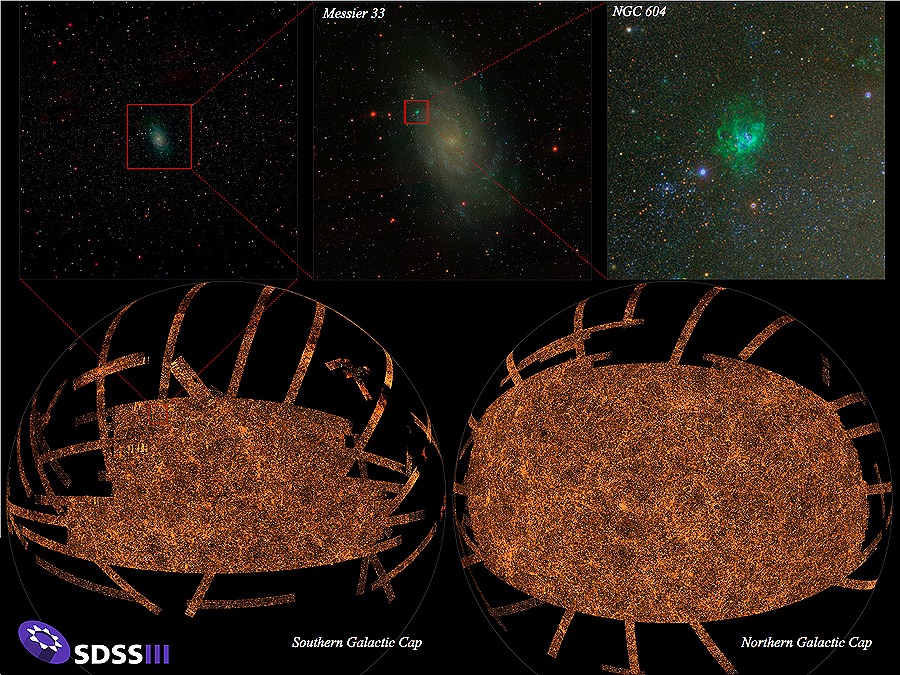
The bottom part of the image shows the sky coverage of the Sloan Digital Sky Survey (SDSS). Each orange dot represents a galaxy in the survey. The top panels show zoom ins on a star forming nebula in the nearby galaxy M33, a member of the Local Group of galaxies of which the Milky Way is a member. Image credit: SDSS.
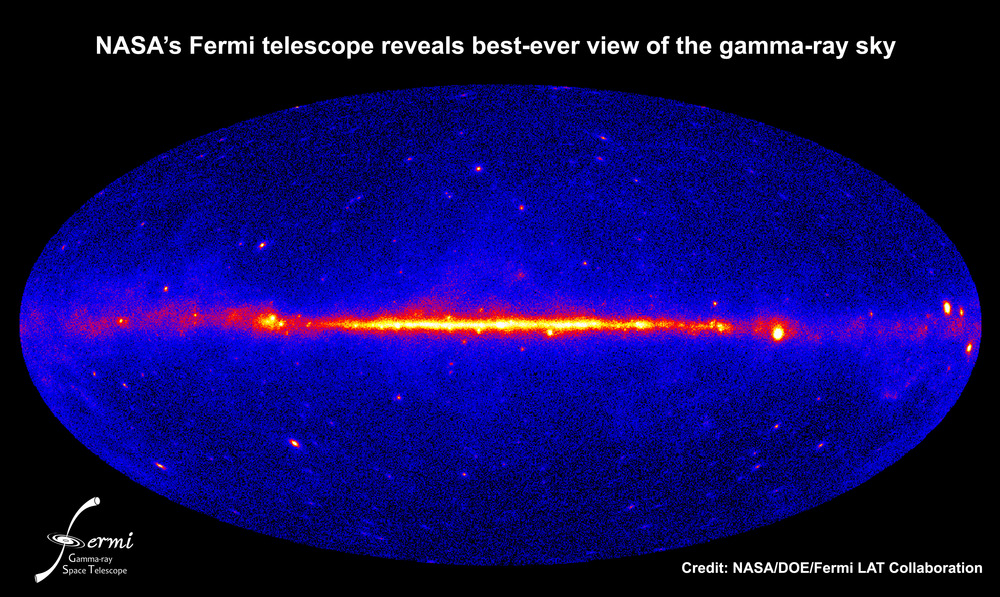
The first three months of data from the Fermi Gamma-ray Space Telescope’s Large Area Telescope (LAT) instrument. The LAT is performing an all-sky survey, scanning the entire sky once every three hours (two orbits). The bright horizontal stripe in the center of the image is the plane of the Milky Way Galaxy. Fermi has now been operating for nearly four years. Image credit: NASA/DOE/Fermi LAT collaboration.