
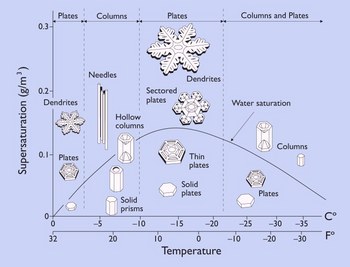
It’s unusual to see physics applied to more ‘common’ things in nature nowadays. Usually it’s ‘supermassive black hole… dark matter… proton collision.. LHC this, LHC that’ but modern research is still applied to tangible things…. Like snowflakes.
A physicist at Caltech did a study of the geometry of snowflakes and how/why they form the way they do.
Check it out!
http://www.physorg.com/news/2011-12-snowflake-science-physicist-snowflakes-thin.html
Tweet
Henry LeparskasI recall one time as a teenager when, to my mother’s chagrin, I had purchased some really strong solvent. I then melted plastic in it, brought it to outdoor temperature, poured it on a piece of plate glass and went outside to catch snowflake imprints.Aren’t snowflakes just awesome!
The physics of snowflakes has fascinated me – and lots of other physicists – for a long time. In fact I’ve done a lot of research on the physics of “common things” and natural phenomena. For example, I’ve studied the formation of mud cracks, and the behavior of paint drips. I am most proud of a paper I published that included a picture of my clothesline, festooned with icicles. All of these things are examples of interesting spatio-temporal behavior that arises in systems driven far from equilibrium. Here’s a good coffee-table book about “pattern formation”, which is an important branch of today’s physics. http://www.amazon.com/Self-Made-Tapestry-Pattern-Formation-Nature/dp/0198502435