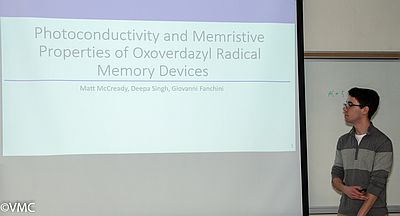
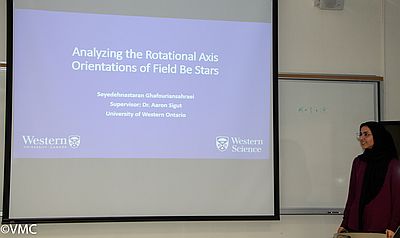
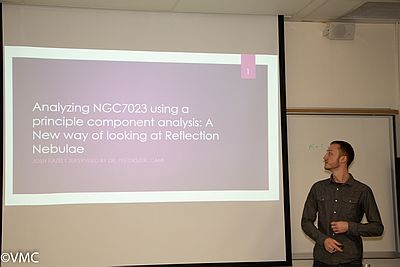
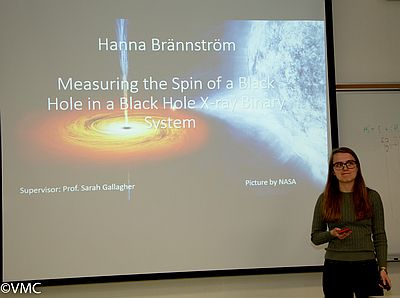
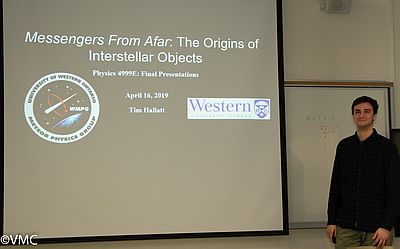
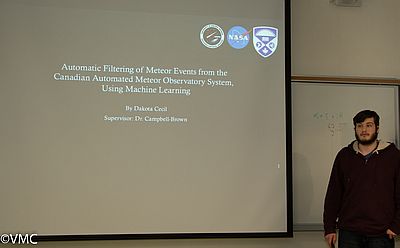
Nadia Aiaseh, a second-year student, won runner up prize in the student poster competition. While third-year student, Elise Woodward, received an honourable mention for her talk in the student presentations.
Considered the “definitive guide” the book strives to provide students and researchers alike, with an accessible, yet in depth, examination of the fundamental issues in meteor science. The book has strong Western connections: professor Margaret Campbell-Brown served as one of the Associate Editors and contributing author, and professor Paul Wiegert is a contributing author as well.
Cambridge University Press summarized the book as “essential reading for anyone who wishes to understand how recent developments broaden our understanding of meteors, meteoroids and their origins.”
On Wednesday July 31st, 2019, Shannon Hicks-Jalali gave a public lecture on her thesis topic: “A Raman water vapour lidar tropospheric climatology and trends analysis over Payerne, Switzerland”
She then successfully defended the thesis. Shannon was supervised by Dr. Robert Sica
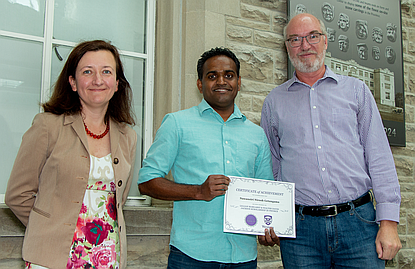
On Tuesday July 30th, 2019, Shayamila Mahagammulla Gamage gave a public lecture on her thesis topic: “Development of a new optimal estimation method retrieval for temperature and relative humidity using rotational Raman lidar back-scatter measurements to study ice supersaturation layers”
She then successfully defended the thesis. Sham was supervised by Dr. Robert Sica
Their work is also making headlines here at home, having been featured recently in both the CBC and Western News.
Abstract:
In June 2019 the Earth will approach within 5° mean anomaly of the centre of the Taurid resonant swarm, its closest post-perihelion encounter with Earth since 1975. This will be the best viewing geometry to detect and place limits on the number of NEOs proposed to reside at the swarm centre until the early 2030s. We present an analysis of the optimal times and pointing locations to image NEOs associated with the swarm
Last week a group of graduate students from the Centre for Planetary and Space Exploration (CPSX), including Astronomy PhD candidate Mohammed Chamma, received some unexpected and very exciting news.
The High Altitude Balloon (HAB) they sent into the atmosphere a year ago, and subsequently lost contact with on its descent, was found by a farmer and finally returned. Amazingly the payload survived its year in the wild and was salvagable. The students have begun analyzing their once-lost data and are planning their next launch scheduled for August.
An article published recently in The Astrophysical Journal of Letters, “Confirming Interstellar C60 + Using the Hubble Space Telescope”, co-authored by Professor Jan Cami, has been featured in recent editions of both AAS Nova and Forbes.
Abstract
Recent advances in laboratory spectroscopy lead to the claim of ionized Buckminsterfullerene (C) as the carrier of two diffuse interstellar bands (DIBs) in the near-infrared. However, irrefutable identification of interstellar C requires a match between the wavelengths and the expected strengths of all absorption features detectable in the laboratory and in space. Here we present Hubble Space Telescope(HST) spectra of the region covering the C 9348, 9365, 9428, and 9577 Å absorption bands toward seven heavily reddened stars. We focus in particular on searching for the weaker laboratory C bands, the very presence of which has been a matter for recent debate. Using the novel STIS-scanning technique to obtain ultra-high signal-to-noise spectra without contamination from telluric absorption that afflicted previous ground-based observations, we obtained reliable detections of the (weak) 9365, 9428 Å and (strong) 9577 Å C bands. The band wavelengths and strength ratios are sufficiently similar to those determined in the latest laboratory experiments that we consider this the first robust identification of the 9428 Å band, and a conclusive confirmation of interstellar .
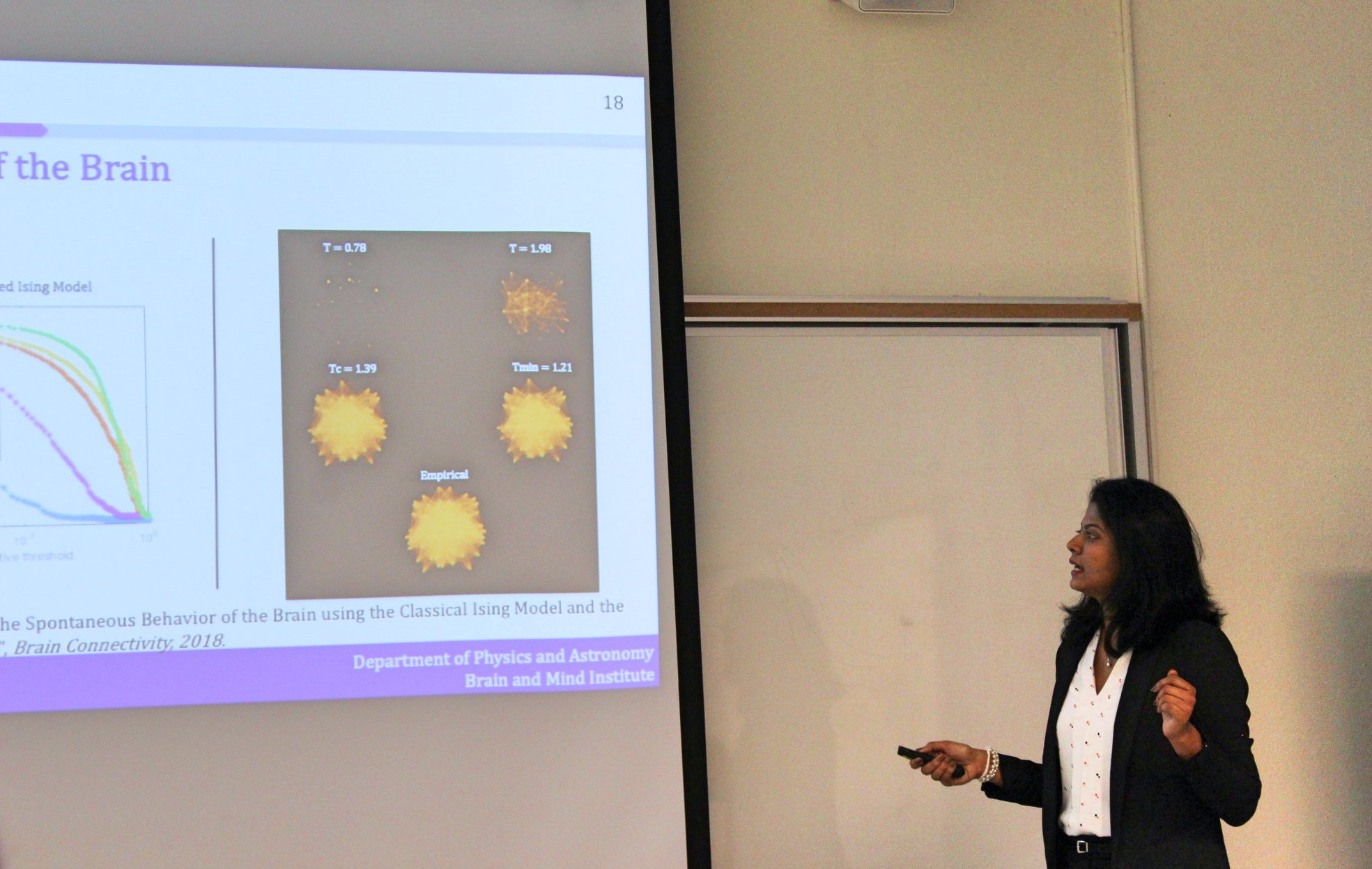
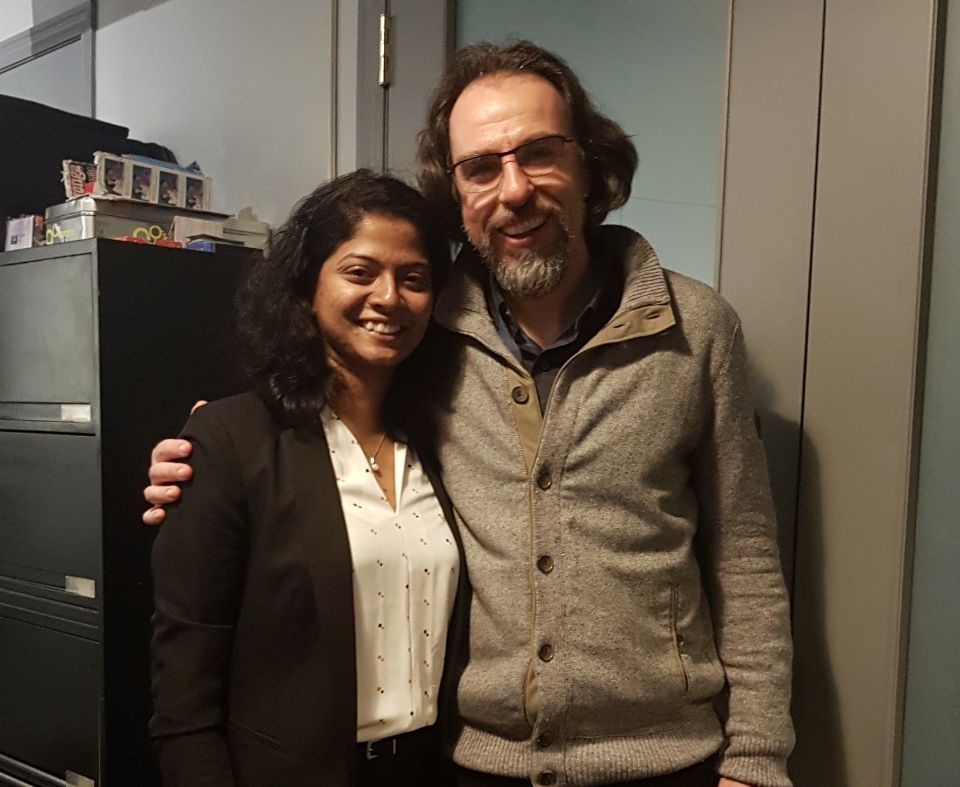
On Thursday April 18th, 2019, Pubuditha Abeyasinghe gave a public lecture on her thesis topic: “Calculating the Dimensionality of the Brain, and other Applications of an Optimized Generalized Ising Model in Predicting Brain’s Spontaneous Functions”
She then successfully defended the thesis. Pubuditha was supervised by Dr. Andrea Soddu

 ) as the carrier of two diffuse interstellar bands (DIBs) in the near-infrared. However, irrefutable identification of interstellar C
 requires a match between the wavelengths and the expected strengths of all absorption features detectable in the laboratory and in space. Here we present Hubble Space Telescope(HST) spectra of the region covering the C
 9348, 9365, 9428, and 9577 Å absorption bands toward seven heavily reddened stars. We focus in particular on searching for the weaker laboratory C
 bands, the very presence of which has been a matter for recent debate. Using the novel STIS-scanning technique to obtain ultra-high signal-to-noise spectra without contamination from telluric absorption that afflicted previous ground-based observations, we obtained reliable detections of the (weak) 9365, 9428 Å and (strong) 9577 Å C
 bands. The band wavelengths and strength ratios are sufficiently similar to those determined in the latest laboratory experiments that we consider this the first robust identification of the 9428 Å band, and a conclusive confirmation of interstellar
 .